
 Tiếng Việt

Tickmill Rebates: Compare Cashback Rates for Traders
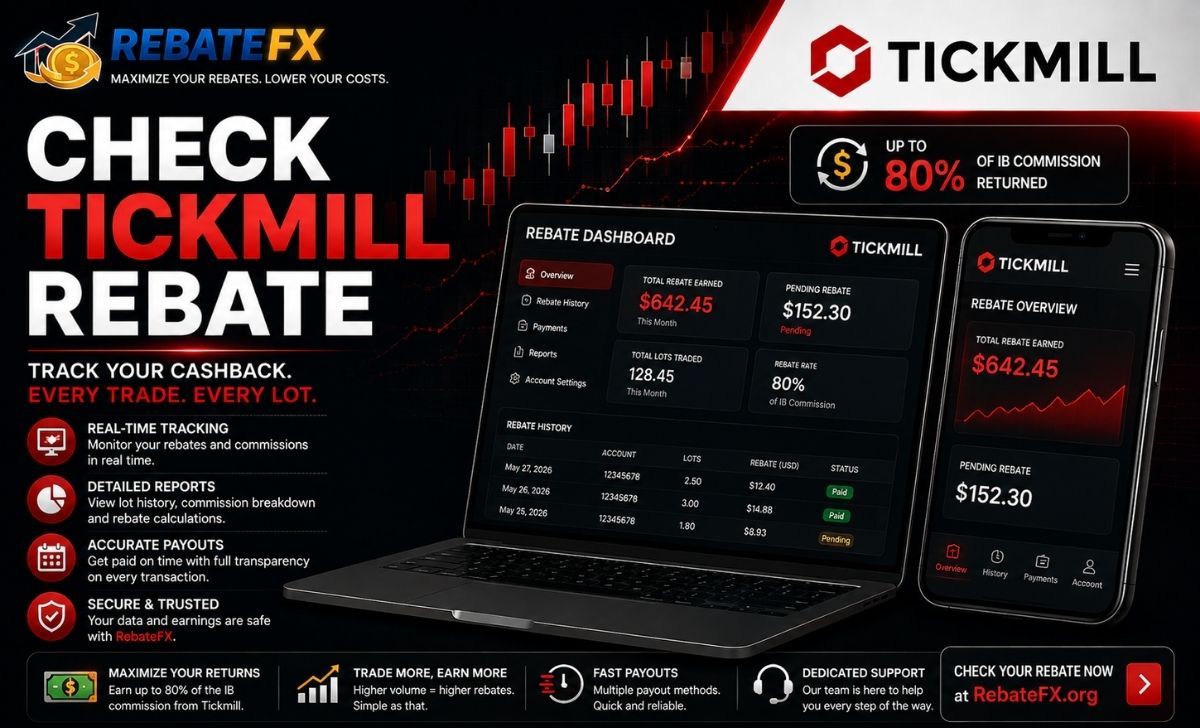
Tickmill rebates return a portion of the IB commission earned on each trade back to the trader, lowering the effective cost per round-turn lot. Rates vary by provider and account type, with third-party rebate services generally offering higher payouts than trading directly without an intermediary.
According to Tickmill, its promotional rebate program, known as “Trade More, Get More”, rewards traders with cash rebates earned alongside their regular trading activity during the campaign period. This structure differs from third-party rebate programs, which pay out based on a fixed share of IB commission rather than a promotional tier.
Rebate rates per lot can vary across third-party providers, as each provider negotiates its own IB commission split with Tickmill. Comparing these rates side by side reveals which provider returns the most value per traded lot.
Commission discounts and cashback on Tickmill are calculated per round-turn lot, based on the IB commission actually received rather than the spread or commission the trader pays. RebateFX applies this same model, returning a share of the IB commission it receives from Tickmill back to traders, at a rate published on its own website. The next section breaks down exactly what Tickmill rebates are and how the payout mechanism works in practice.
Contents:
What Are Tickmill Rebates and How Do They Work?
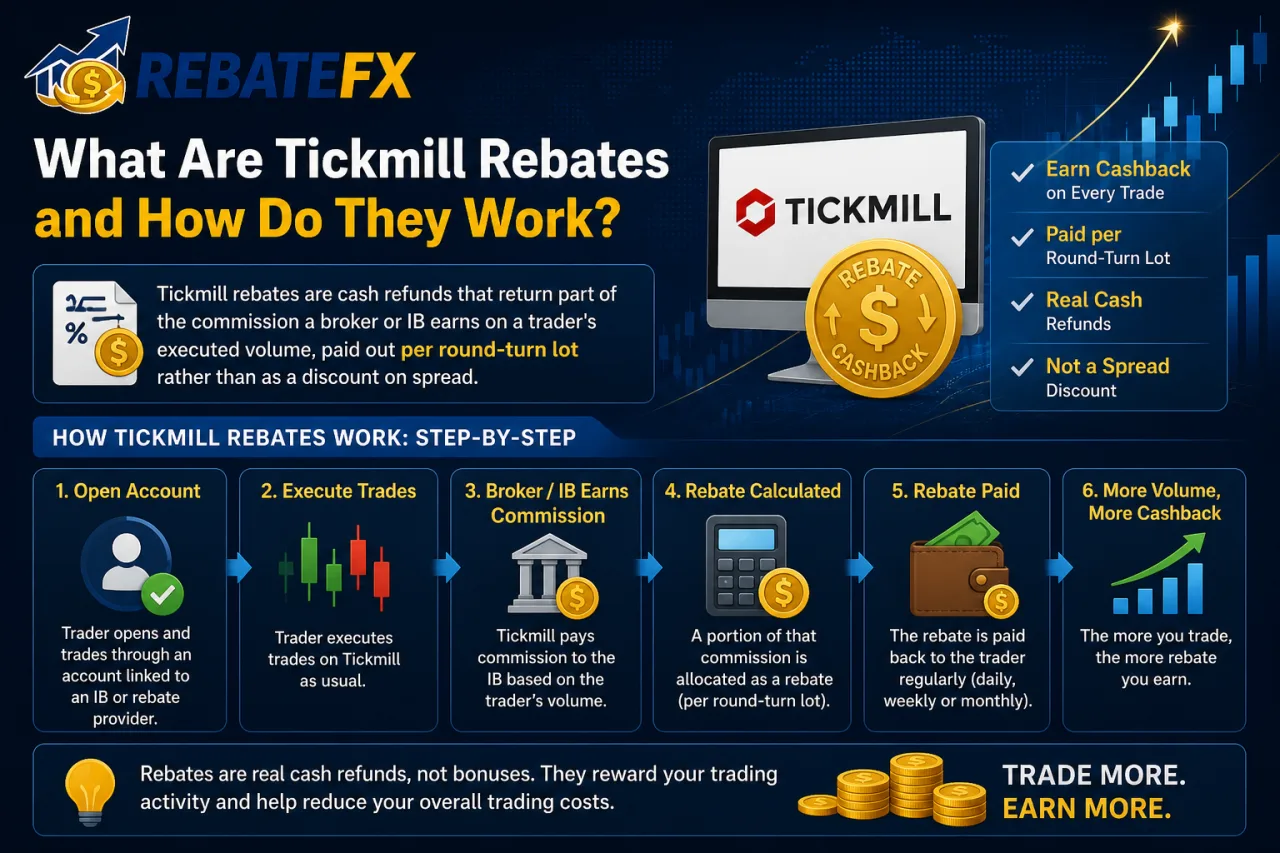
Tickmill rebates are cash refunds that return part of the commission a broker or IB earns on a trader’s executed volume, paid out per round-turn lot rather than as a discount on spread. Each closed lot generates a fixed or percentage-based refund credited back to the trader, independent of the spread charged on the trade.
The general process follows a few core steps:
- Trader opens and trades through an account linked to an IB or rebate provider.
- Tickmill credits IB commission to that provider based on the trader’s closed volume.
- Provider shares an agreed percentage of that commission back to the trader as rebate.
- Trader receives the rebate per lot, either per trade, daily, or on a set payout schedule.
Two details shape the final payout. The rebate amount scales directly with traded volume, so higher lot counts produce proportionally larger refunds. The percentage shared also depends on which provider or account structure routes the trade, which is why comparing rates across providers matters before choosing where to trade.
Which Tickmill Account Types Are Eligible for Rebates?
Tickmill offers three main account types eligible for rebates: Pro, Classic, and VIP, each carrying a different commission and spread structure that affects the final rebate value. This grouping determines how rebate providers calculate payouts, since the IB commission base differs across accounts.
- Pro account charges a fixed commission per lot alongside tighter raw spreads, generating a stable and often higher rebate base for third-party providers.
- Classic account runs on spread-only pricing with no separate commission, so rebates on this type derive from the IB commission built into the spread markup.
- VIP account targets higher-volume traders with commission pricing similar to Pro but scaled for larger trade sizes, typically producing the largest per-lot rebate amount.
Pro and VIP accounts often qualify for higher rebate percentages among Tickmill’s account types, as their commission-based structure gives providers a clearer IB commission figure to split. Classic accounts still qualify for rebates, though the payout depends on how the provider values the spread-based commission rather than a fixed per-lot fee.
How Do Tickmill’s Own Promotional Rebate Programs Work (e.g. ‘Trade More, Get More’)?
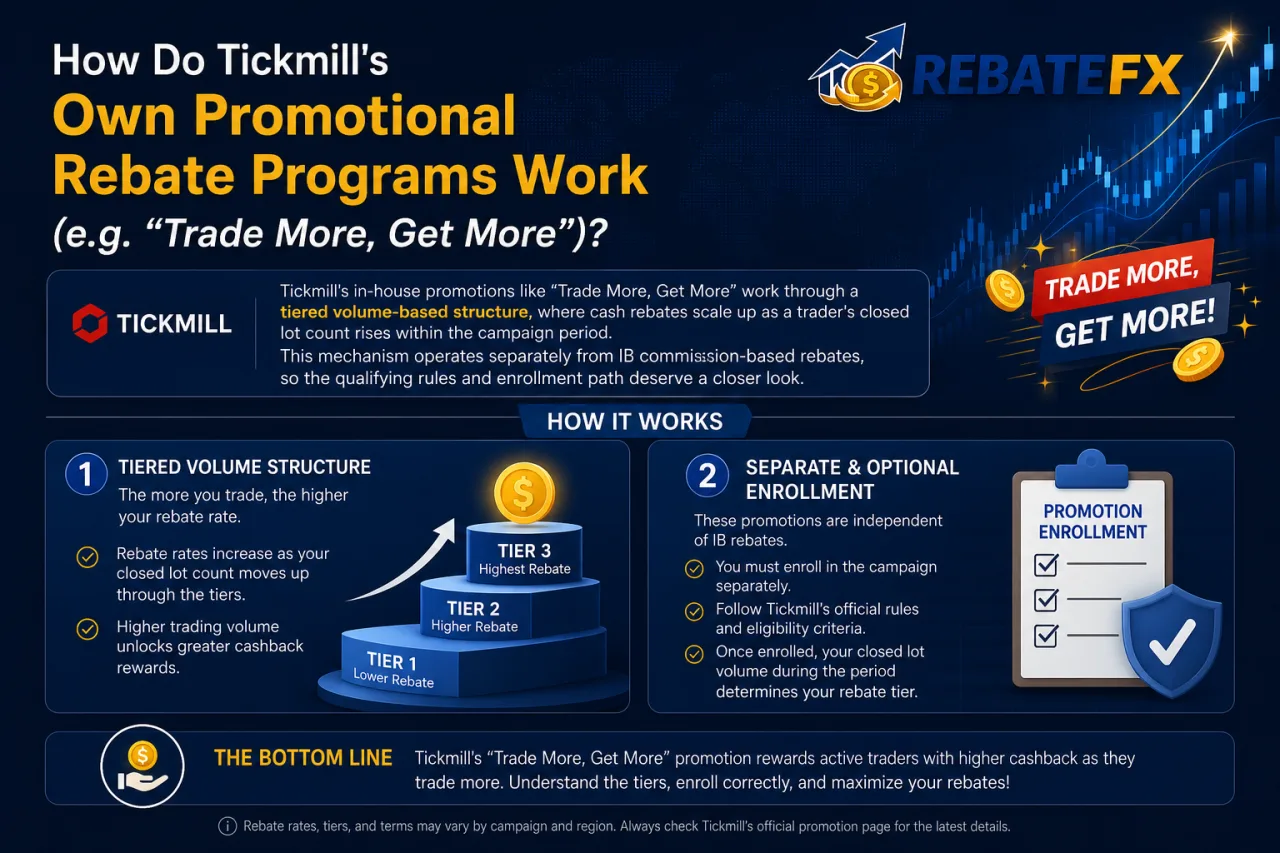
Tickmill’s in-house promotions like “Trade More, Get More” work through a tiered volume-based structure, where cash rebates scale up as a trader’s closed lot count rises within the campaign period. Unlike the IB commission-based rebates covered earlier, this native program runs entirely inside Tickmill’s own system, with its own qualifying rules and enrollment path.
Two aspects define how this promotional structure functions:
- The tier system rewards higher trading volume with a higher rebate rate, meaning a trader who closes more lots during the promotion window unlocks a better payout bracket than one trading fewer lots.
- Only trades executed on eligible account types during the active campaign period count toward the qualifying volume.
- Enrollment happens directly through Tickmill’s own client portal rather than through a third-party provider.
The sections below cover the tiered cashback mechanics, which trades qualify, and how a trader signs up directly with Tickmill for this native promotion.
What Are the Volume Tiers and Rebate Amounts in Tickmill’s Promotions?
Tickmill’s promotional tiers group rebate amounts by closed lot-volume brackets, with each higher bracket unlocking a larger cashback payout per lot traded; according to Tickmill, the cashback rate increases as traders move up through the volume tiers, with exact figures depending on account type and volume traded during the campaign. This breakdown clarifies how the tiered structure translates into actual cashback figures during a campaign period.
Tickmill’s own tier design typically groups traders into brackets based on closed lot-volume, with rebate amounts increasing at each higher bracket.
- Starting tier rewards traders who cross the minimum qualifying lot count with the base cashback rate.
- Mid-volume tier increases the payout rate once a trader’s closed volume surpasses the first threshold.
- Top tier delivers the highest cashback rate, reserved for traders reaching the campaign’s maximum lot bracket.
Payout amounts within each bracket scale directly with the number of lots closed, so a trader landing in a higher tier earns more cashback per lot than one staying in the base bracket. Exact rate figures for each tier are published by Tickmill in the official promotion terms. These figures apply only to trades executed during the active promotion window, distinct from the ongoing IB commission rebate rates covered earlier in this comparison.
How Do Rebate Rates Per Lot Compare Across Different Third-Party Rebate Providers?
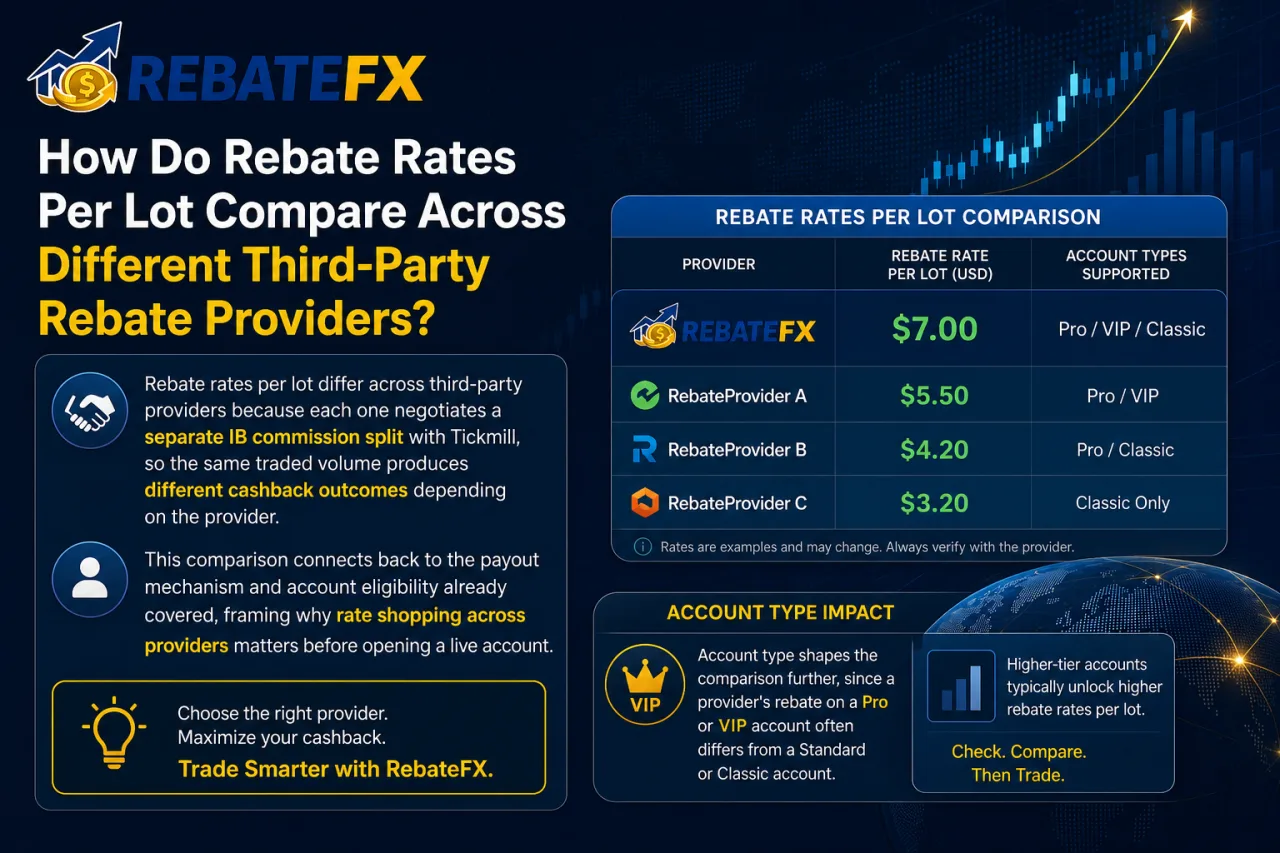
Rebate rates per lot differ across third-party providers because each one negotiates a separate IB commission split with Tickmill, so the same traded volume produces different cashback outcomes depending on the provider. This directly affects rate shopping across providers before opening a live account.
Account type shapes the comparison further, since a provider’s rebate on a Pro or VIP account often differs from what the same provider pays on a Classic account. A provider offering a strong rate on commission-based accounts does not automatically match that rate on spread-only accounts, because the underlying IB commission base is calculated differently.
The sections below break this comparison into two parts: how rates vary specifically by account type, and which factors determine why one provider’s percentage share ends up higher or lower than another’s.
Third-Party Rebate Providers vs Tickmill’s Native Promotions: Which Offers More?
Third-party rebate providers win on consistency, paying out on every closed lot year-round, while Tickmill’s native promotions win on peak payout during active campaign windows. This contrast builds directly on the two payout mechanisms already covered: the ongoing per-trade IB commission split versus the tiered, time-limited campaign structure.
The two models serve different trading patterns rather than one simply beating the other outright.
- Third-party providers credit rebates on every round-turn lot regardless of season or promotion status, giving a predictable per-lot return over months of trading.
- Tickmill’s own “Trade More, Get More” style campaigns concentrate rebate value into a fixed enrollment window, rewarding high-volume bursts rather than steady long-term trading.
- Traders holding accounts through providers like RebateFX continue receiving IB commission-based rebates whether or not a native promotion is currently running.
- Traders relying solely on Tickmill’s native promotion receive no rebate once the campaign period ends, unlike the ongoing third-party structure.
A trader closing volume year-round generally accumulates more total rebate value through a third-party provider than by waiting for periodic native campaigns. Choosing between the two depends on trading frequency and whether volume concentrates during a live promotion or spreads evenly across the year.
How Is the Cashback Calculated Per Round-Turn Lot on Tickmill?
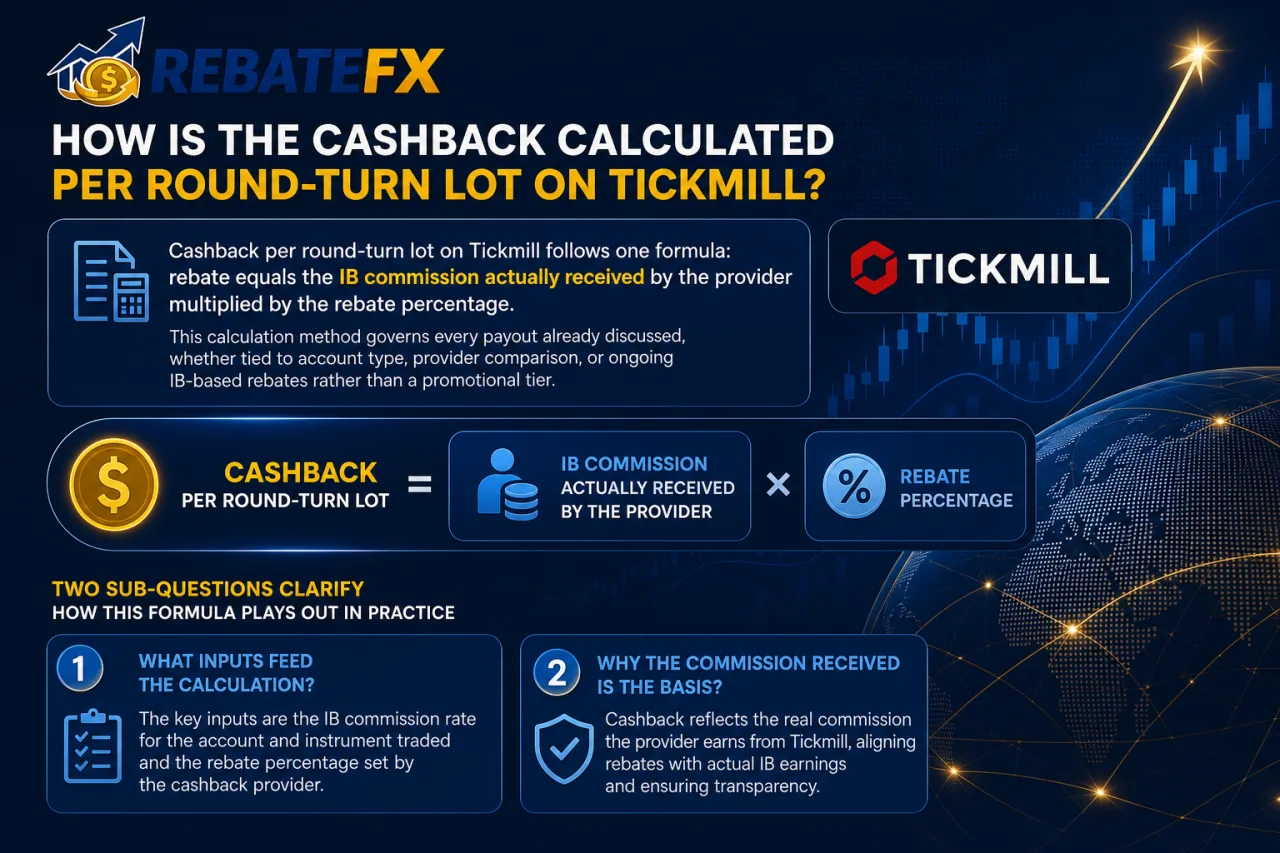
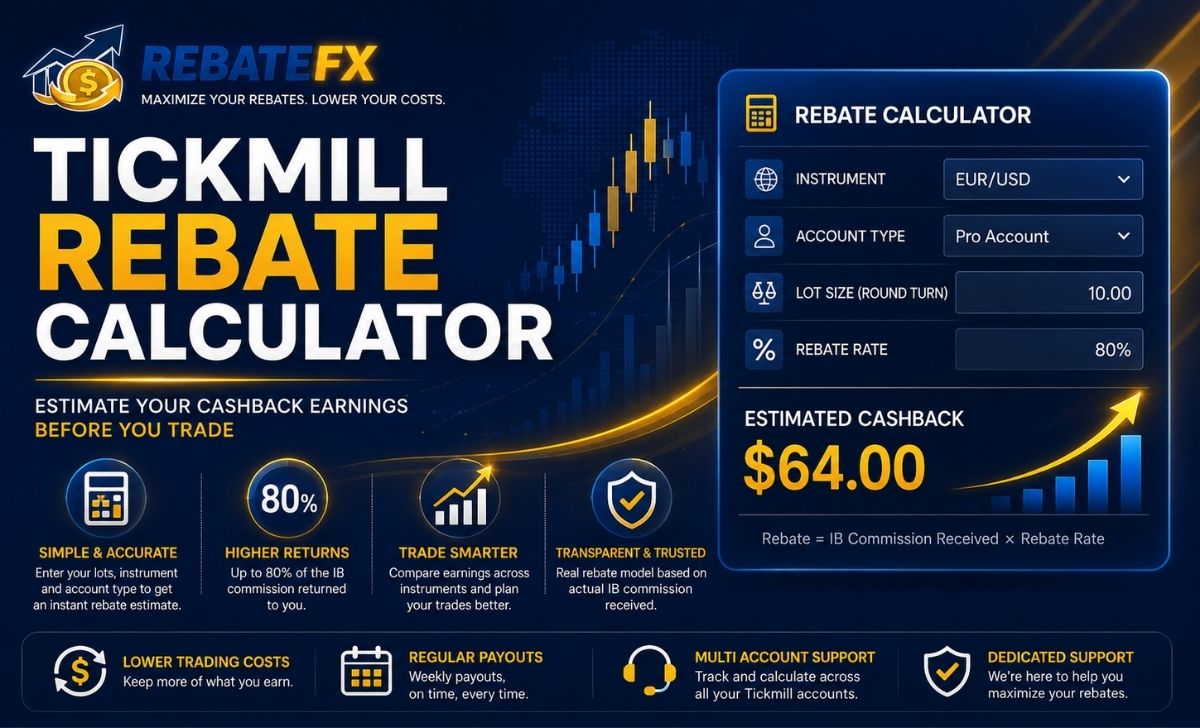
Cashback per round-turn lot on Tickmill follows one formula: rebate equals the IB commission actually received by the provider multiplied by the rebate percentage. This calculation method governs every payout already discussed, whether tied to account type, provider comparison, or ongoing IB-based rebates rather than a promotional tier.
Two sub-questions clarify how this formula plays out in practice, covered in the sections below: what inputs feed the calculation, and why the commission received matters more than the raw cost a trader pays.
What Factors Affect the Final Rebate Amount Received?
Five factors change the final rebate amount received: broker, account type, traded product, trading volume, and eligible transaction criteria. This question builds directly on the calculation formula covered above, since each factor shifts either the IB commission input or the rebate percentage applied to it.
- Broker sets the base IB commission rate available for a provider to split, so Tickmill’s own commission schedule caps how much rebate a provider can ever share.
- Account type changes the commission structure feeding the calculation, as Pro and VIP accounts generate a distinct commission base compared to spread-only Classic accounts.
- Traded product influences the underlying commission Tickmill pays out, since forex majors, minors, and other instrument classes carry different IB commission schedules.
- Trading volume scales the payout proportionally, so a higher closed lot count produces a proportionally larger total rebate.
- Eligible transaction criteria filter which trades count toward the rebate, excluding activity that falls outside the provider’s or Tickmill’s qualifying conditions.
Traders comparing providers factor in all five elements together rather than judging rebate offers on percentage alone, since a high percentage on a low-commission product or account type still produces a smaller payout than a lower percentage applied to a higher commission base.
What Rebate Rate Does RebateFX Offer for Tickmill and How Is It Received?
RebateFX offers a rebate rate of up to 80% of the IB commission it actually receives from Tickmill, paid out per round-turn lot rather than as a spread discount. This rate ties directly to the calculation formula covered earlier. For example, if RebateFX receives 100 USD in IB commission from Tickmill, the trader receives 80 USD back (100 USD x 80%). The sections below break down how the payout percentage applies and how a trader actually receives the funds.
How Do You Register and Track Tickmill Rebates via RebateFX?
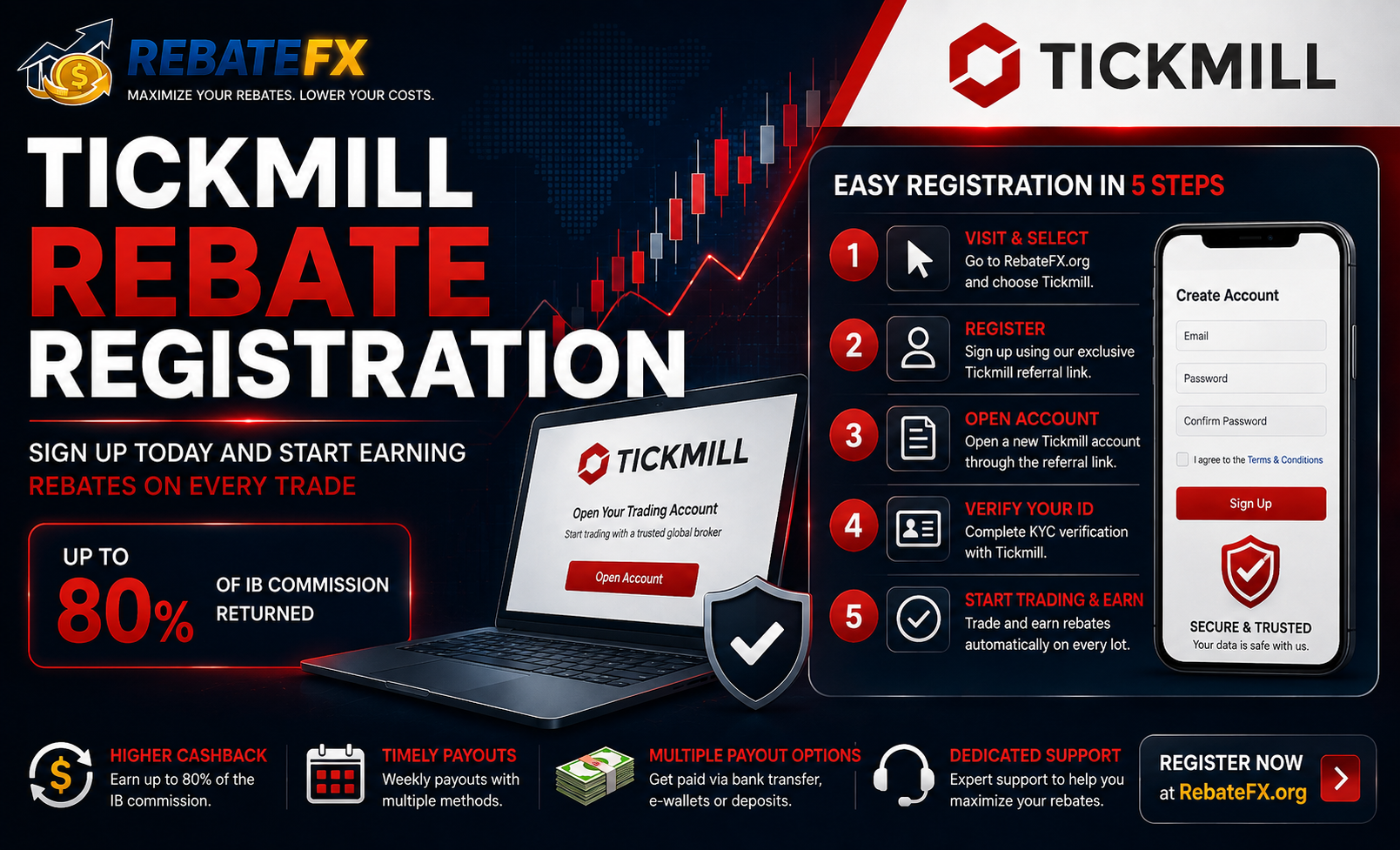
Traders register a Tickmill account through RebateFX by opening a new account via RebateFX’s referral link, then track accrued rebates through the platform’s client dashboard. This registration and tracking process determines how the 80% commission split covered above actually flows to a trader’s balance.
The workflow follows a few core steps:
- Trader visits RebateFX and opens a new Tickmill account using the provided referral link, ensuring the account links to RebateFX as the IB.
- Trader completes Tickmill’s standard verification and funding steps under that linked account.
- RebateFX logs the account against the trader’s closed volume once live trading begins.
- Trader logs into the RebateFX dashboard to view accrued rebate figures, updated per the provider’s payout schedule.
Existing Tickmill account holders typically cannot retroactively link to RebateFX, since the IB relationship must be established at account opening. Tracking itself stays straightforward: the dashboard displays lot volume, rebate accrued, and payout status without requiring a separate calculation from the trader.
Conclusion
In conclusion, Tickmill rebates allow traders to recover part of the IB commission generated from eligible closed trading volume, with RebateFX offering up to 80% of the commission it actually receives. The final cashback depends on the account type, traded product, round-turn lot volume, provider rate, and transaction eligibility, while third-party programs generally provide more consistent year-round rebates than temporary broker promotions. Traders should register through the correct referral link, compare calculation methods and payout schedules, and verify accrued rebates through the provider’s dashboard.
Article about Tickmill Rebate