
 Tiếng Việt
IC Markets Rebates: Best Cashback Rates for Traders
A portion of the IB commission actually received by the rebate provider is returned to the trader on every executed lot with IC Markets rebates. This cashback mechanism lets traders recover part of their trading costs regardless of whether the position closes in profit or loss.
The IB Commission Rebate model is the mechanism behind IC Markets rebates, where a rebate provider shares back part of the IB commission it actually receives from IC Markets. The payout per lot depends on the account type, traded instrument, and the rebate percentage agreed with the provider, with calculations based on volume traded.
Providers differ in the rebate rates they offer for IC Markets, so it’s worth comparing offers before choosing where to sign up. Comparing providers reveals differences in payout percentage, minimum volume requirements, and supported account types.
Opening a trading account through a provider’s referral link and registering for the cashback program is what signing up for IC Markets rebates requires. Rebate FX offers an IC Markets rebate program that returns 80% of the IB commission it receives, with payments tracked and processed per trading volume. The section below explains what IC Markets rebates are and how they benefit traders on every trade.
Contents:
What Are IC Markets Rebates?
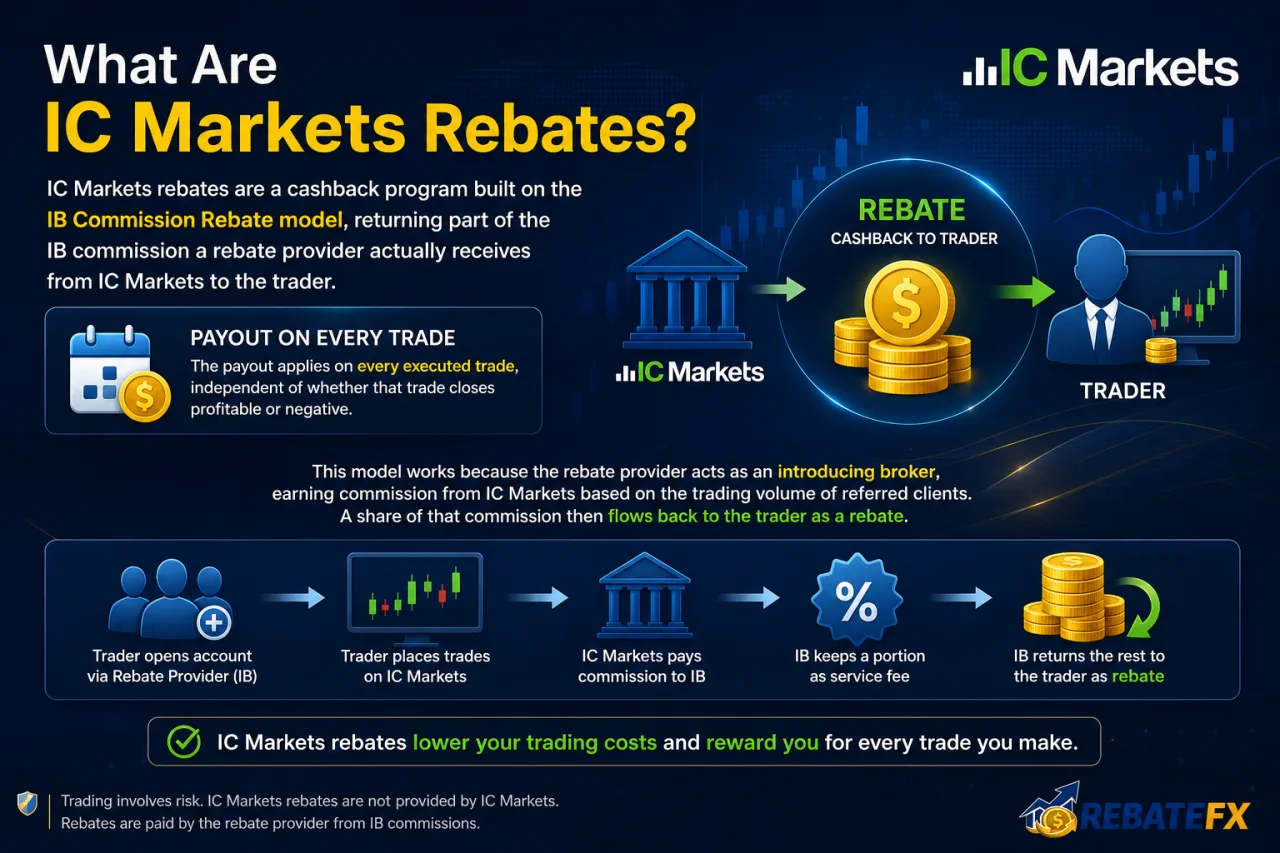
IC Markets rebates are a cashback program built on the IB Commission Rebate model, returning part of the IB commission a rebate provider actually receives from IC Markets to the trader. The payout applies on every executed trade, independent of whether that trade closes profitable or negative.
This model works because the rebate provider acts as an introducing broker, earning commission from IC Markets based on the trading volume of referred clients. A share of that commission then flows back to the trader as cashback, typically calculated per lot traded rather than as a fixed fee.
Key characteristics of this structure include:
- Depends on the IB commission the provider actually receives, not on the spread or commission the trader pays directly.
- Applies to every closed trade, regardless of win or loss outcome.
- Varies by provider, since each one negotiates its own commission terms with IC Markets and shares a different percentage back.
- Calculates based on traded volume, making the rebate consistent per lot rather than tied to trade profitability.
RebateFX, for instance, structures its IC Markets rebate around this same IB Commission Rebate framework.
How Do IC Markets Rebates Work and How Are They Calculated Per Lot?
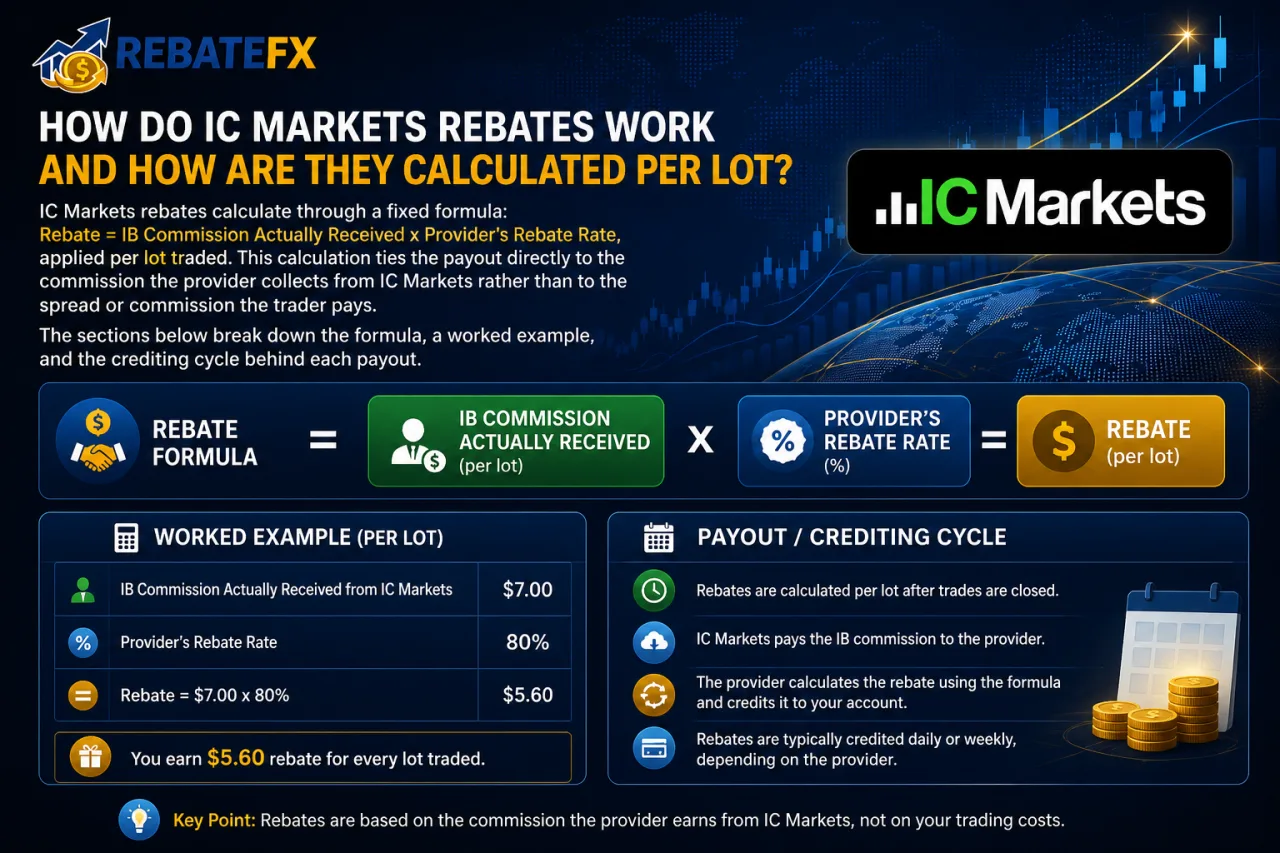
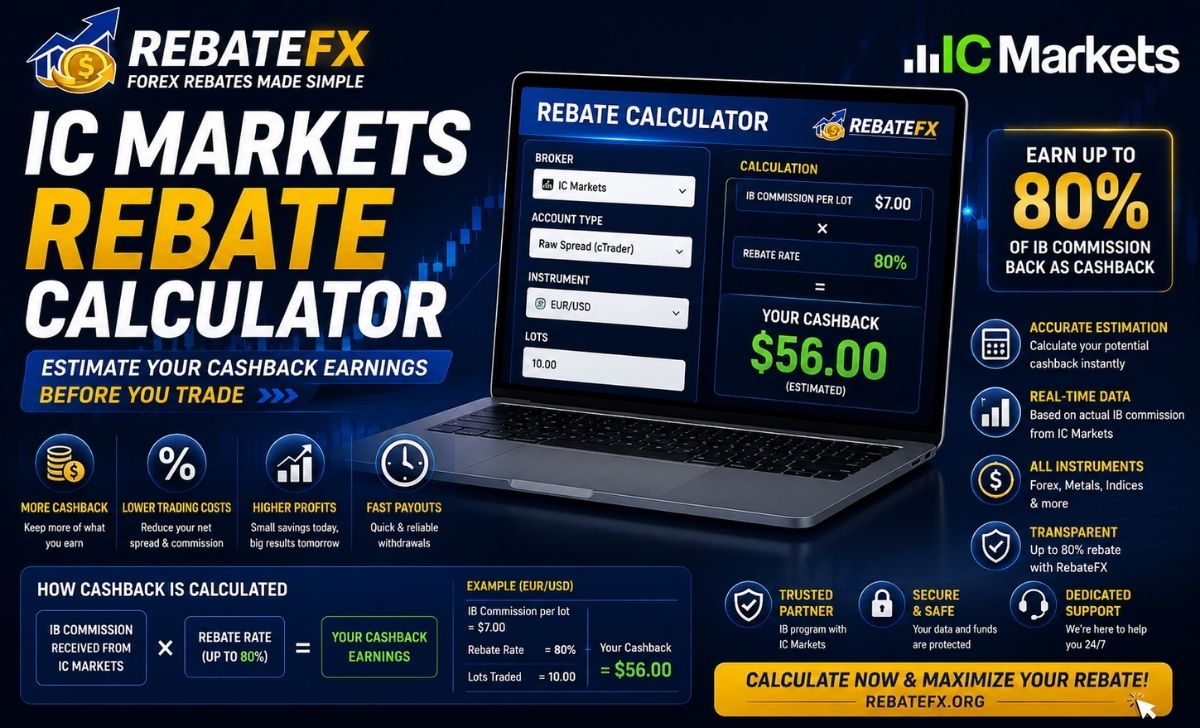
IC Markets rebates calculate through a fixed formula: Rebate = IB Commission Actually Received x Provider’s Rebate Rate, applied per lot traded. This calculation ties the payout directly to the commission the provider collects from IC Markets rather than to the spread or commission the trader pays.
For example, if a rebate provider receives 100 USD in IB commission from a traded lot, and the rebate rate is set at 80%, the trader receives 80 USD back from that trade.
Rebates get credited either per closed trade or on a periodic basis such as daily, weekly, or monthly, depending on the provider’s payout schedule.
The sections below break down the formula, a worked example, and the crediting cycle behind each payout.
What Factors Affect the Actual Rebate Amount Received?
Five factors change the actual rebate amount received: broker, account type, traded instrument, trading volume, and eligible transactions. Each variable shifts the IB commission the provider actually collects, which directly determines the payout since rebates track received commission rather than the spread or commission the trader pays.
These factors work together rather than in isolation, and understanding each one clarifies why two traders on the same broker can see different cashback results.
- Broker sets the base IB commission rate available to the rebate provider, so IC Markets terms differ from other brokers’ terms.
- Account type changes the commission structure, since raw spread accounts and commission-based accounts generate different IB earnings per lot.
- Traded instrument affects payout size, as forex, indices, and commodities carry distinct commission schedules.
- Trading volume scales the total rebate, because payout accumulates per lot rather than as a flat amount.
- Eligible transactions determine which trades qualify, excluding activity that falls outside the provider’s rebate terms.
Any change in these variables shifts the final cashback figure, even when the advertised rebate percentage stays constant.
How Do IC Markets Rebate Rates Compare Across Different Rebate Providers?
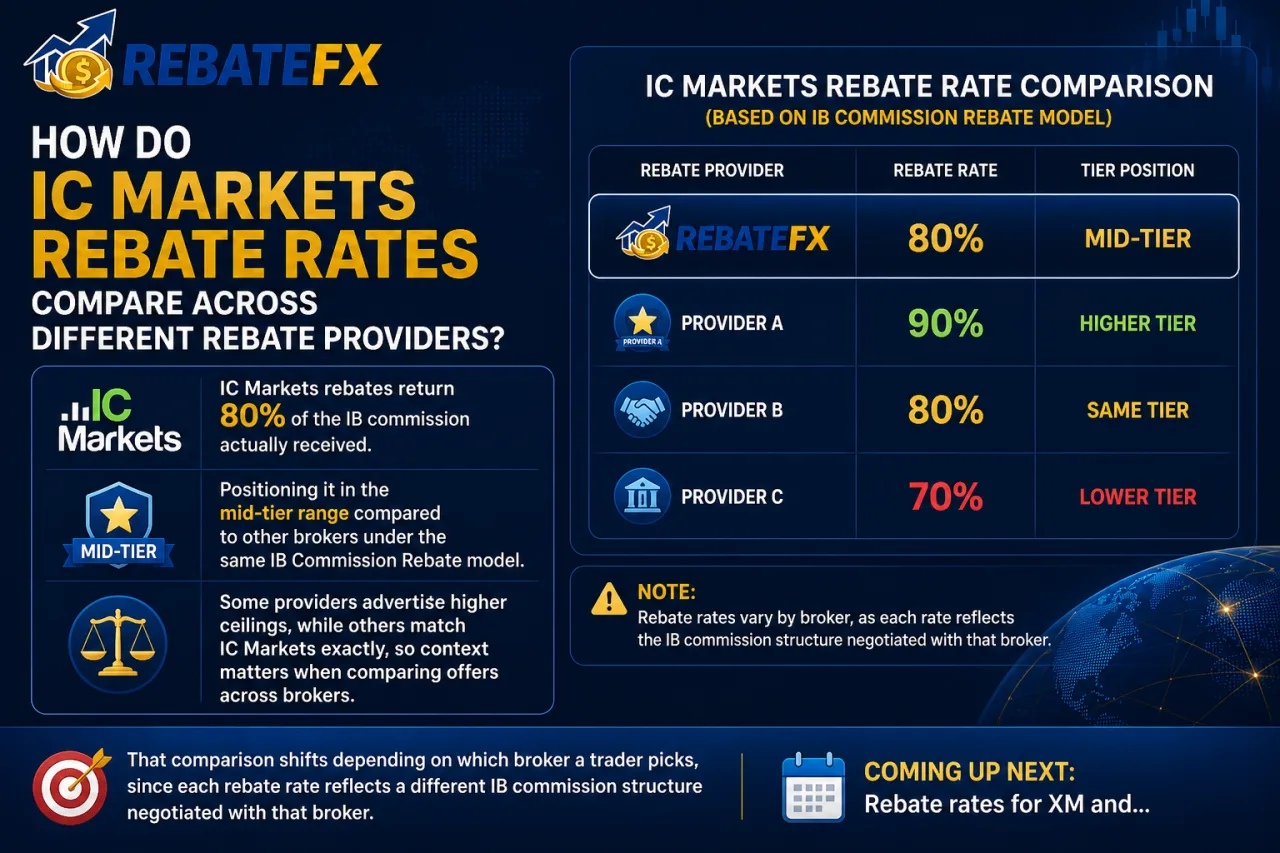
IC Markets rebates return 80% of the IB commission actually received, positioning it in the mid-tier range compared to other brokers under the same IB Commission Rebate model. Some providers advertise higher ceilings, while others match IC Markets exactly, so context matters when comparing offers across brokers.
That comparison shifts depending on which broker a trader picks, since each rebate rate reflects a different IB commission structure negotiated with that broker. XM and FBS providers commonly list rebate rates of up to 90% of the IB commission received on their own public websites, above the rate typically offered for IC Markets. These figures represent commonly listed rates rather than fixed industry standards, and exact percentages vary by provider, so traders should confirm current rates directly on each provider’s official website before signing up.
Tickmill, HFM, and XTB providers commonly list rebate rates around 80% of the IB commission received on their public websites, comparable to the rate offered for IC Markets. As with any provider comparison, these figures reflect commonly advertised rates rather than a verified industry-wide benchmark, so exact figures vary by provider and traders should confirm current terms directly on each provider’s official site before signing up.
These percentages apply strictly to the IB commission a provider actually receives from each broker, not to the spread or commission a trader pays directly. Actual cashback amounts still vary by account type, traded product, and trading volume, so the advertised percentage alone does not determine the final payout a trader collects per lot.
How to Sign Up and Receive Rebate Payments from IC Markets Trading?
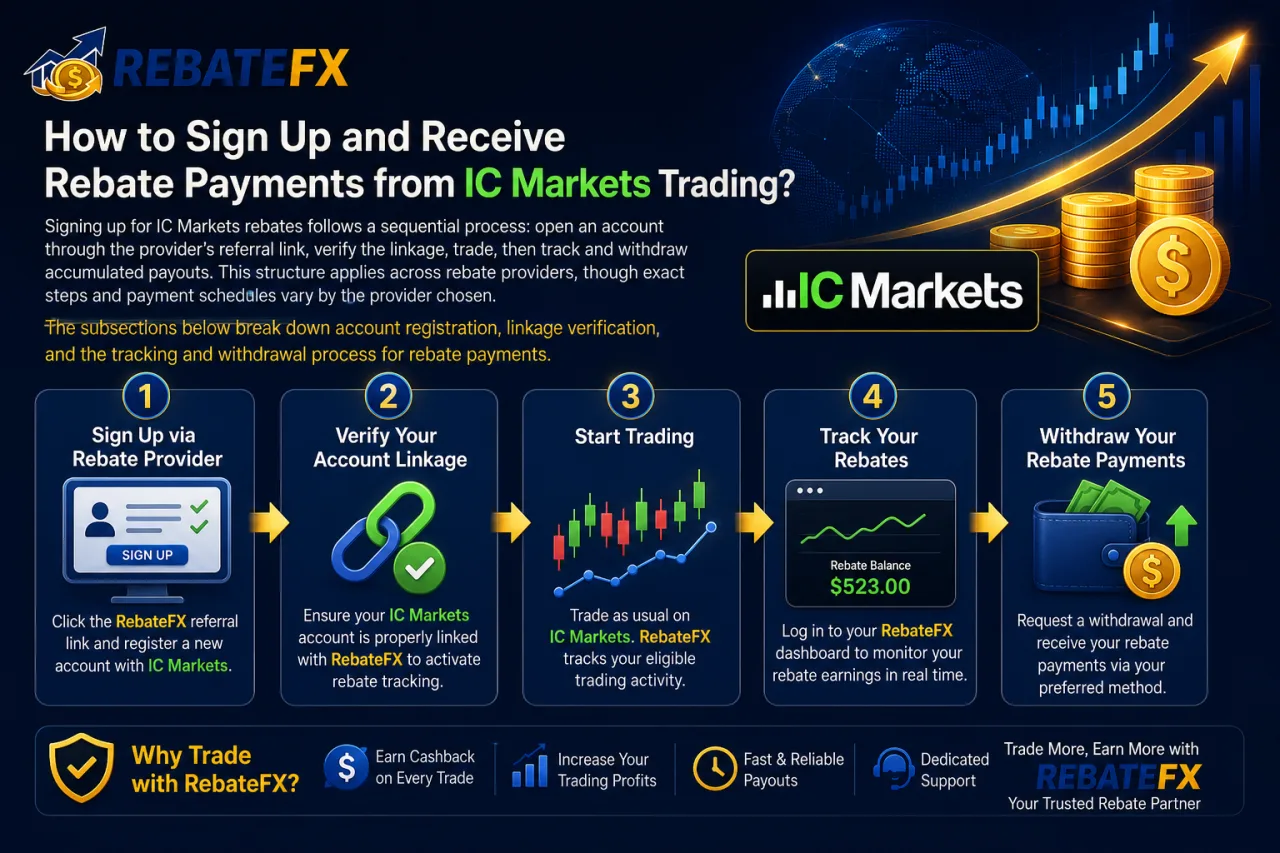
Signing up for IC Markets rebates follows a sequential process: open an account through the provider’s referral link, verify the linkage, trade, then track and withdraw accumulated payouts. This structure applies across rebate providers, though exact steps and payment schedules vary by the provider chosen.
The step-by-step guide below outlines the core actions involved:
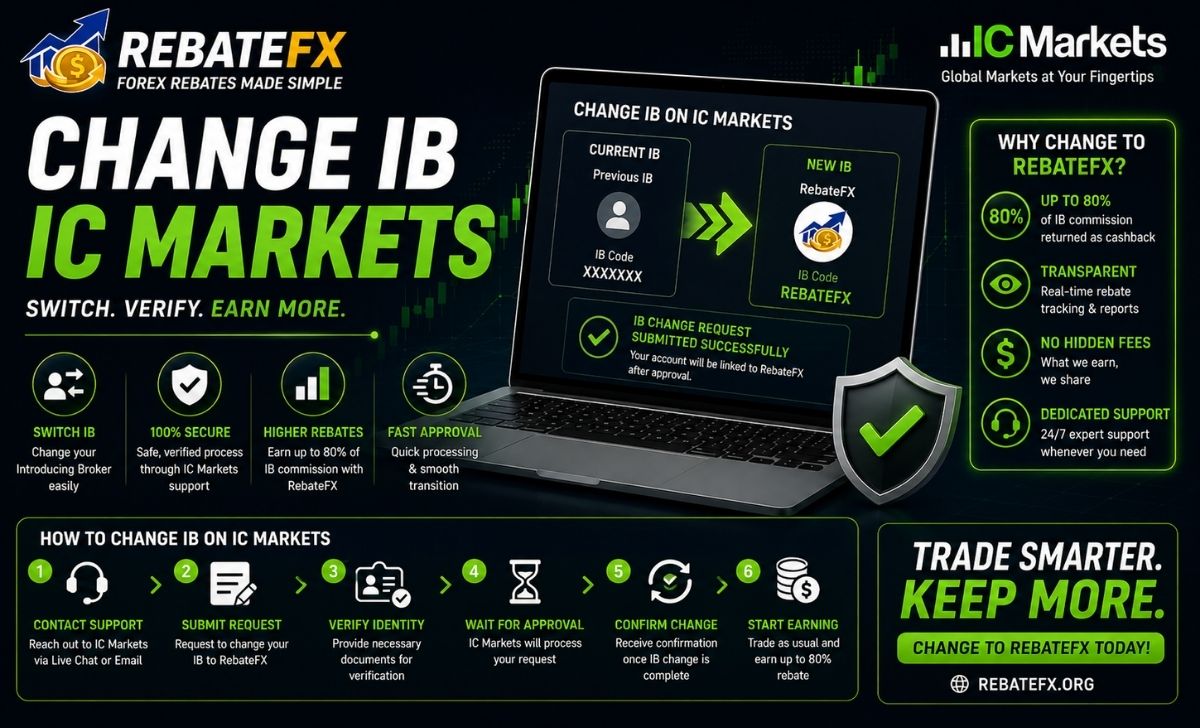
- Register a new trading account through the rebate provider’s referral link, rather than directly through IC Markets.
- Verify that the account is correctly linked to the provider, confirming eligibility for rebate tracking.
- Start trading as usual, since rebate accrual runs in the background based on trading volume.
- Track accumulated rebates through the provider’s dashboard and withdraw payouts according to the provider’s payment schedule.
The subsections below break down account registration, linkage verification, and the tracking and withdrawal process for rebate payments in more detail.
How to Check and Track Your IC Markets Rebate Payments?
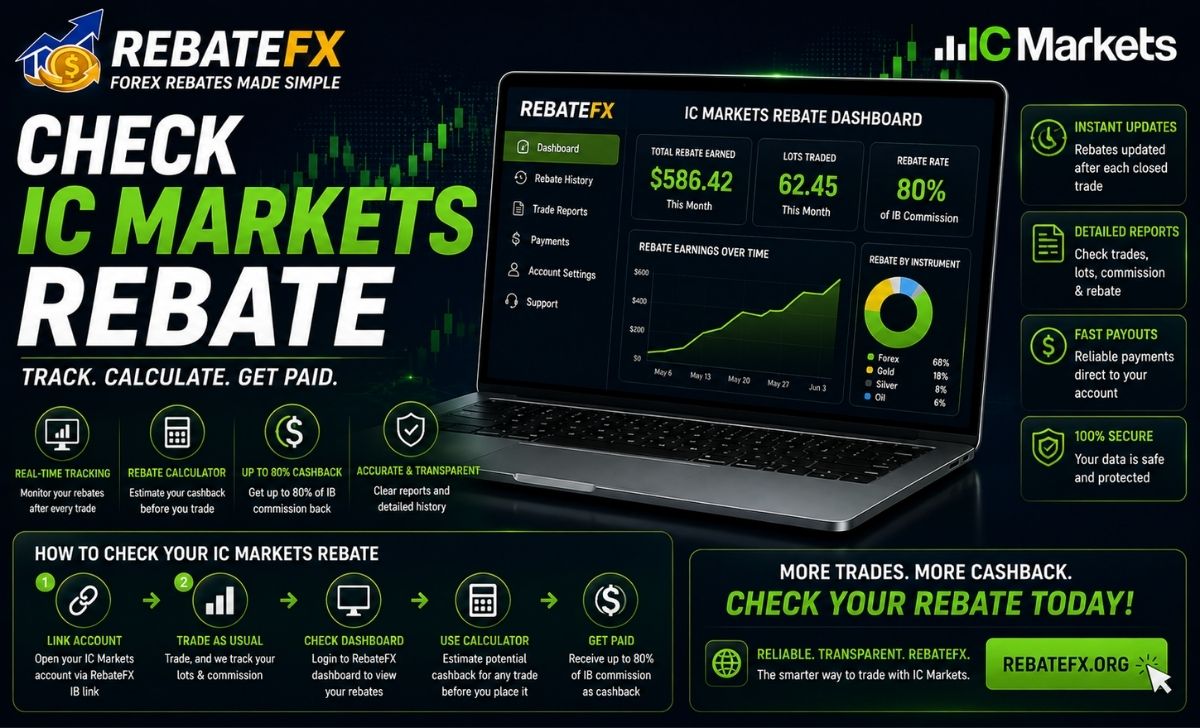
Traders check IC Markets rebates through the provider’s dashboard, which displays accumulated cashback per lot and confirms each amount against the IB commission actually received from IC Markets. This tracking process ties directly into how a trader verifies whether rebate payments match real trading activity rather than an estimated figure.
The dashboard typically logs trades by date, instrument, and lot size, then converts that volume into the corresponding rebate value.
- Displays accumulated rebate totals updated per closed trade or per trading session.
- Breaks down entries by instrument, lot size, and date for easier verification.
- Matches recorded payouts against the IB commission the provider actually received from IC Markets.
- Flags discrepancies when a logged trade shows no corresponding rebate entry.
Cross-checking these dashboard figures against actual trading history confirms whether the rebate percentage advertised aligns with what gets credited per lot traded.
Which Account Types and Trading Conditions on IC Markets Are Eligible for Rebates?
Eligibility for IC Markets rebates groups around three variables: account type, traded product, and trading volume, each shifting the payout a trader actually receives. These variables interact rather than apply independently, so the same rebate percentage can produce different cashback outcomes depending on how an account gets structured. The subsections below break down account type eligibility and product-specific conditions in more detail.
Are All IC Markets Products and Volumes Eligible for the Same Rebate Rate?
No, IC Markets rebates do not apply the same rate uniformly across all products and volumes, since eligibility and payout depend on which transactions qualify and how much IB commission the provider actually receives. This variation ties back to the eligibility structure covered above, where account type, traded product, and trading volume each shift the final cashback figure.
A trader running high volume on one instrument does not automatically see the same payout as a trader spreading similar volume across multiple products, because each instrument carries its own commission schedule. Excluded or non-qualifying transactions further reduce the effective rebate even when the advertised percentage stays fixed. The rebate rate advertised represents a ceiling applied to eligible activity, not a flat guarantee across every product and volume tier.
Conclusion
In conclusion, IC Markets rebates allow traders to recover part of the IB commission generated from eligible trading activity, regardless of whether individual trades close in profit or loss. The final cashback is calculated by multiplying the IB commission actually received by the provider’s rebate rate, with the amount varying by account type, instrument, volume, and transaction eligibility. Traders should register through the correct referral link, confirm that the account is properly linked, and regularly compare their trading history with the rebate provider’s dashboard before requesting a payout.
Article about IC Markets Rebate