

 Tiếng Việt
The XTB Rebate Calculator estimates cashback earned from trading commissions by entering lot volume and the applicable rebate rate. The tool multiplies traded volume by the rebate rate per lot to output an estimated cashback amount in USD. This gives traders a fast way to project payouts before placing any trade.
XTB IB commission rebate calculation works by returning a fixed portion of the IB commission that the broker actually receives from a trader’s volume. RebateFX shares back a portion of the IB commission actually received to the trader. For example, a trader executing a set number of standard lots generates an IB commission, and the rebate is calculated as a percentage of that commission, not of the spread or the total commission the trader paid.
Cashback lowers net trading cost on XTB by refunding part of the commission back to the trader’s account after each qualifying trade. The effective spread or commission paid decreases once the rebate amount is subtracted from the original trading cost. Over higher trading volumes, this reduction compounds into meaningful savings.
XTB’s built-in trading calculator serves a different purpose, focusing on pip value, spread cost, and margin requirements rather than rebate cashback. This tool complements the rebate calculator but does not replace it for cashback estimation. The section below explains how to use the XTB Rebate Calculator step by step to estimate cashback accurately through Rebate FX.
Contents:
How to Use the XTB Rebate Calculator to Estimate Your Cashback?
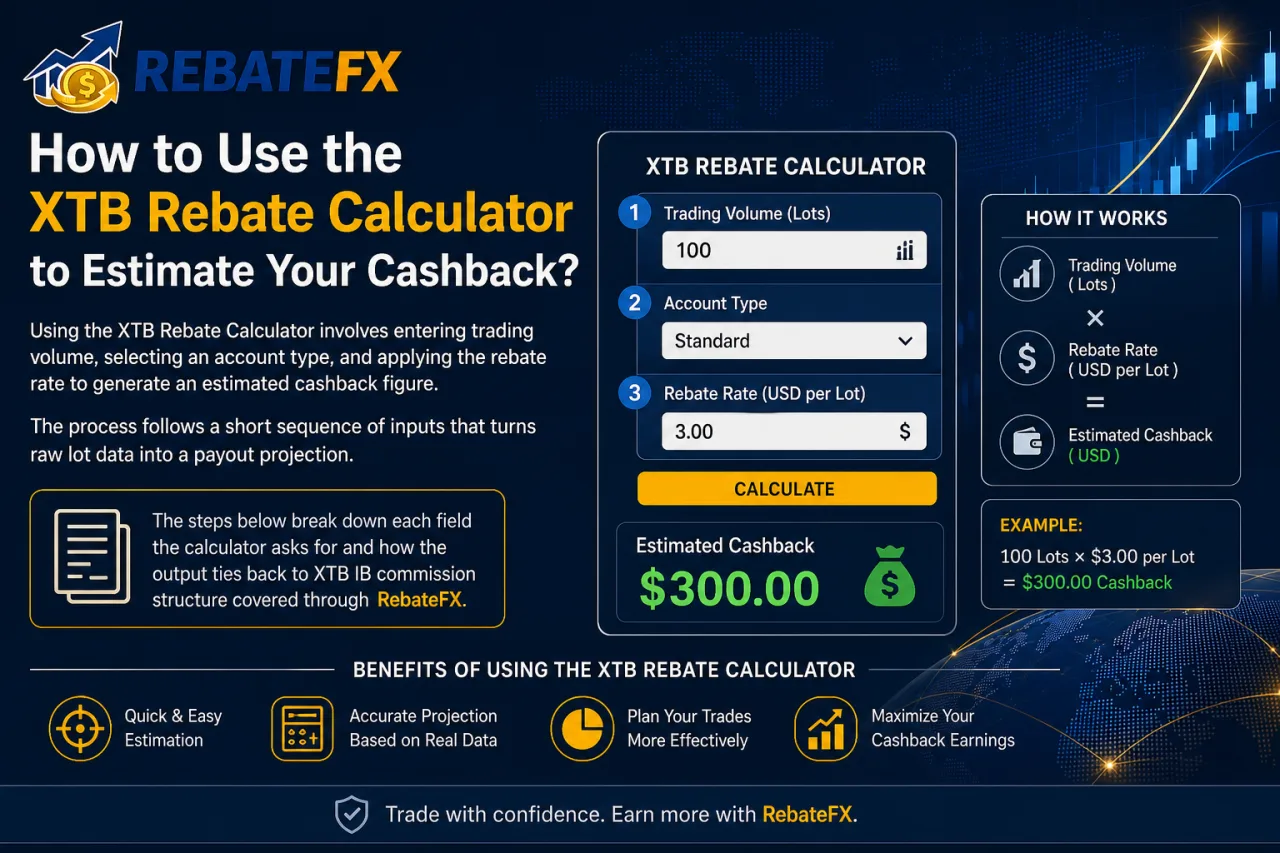
Using the XTB Rebate Calculator involves entering trading volume, selecting an account type, and applying the rebate rate to generate an estimated cashback figure. The process follows a short sequence of inputs that turns raw lot data into a payout projection.
The steps below break down each field the calculator asks for and how the output ties back to XTB IB commission structure covered through RebateFX.
What Inputs Are Needed for an Accurate Rebate Calculation?
An accurate rebate calculation requires five core inputs: lot volume, instrument type, account type, the IB commission rate RebateFX receives from XTB, and the applicable rebate percentage. Each field feeds directly into the output the calculator generates, so missing or incorrect data skews the estimate.
The list below breaks down what each input contributes to the calculation:
- Lot volume determines the base trading size the rebate is calculated against.
- Instrument type affects the commission structure applied, since different asset classes carry different IB commission rates.
- Account type influences eligibility and the commission rate tied to that specific trading account.
- IB commission rate reflects the amount RebateFX actually receives from XTB per traded volume.
- Rebate percentage applies the fixed share returned to the trader, set at 80% for XTB through RebateFX.
Entering all five values together produces a cashback figure that mirrors the actual IB commission structure rather than a rough estimate based on spread alone.
What Output Does the Calculator Show?
The XTB Rebate Calculator shows an estimated cashback amount in USD based on the lot volume and rebate rate entered. This figure represents the output that follows directly from the inputs covered above.
The displayed number reflects a projection, not a fixed guaranteed payout. Actual cashback varies depending on account type, traded volume, and the instrument used, since these factors change the underlying IB commission rate XTB pays out.
The output serves as a planning reference rather than a final settlement figure. Traders use it to gauge expected savings before executing trades, then compare that estimate against the cashback actually credited through RebateFX after the trade closes.
How Does XTB IB Commission Rebate Calculation Work?
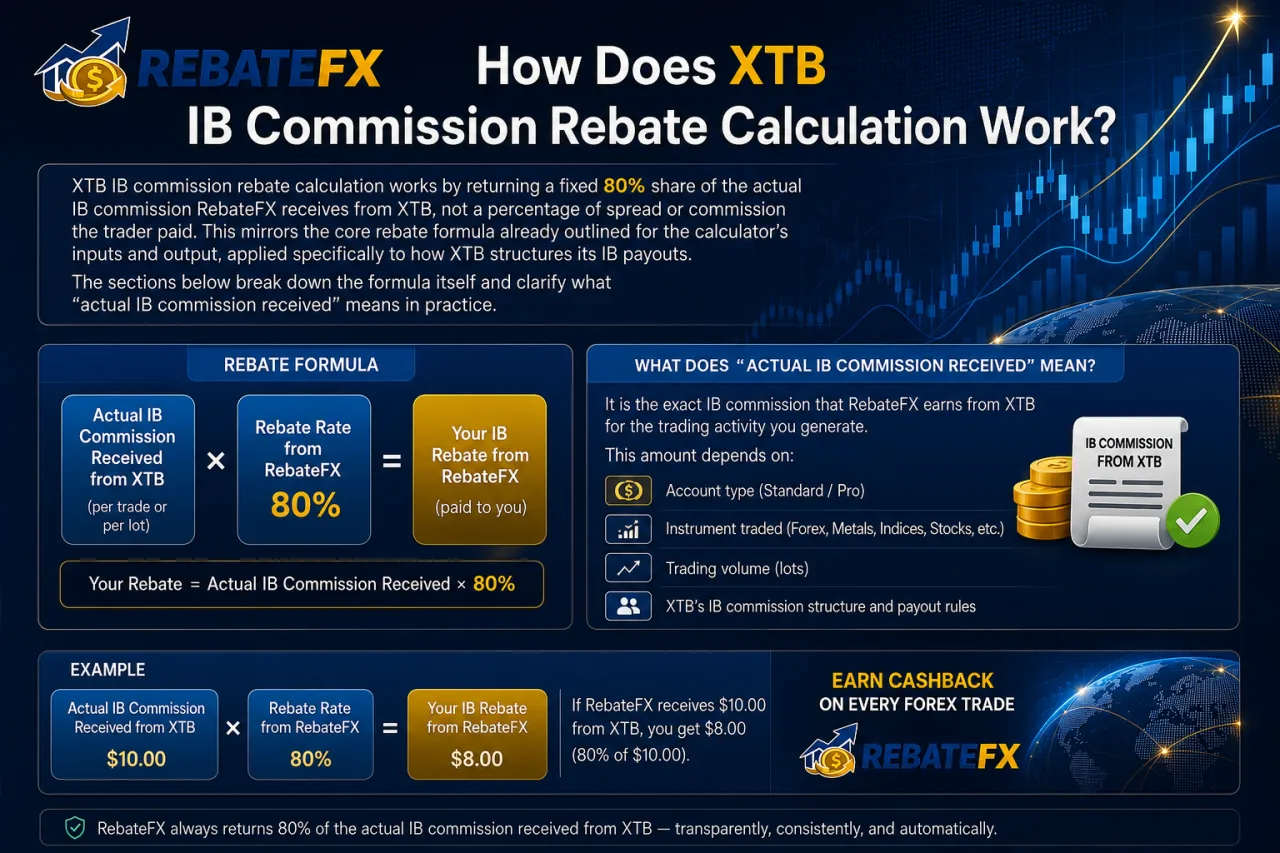
XTB IB commission rebate calculation works by returning a fixed 80% share of the actual IB commission RebateFX receives from XTB, not a percentage of spread or commission the trader paid. This mirrors the core rebate formula already outlined for the calculator’s inputs and output, applied specifically to how XTB structures its IB payouts.
The sections below break down the formula itself and clarify what “actual IB commission received” means in practice.
What Is an Example of Calculating XTB Rebate Based on Lot Volume?
A concrete example: if RebateFX receives 100 USD in IB commission from a trader’s volume on XTB, the trader receives 80 USD back, matching the 80% rebate rate. This example ties the rebate formula directly to lot volume, since the 100 USD commission figure itself scales with how many lots the trader executes.
Higher lot volume generates a larger IB commission for RebateFX, which then produces a proportionally larger rebate under the same 80% rate. A trader running a smaller position that generates 20 USD in IB commission receives 16 USD back, following the identical calculation. The ratio stays fixed at 80% regardless of the commission amount, so the payout scales linearly with traded lots rather than following a variable or tiered structure.
This linear relationship means the calculator’s output for any lot volume follows the same underlying formula: commission received multiplied by 80%, with lot volume acting as the variable that determines how much commission gets generated in the first place.
Why Is the Rebate Rate Applied to IB Commission, Not Spread or Trader-Paid Commission?
Yes, the rebate rate applies strictly to the actual IB commission RebateFX receives from XTB, not to spread or the total commission a trader pays, because the broker’s IB payout structure only shares income the broker itself distributes to introducing brokers. This calculation basis avoids a common misconception where traders assume the 80% figure reduces spread or shaves off their paid commission directly.
The distinction matters because spread and trader-paid commission represent XTB’s revenue, while IB commission represents a separate payout XTB allocates specifically to partners like RebateFX. Three points clarify why this basis holds:
- Spread reflects the price markup XTB charges on each trade, unrelated to IB payout structure.
- Trader-paid commission covers the broker’s own fee, not the amount shared with introducing brokers.
- IB commission represents the fixed amount XTB pays RebateFX per qualifying trade, forming the only base the 80% rate applies to.
Actual cashback still varies by account type, product traded, volume executed, and whether the trade qualifies under XTB’s rebate terms. These variables shift the underlying IB commission amount itself, which then changes the final rebate figure even though the 80% share stays constant.
How Does Cashback Reduce Your Net Trading Cost on XTB?
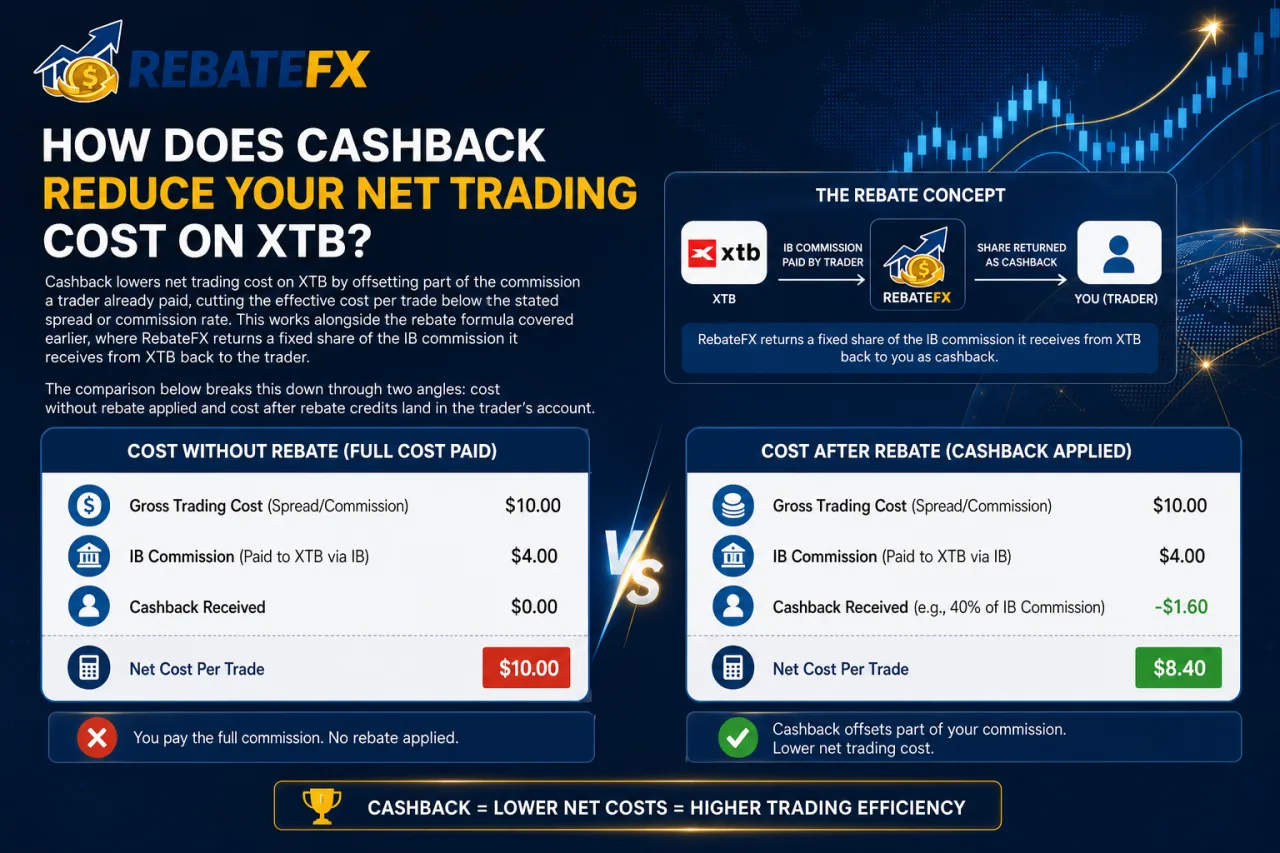
Cashback lowers net trading cost on XTB by offsetting part of the commission a trader already paid, cutting the effective cost per trade below the stated spread or commission rate. This works alongside the rebate formula covered earlier, where RebateFX returns a fixed share of the IB commission it receives from XTB back to the trader.
The comparison below breaks this down through two angles: cost without rebate applied and cost after rebate credits land in the trader’s account.
What Is the Difference Between Gross Trading Cost and Net Trading Cost After Rebate?
Gross trading cost covers the full spread or commission charged on a trade, while net trading cost after rebate equals gross cost minus the cashback credited through RebateFX. This distinction builds directly on the earlier point about cashback offsetting part of the commission a trader already paid.
A simple numeric comparison illustrates the gap between the two figures:
- Gross cost stands at 100 USD in commission charged on a given trading volume.
- Rebate credited returns 80 USD back to the trader, based on the 80% share applied to XTB’s IB commission.
- Net cost drops to 20 USD once the rebate amount subtracts from the original 100 USD charge.
Gross cost stays fixed at the moment of execution, appearing on the trade confirmation before any rebate processes. Net cost only becomes visible after RebateFX credits the cashback, which happens on a schedule tied to qualifying trades rather than instantly. Traders comparing broker costs benefit from tracking both figures separately, since gross cost reflects what XTB charges upfront while net cost reflects the actual expense after rebate credits land in the account.
Is XTB’s Built-In Trading Calculator the Same as a Rebate Calculator?
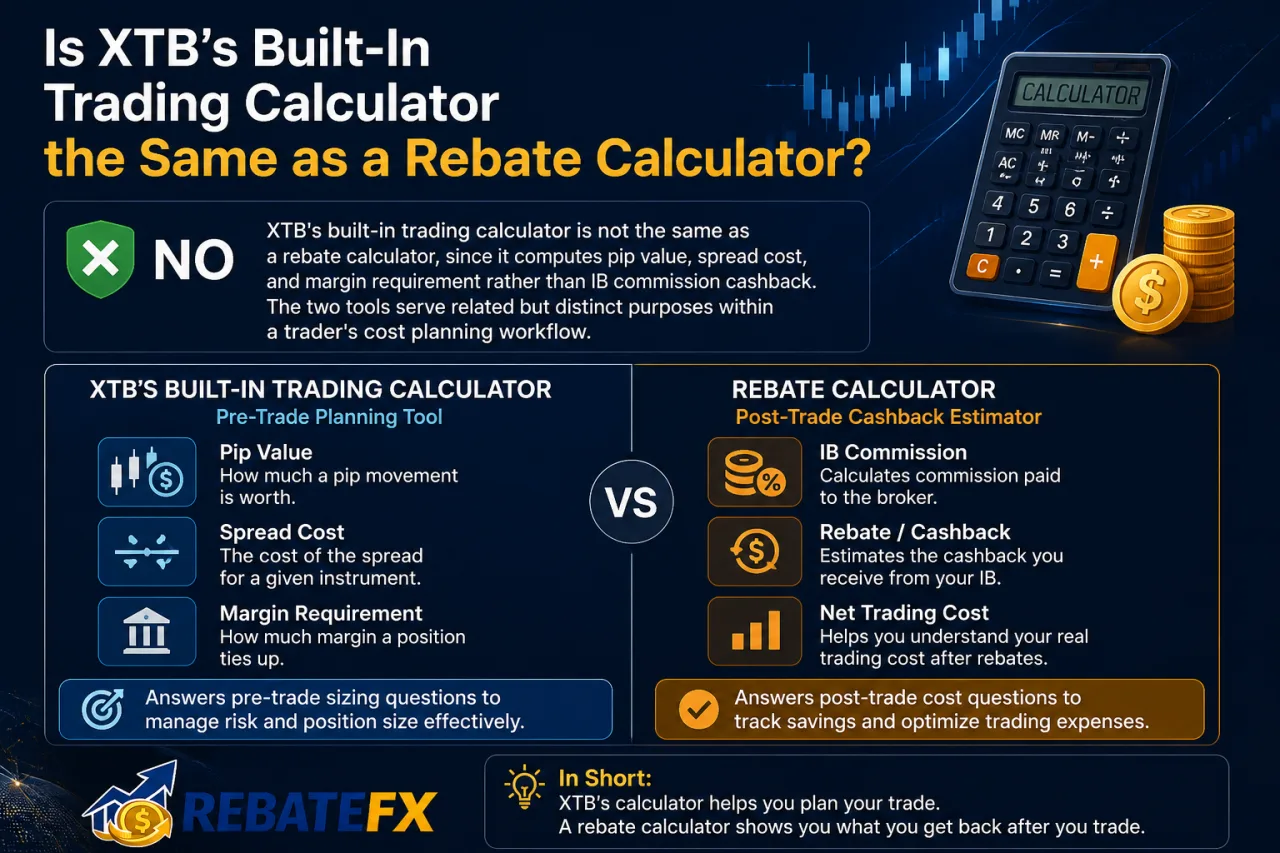
No, XTB’s built-in trading calculator is not the same as a rebate calculator, since it computes pip value, spread cost, and margin requirement rather than IB commission cashback. The two tools serve related but distinct purposes within a trader’s cost planning workflow.
XTB’s native calculator answers pre-trade sizing questions: how much a pip movement is worth, what spread cost applies to a given instrument, and how much margin a position ties up. None of these outputs touch IB commission or the 80% rebate share RebateFX returns from that commission. The subsections below separate this distinction into two angles: what XTB’s own calculator actually measures, and how that differs from what the rebate calculator is built to output.
What Does XTB’s Native Trading Calculator Measure (Pip Value, Spread, Margin)?
XTB’s native trading calculator measures three core figures: pip value, spread cost, and margin requirement, none of which touch IB commission cashback. This distinguishes the platform’s built-in tool from the rebate calculator covered above, since the two answer different questions in a trader’s cost planning process.
Pip value quantifies how much a single price movement of one pip translates into profit or loss for a given lot size and instrument. Spread cost shows the price markup XTB applies between bid and ask on a trade, reflecting the broker’s own revenue rather than any IB payout. Margin requirement calculates how much account equity a position ties up before execution, based on leverage and instrument type.
None of these three outputs factor in the 80% rebate share RebateFX returns from IB commission. A trader using XTB’s native calculator sees cost and sizing data upfront, while cashback estimation still requires the separate rebate calculator to project savings after the trade closes.
What Factors Cause Your Actual XTB Rebate to Vary?
Actual XTB rebate varies across four factors: account type, product or instrument traded, trading volume, and whether the trade qualifies under the rebate program. Each factor shifts the underlying IB commission XTB pays RebateFX, which then changes the final cashback figure even though the 80% share stays fixed. The subsections below break down each factor individually.
How Does Account Type Affect the Rebate Amount on XTB?
Account type affects the rebate amount on XTB because each account tier carries a distinct IB commission structure, which shifts the base the 80% rebate rate applies to. This ties back to the earlier point that actual cashback varies by account type even though the rebate percentage itself stays fixed.
A standard account and a raw spread or commission-based account generate different IB commission figures for the same traded volume, since the broker’s payout to introducing brokers depends partly on how each account type prices trades. RebateFX applies the same 80% share regardless of account, but the underlying commission amount that share multiplies against changes with the account tier selected.
This means two traders running identical lot volume on different account types receive different cashback totals, not because the rebate rate shifts, but because the IB commission RebateFX receives from XTB differs by account structure. Confirming account type before estimating cashback through the rebate calculator keeps the projection aligned with the actual commission basis XTB applies.
How Do Product Type and Trading Volume Influence Eligible Rebate?
Product type and trading volume influence eligible rebate because each instrument carries a distinct IB commission rate, and higher volume generates a larger commission base for the same 80% share to apply against. This connects directly to the account type factor covered above, since product and volume shift the underlying commission figure while the rebate percentage itself stays fixed.
Different asset classes on XTB carry different IB commission structures, so a forex pair and a stock index CFD executed at the same lot size still generate different commission amounts for RebateFX. Volume compounds this effect on top of the product-level difference: a trader running larger lot sizes on a given instrument produces a proportionally larger IB commission, which then scales the rebate payout upward under the same fixed rate.
- Product type sets the base commission rate XTB pays per traded volume.
- Trading volume multiplies that base rate into the total commission RebateFX receives.
- Combined, these two factors determine how much commission exists before the 80% share applies.
Checking both instrument type and expected volume before estimating cashback keeps the rebate calculator’s output aligned with the actual commission basis XTB generates on that specific trade.
Conclusion
In conclusion, the XTB Rebate Calculator helps traders estimate potential cashback by entering lot volume, instrument type, account type, IB commission rate, and the applicable rebate percentage. RebateFX returns 80% of the IB commission it actually receives from XTB, but the final cashback may vary according to the traded product, account structure, executed volume, and trade eligibility. Traders should treat the calculator’s output as a projection and compare it with the actual cashback credited after each qualifying trade is settled.

Soren Carrick is a Broker Rebate Program Specialist at RebateFX.org, specializing in Forex rebate programs, Introducing Broker (IB) operations, broker cashback systems, and trading cost analysis. He manages English-language content for IC Markets Rebate, Tickmill Rebate, and XTB Rebate, focusing on account registration, IB transfers, rebate calculations, cashback tracking, and payment verification to help traders understand rebate conditions and manage trading expenses more effectively.