

 Tiếng Việt
Registering for the Tickmill rebate program requires opening a Tickmill trading account through an approved rebate provider’s referral link, then submitting the account number for verification before any commission rebate activates. This affiliation step must happen before live trading begins, since rebates only apply to volume generated under the linked IB account.
The sign-up process follows a short sequence: create or link a Tickmill account via the provider’s referral link, complete identity verification, and register the account details on the rebate provider’s portal. Once confirmed, every eligible trade automatically starts accruing rebate value.
Rebate rates for Tickmill vary by provider, with some platforms offering up to 80% of the IB commission earned back to the trader. Tickmill’s rebate rates vary depending on the account type and trading conditions offered. Rates typically differ based on account type and the trading instrument involved.
Rebate amounts are calculated by multiplying the trading volume in lots by a fixed rebate rate per lot, or by applying a percentage to the IB commission generated from that volume. Higher lot volumes directly increase the total rebate paid out, regardless of trade outcome.
Payout methods for Tickmill rebates commonly include spread or commission discounts, direct cash payments, and account deposit credits, depending on the rebate provider chosen. Rebate FX outlines these options alongside the exact registration steps in the section below, starting with how to register for the Tickmill rebate program.
Contents:
How to Register for the Tickmill Rebate Program?
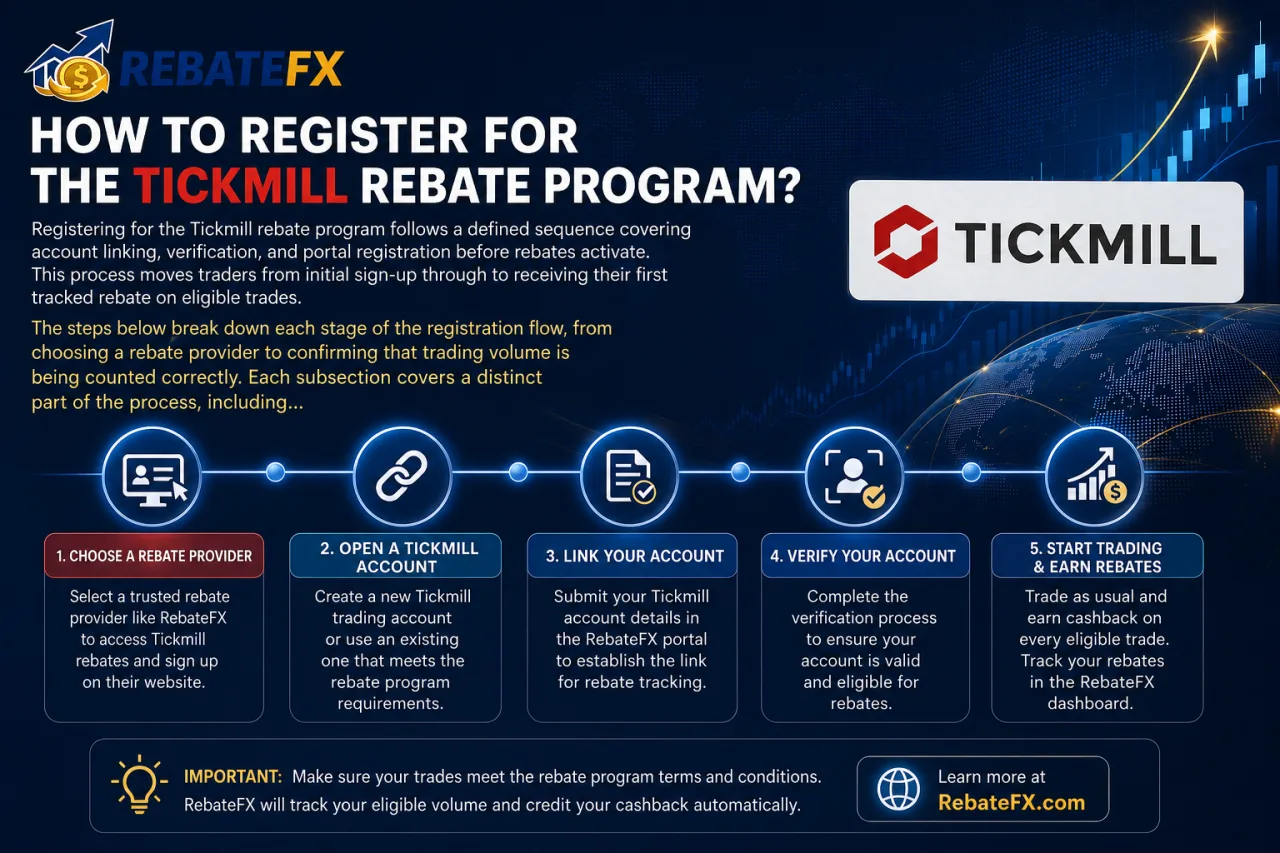
Registering for the Tickmill rebate program follows a defined sequence covering account linking, verification, and portal registration before rebates activate. This process moves traders from initial sign-up through to receiving their first tracked rebate on eligible trades.
The steps below break down each stage of the registration flow, from choosing a rebate provider to confirming that trading volume is being counted correctly. Each subsection covers a distinct part of the process, including creating the linked Tickmill account, verifying identity, submitting account details on the provider’s portal, and checking that rebate tracking has started.
What Are the Step-by-Step Instructions to Sign Up for a Tickmill Rebate Account?
Signing up for a Tickmill rebate account follows five sequential steps: visiting the rebate provider’s website, selecting Tickmill, registering through the referral link, opening a linked trading account, and completing verification before trading starts. Each step builds on the previous one, so skipping the referral link at registration disqualifies the account from rebate tracking entirely.
The instructions below walk through this flow using RebateFX as the rebate provider example, since the platform lists Tickmill directly among its supported brokers.
- Visit the rebate provider’s website, such as RebateFX, and locate the Tickmill program page.
- Select Tickmill from the list of supported brokers to view its specific rebate terms.
- Register on the provider’s site using the designated referral link or IB code tied to Tickmill.
- Open a new Tickmill trading account through that same referral link, or link an existing eligible account if permitted.
- Complete identity verification with Tickmill to activate full trading and withdrawal permissions.
- Start trading on the verified account, since eligible volume begins accruing rebate value immediately once tracking confirms the IB link.
Traders already holding a Tickmill account without a referral link generally need to open a separate new account, since retroactive linking is rarely supported. New traders benefit from confirming the referral link is active before funding the account, avoiding untracked initial trades.
What Documents or Information Are Needed to Complete Registration?
Completing Tickmill rebate registration requires a valid email address, the linked trading account number, and standard identity verification documents accepted by Tickmill. These details confirm the account belongs to the trader and remains correctly tied to the rebate provider’s referral link.
The email address registers the trader on the rebate provider’s portal and receives rebate tracking confirmations. The trading account number, generated after opening the linked Tickmill account, allows the provider to match trading volume against the correct IB record. Personal verification typically follows Tickmill’s standard identity checks, such as a government-issued ID and proof of address, since unverified accounts often face restricted trading or withdrawal permissions.
Exact document requirements and verification steps vary by account type and jurisdiction, so traders confirm specifics directly through Tickmill’s account opening process rather than relying on general assumptions.
Is It Necessary to Open a New Tickmill Account or Can an Existing Account Be Linked?
Opening a new Tickmill account is generally required for rebate eligibility, since most rebate providers cannot link a pre-existing account that was opened outside their referral link. This restriction ties back to how IB tracking works on the broker’s side.
Linking an existing account depends entirely on the rebate provider’s specific policy, not on a universal Tickmill rule. A few reasons explain why most cases require a fresh account:
- Existing accounts opened without a referral link lack the IB tag needed for volume tracking.
- Tickmill’s backend assigns the IB relationship at account creation, making retroactive changes rarely possible.
- Providers avoid disputes over commission attribution by requiring registration before any trading activity starts.
Note: a small number of rebate providers make an exception for accounts with limited trading history, allowing a linking request in that specific case. This exception is not standard across the industry. Traders confirm this option directly with their chosen provider, such as RebateFX, rather than assuming an existing Tickmill account qualifies by default.
What Rebate Rates Do Different Providers Offer for Tickmill?
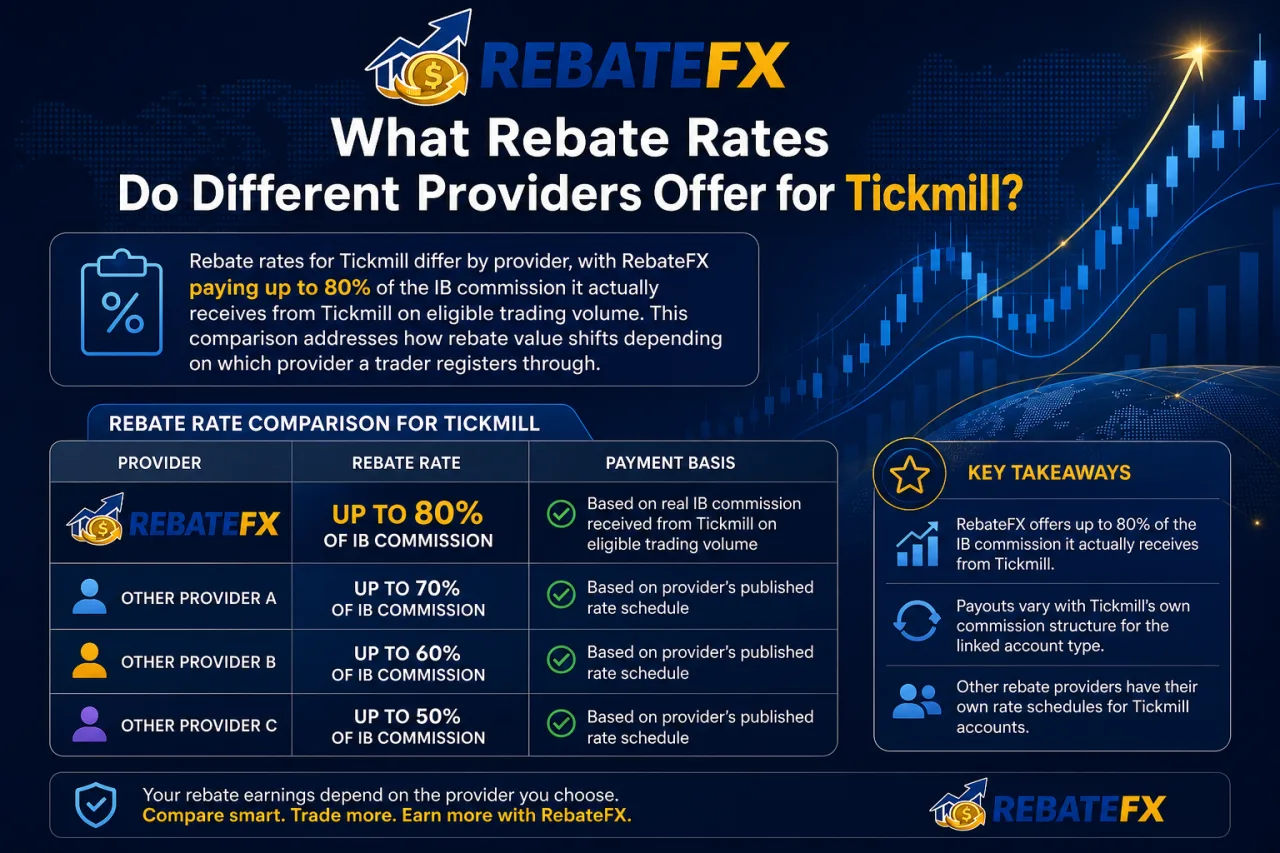
Rebate rates for Tickmill differ by provider, with RebateFX paying up to 80% of the IB commission it actually receives from Tickmill on eligible trading volume. This comparison addresses how rebate value shifts depending on which provider a trader registers through.
Since RebateFX operates on real IB commission received rather than a fixed cash figure, payouts move with Tickmill’s own commission structure for the linked account type. Other rebate providers publish separate rate schedules for Tickmill, and those figures depend on each provider’s individual IB agreement with the broker rather than a shared industry standard.
The sections below break down how RebateFX calculates its Tickmill rebate rate and how that rate compares against other providers offering similar programs.
How Does the Tickmill Rebate Rate Compare Across Providers?
RebateFX’s Tickmill rebate rate stands out for paying up to 80% of the IB commission it actually receives, while other providers set their own percentage independent of that figure. This comparison covers how that structure holds up against the general variance seen across the rebate provider market.
Rebate percentages published by different providers reflect separate IB agreements each one holds with Tickmill, not a shared benchmark across the industry. Actual rebate value depends on a few variables beyond the headline rate:
- Account type opened under the linked Tickmill IB relationship.
- Trading product involved, since instruments carry different commission structures.
- Trading volume generated, as higher lots scale the rebate proportionally.
Comparing providers strictly by advertised percentage overlooks these underlying factors, making the effective payout the more reliable metric for evaluating which program suits a given trading style.
What Payout Methods Are Available for Tickmill Rebates?
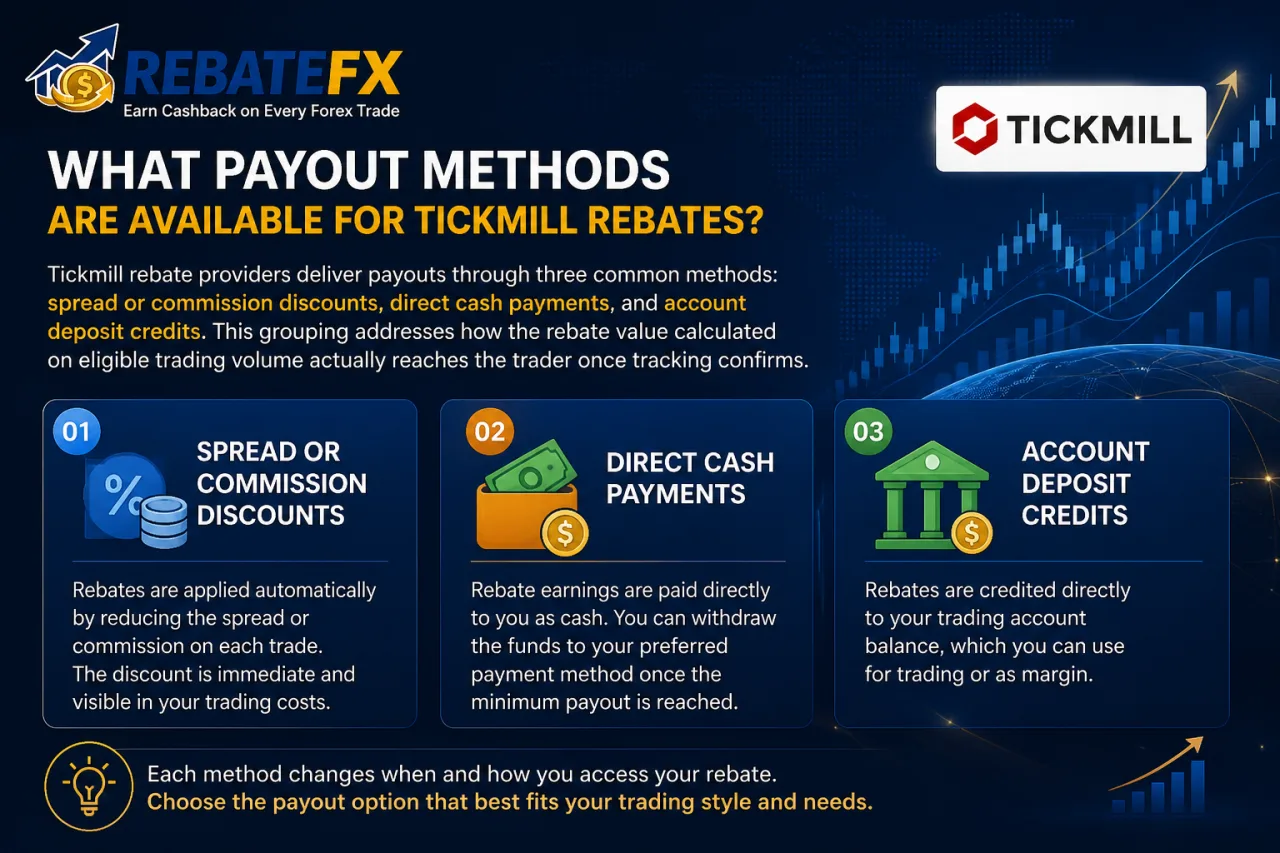
Tickmill rebate providers deliver payouts through three common methods: spread or commission discounts, direct cash payments, and account deposit credits. This grouping addresses how the rebate value calculated on eligible trading volume actually reaches the trader once tracking confirms.
Each method changes when and how the trader accesses the rebate, since some apply automatically at trade execution while others require a manual claim or transfer cycle. The subsections below cover how these three payout forms differ and which factors influence which option a given provider offers.
Cash Payment vs Spread/Commission Discount vs Deposit Credit: Which Payout Method Fits Best?
Cash payment wins on flexibility for withdrawal timing, spread/commission discount wins on immediacy since it applies automatically at trade execution, and deposit credit wins on compounding trading capital without a separate transfer step. Each format suits a different trading priority rather than one option outranking the others universally.
Direct cash payment transfers rebate value to the trader’s external account or e-wallet on a set cycle, giving full control over the funds outside the trading environment. This method suits traders withdrawing rebate income regularly rather than reinvesting it, though payout frequency depends on the provider’s processing schedule.
Spread or commission discount reduces trading cost at the moment a trade executes, lowering the breakeven point on every position without waiting for a separate rebate credit. This format fits high-frequency traders focused on cutting transaction cost directly rather than tracking a rebate ledger.
Deposit credit adds rebate value straight into the trading account balance, increasing available margin for further positions. Traders scaling volume within the same account benefit most from this option, since the credited amount compounds into additional trading capacity rather than sitting outside the account.
How Is the Tickmill Rebate Amount Calculated Based on Trading Volume?
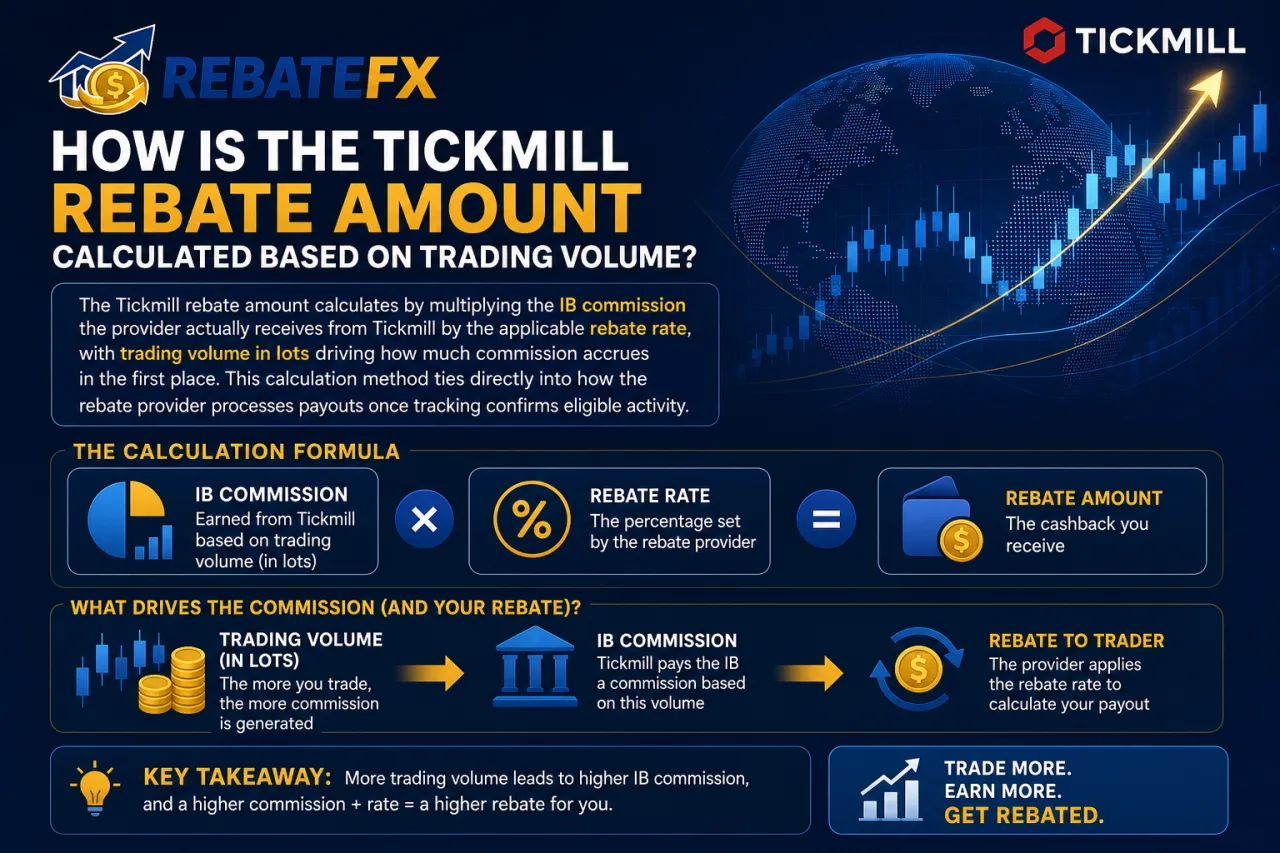
The Tickmill rebate amount calculates by multiplying the IB commission the provider actually receives from Tickmill by the applicable rebate rate, with trading volume in lots driving how much commission accrues in the first place. This calculation method ties directly into how the rebate provider processes payouts once tracking confirms eligible activity.
Two components determine the final figure passed on to a trader, and each one scales independently before the multiplication happens.
- Trading volume generated on the linked account, measured in lots, sets the base commission Tickmill pays the IB.
- Rebate rate applied by the provider determines what portion of that received commission gets passed back.
Higher lot volume increases the commission base, which then increases the rebate output proportionally at the same fixed rate. The calculation runs on commission the provider actually receives from Tickmill, not on the spread or commission the trader pays on each trade, since those figures belong to a separate cost structure on the broker’s side.
The subsection below breaks down this formula step by step, covering how the IB commission received and the rebate rate combine to produce the payout figure for a given volume.
What Is the Formula Used to Calculate Rebate Payouts?
The formula multiplies the IB commission the provider actually receives from Tickmill by the applicable rebate rate, producing the exact payout figure credited to the trader. This calculation directly answers what formula drives Tickmill rebate payouts once trading volume closes out on the linked account.
Rebate payout = IB commission received × rebate rate. For example, if the provider receives a certain amount in IB commission from Tickmill, the trader receives a portion of that amount back based on the applicable rebate rate, since Tickmill’s rebate rates vary depending on the account type and trading conditions offered.
This formula stays consistent regardless of account size, but the two inputs feeding it shift based on several factors:
- Account type opened under the linked Tickmill IB relationship changes the base commission rate Tickmill assigns.
- Trading product involved carries a different commission structure per instrument.
- Eligible trading volume determines how much commission accrues before the rebate rate applies.
Actual payout amounts vary accordingly, since the commission received and the rebate rate applied differ across accounts and products rather than following one fixed universal figure.
Does Trading Volume/Lot Size Directly Affect the Rebate Amount?
Yes, trading volume and lot size directly affect the Tickmill rebate amount, since higher volume increases the IB commission the provider receives, which then scales the rebate proportionally. This confirms the direct link between volume and payout size raised by the volume impact question above.
The relationship follows a few consistent patterns:
- Larger lot volume generates more IB commission from Tickmill on the linked account.
- Higher commission base multiplies against the fixed rebate rate to produce a larger payout.
- Eligibility conditions still vary by account type and trading product, so the same volume does not always convert into an identical rebate across different setups.
Traders scaling lot size see rebate growth follow that increase closely, provided the account and product remain eligible under the linked IB relationship. Volume alone does not override account-specific or product-specific rate differences already tied to the Tickmill IB agreement.
What Rare Considerations Should Traders Check Before Registering for a Tickmill Rebate?
Traders check three rare considerations before registering for a Tickmill rebate: account type restrictions, multi-provider registration conflicts, and verification or tracking gaps that block rebate eligibility. These factors sit outside the core registration, rate, and calculation steps already covered, yet each one determines whether a linked account actually accrues rebate value once trading starts. The subsections below break down how each consideration affects eligibility.
Can a Trader Register for the Same Tickmill Account with Multiple Rebate Providers?
No, a trader cannot validly register the same Tickmill account with multiple rebate providers, since Tickmill’s backend only permits one active IB link per trading account at a time. This limitation follows directly from the multi-provider conflict already flagged among the rare considerations above.
A few factors explain why dual registration fails in practice:
- Attributes each trading account to a single IB relationship at the broker level.
- Rejects a second referral link once the first registration locks the account.
- Creates tracking disputes between providers if both attempt to claim the same volume.
Traders wanting to compare providers open separate accounts under each referral link instead, keeping rebate tracking clean and avoiding conflicting claims on the same trading volume.
How Can Traders Verify That Their Rebate Tracking Is Working Correctly After Registration?
Traders verify Tickmill rebate tracking works correctly by logging into the rebate provider’s dashboard and confirming recorded trading activity matches the linked account’s actual volume.
This check directly addresses the rare tracking gap concern raised among the considerations above.
A functioning setup shows a few consistent signs on the provider’s portal:
- Displays the linked Tickmill account number matching the one submitted at registration.
- Records closed trades or lot volume within a reasonable window after execution.
- Reflects accruing rebate value tied to that recorded volume rather than showing zero activity.
Traders noticing no recorded activity after placing eligible trades contact the rebate provider’s support team to confirm the IB link registered correctly. Checking this early after sign-up catches a broken referral link before significant trading volume passes through untracked.
Conclusion
In conclusion, registering for a Tickmill rebate requires opening an eligible trading account through the correct provider referral link, completing verification, and confirming that rebate tracking is active before trading. The final cashback is calculated from the IB commission actually received and depends on trading volume, account type, traded instrument, eligibility conditions, and the provider’s applicable rebate rate. Traders should compare payout methods and effective rates carefully, use only one rebate provider per account, and regularly verify recorded volume and accrued cashback through the provider’s dashboard.

Soren Carrick is a Broker Rebate Program Specialist at RebateFX.org, specializing in Forex rebate programs, Introducing Broker (IB) operations, broker cashback systems, and trading cost analysis. He manages English-language content for IC Markets Rebate, Tickmill Rebate, and XTB Rebate, focusing on account registration, IB transfers, rebate calculations, cashback tracking, and payment verification to help traders understand rebate conditions and manage trading expenses more effectively.