

 Tiếng Việt
A Tickmill rebate calculator estimates cashback earnings by multiplying traded lot volume by the rebate rate per lot assigned to each instrument. Traders enter lot size, currency pair, and account type to get a projected payout before placing any trade.
Rebate rates vary significantly across providers. Tickmill’s Introducing Broker program follows the same IB Commission Rebate model used across all brokers on RebateFX, where the rebate equals the IB commission received multiplied by the rebate percentage, with the main difference lying in the rebate percentage offered rather than the underlying model. Comparing these percentages side by side reveals which provider delivers higher effective returns on the same trading volume.
Tickmill’s “Trade More, Get More” promotion is designed to increase cashback rates as monthly trading volume rises, subject to specific eligibility conditions set by the broker. Meeting the volume thresholds set by Tickmill determines which tier of rebate a trader qualifies for each period.
Rebate calculators provide close estimates but real payouts on pairs like EUR/USD or JPY crosses can differ slightly due to spread variability and rounding in lot calculations. Cross-checking calculator outputs against actual statements confirms whether the projected cashback matches the amount credited.
Understanding how these estimates are generated clarifies why accuracy depends on correct input data, a detail examined by RebateFX in the following breakdown of how the Tickmill rebate calculator works.
Contents:
How Does the Tickmill Rebate Calculator Work?
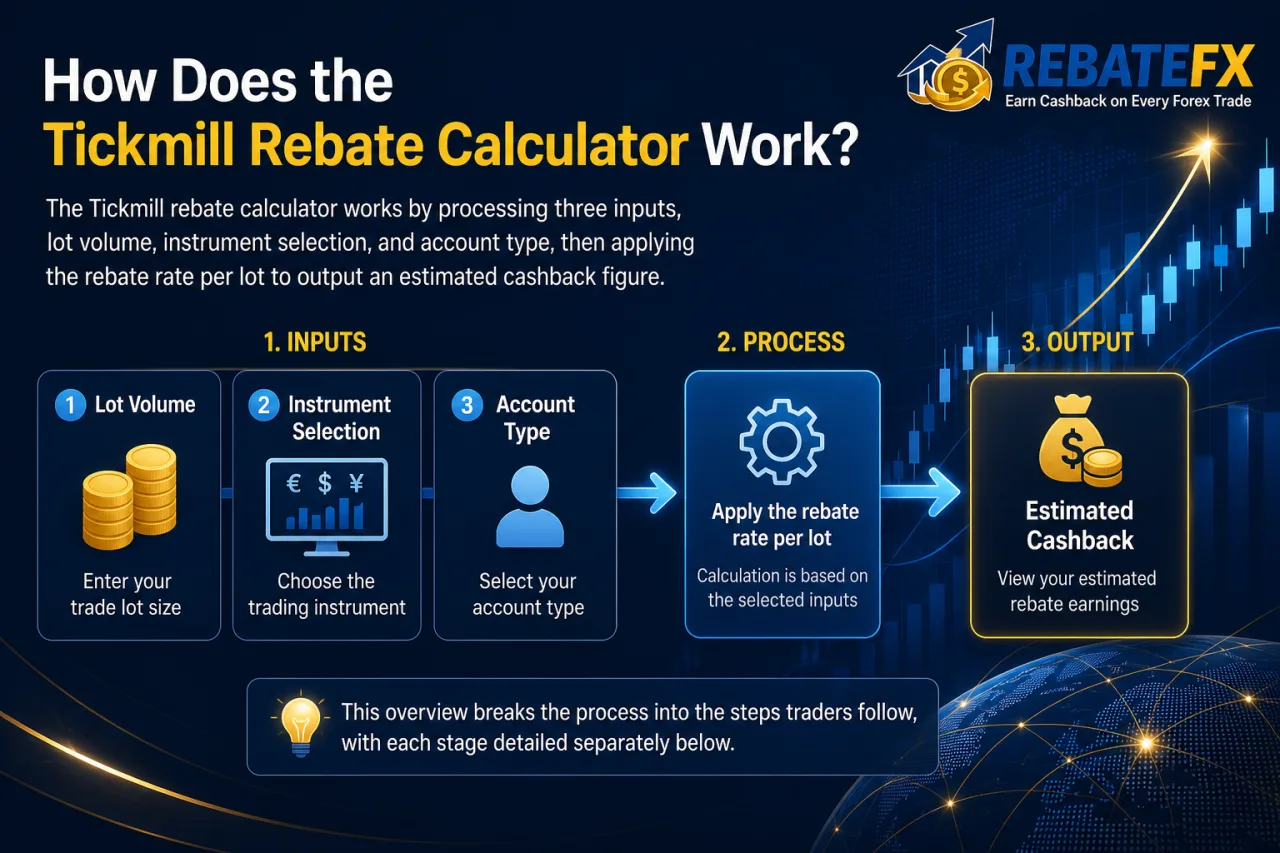
The Tickmill rebate calculator works by processing three inputs, lot volume, instrument selection, and account type, then applying the rebate rate per lot to output an estimated cashback figure. This overview breaks the process into the steps traders follow, with each stage detailed separately below.
What Inputs Are Needed to Calculate Your Rebate?
Calculating a Tickmill rebate requires four inputs: traded lot volume, instrument type, account type, and the rebate rate per lot assigned to that instrument. These fields together determine the final IB commission received before the rebate percentage applies to it.
- Traded lot volume: the total number of standard lots opened across a chosen period, forming the base multiplier for the calculation.
- Instrument type: the currency pair, index, or commodity traded, since rebate rates per lot differ by instrument category.
- Account type: the specific Tickmill account tier the trader holds, as commission structures and eligible rebate rates vary between account types.
- Rebate rate per lot: the fixed cashback amount applied once lot volume and instrument are confirmed.
Entering these four values lets the calculator multiply lot volume by the applicable rate per lot, producing an estimated commission figure before the rebate percentage is deducted. Missing or incorrect account type selection skews the output, since rebate rates per lot are not uniform across every Tickmill account tier.
How to Calculate Rebate for EUR/USD or JPY Pairs?
Calculating rebate for EUR/USD or JPY pairs multiplies traded lot volume by the rebate rate per lot assigned to that specific instrument, then applies the rebate percentage to the resulting IB commission. Lot size and instrument category directly change the IB commission figure before any cashback percentage gets applied.
For a EUR/USD example, trading 10 standard lots at a fixed rate per lot generates a set IB commission amount. Applying an 80% rebate rate to that commission produces the final cashback payout, following the same formula used across other instruments: rebate = IB commission received x rebate rate.
JPY pairs follow the identical formula but often carry a different rate per lot due to instrument-specific pricing, so the same 10-lot volume can produce a different commission base than EUR/USD. JPY crosses may also show slight rebate variance from spread fluctuation during high volatility periods.
Traders comparing both pairs confirm instrument selection changes the commission input, while the rebate percentage itself stays fixed per account type.
How Much Cashback Can You Earn Trading with Tickmill?
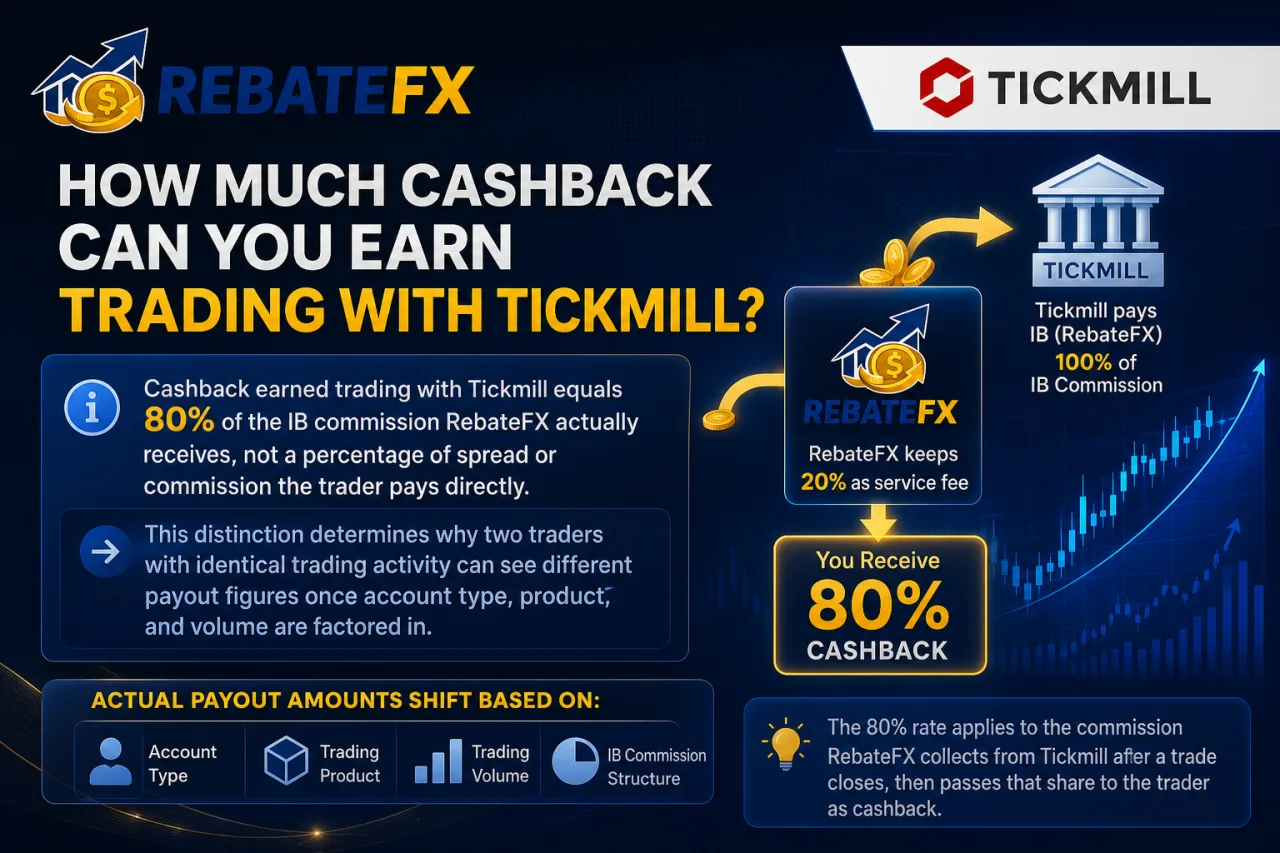
Cashback earned trading with Tickmill equals 80% of the IB commission RebateFX actually receives, not a percentage of spread or commission the trader pays directly. This distinction determines why two traders with identical trading activity can see different payout figures once account type, product, and volume are factored in.
The 80% rate applies to the commission RebateFX collects from Tickmill after a trade closes, then passes that share to the trader as cashback. Actual payout amounts shift based on several factors:
- Account type: commission structures differ between Tickmill’s account tiers, changing the base figure the 80% rate applies to.
- Product traded: forex pairs, indices, and commodities carry separate commission schedules per lot.
- Trading volume: higher lot volume raises the total IB commission base, increasing the resulting cashback.
- Trade eligibility: only trades that generate IB commission for RebateFX qualify for the rebate calculation.
The rebate is calculated from the commission RebateFX receives, not from the trader’s own spread or commission cost.
Tickmill vs Other Rebate Providers: Which Cashback Rate Is Higher?
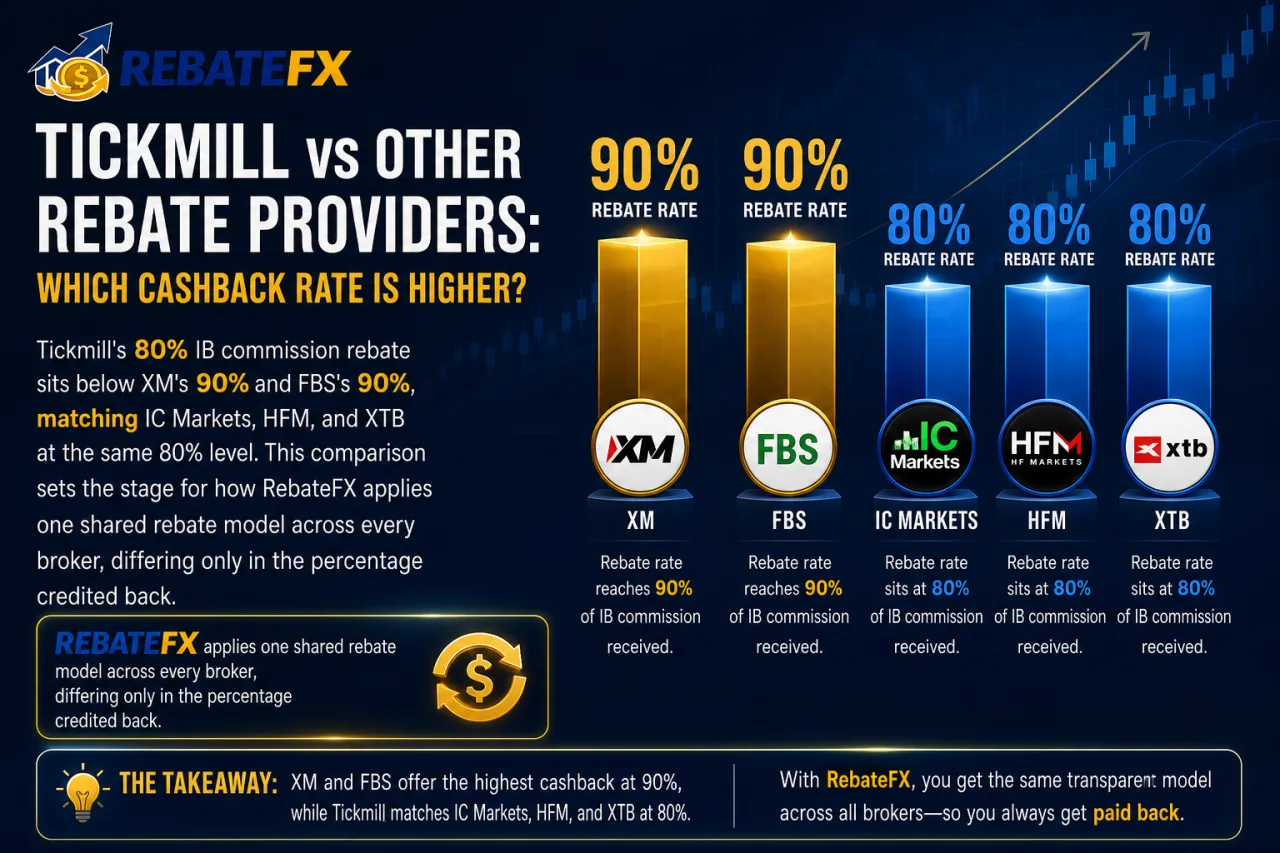
Tickmill’s 80% IB commission rebate sits below XM’s 90% and FBS’s 90%, matching IC Markets, HFM, and XTB at the same 80% level. This comparison sets the stage for how RebateFX applies one shared rebate model across every broker, differing only in the percentage credited back. Figures below reflect the rebate rate table published on RebateFX.
- XM: rebate rate reaches 90% of IB commission received.
- FBS: rebate rate reaches 90% of IB commission received.
- IC Markets: rebate rate sits at 80% of IB commission received.
- HFM: rebate rate sits at 80% of IB commission received.
- XTB: rebate rate sits at 80% of IB commission received.
- Tickmill: rebate rate sits at 80% of IB commission received.
Every broker listed above operates under the same IB Commission Rebate structure, where RebateFX shares a fixed portion of the commission it actually receives from each broker rather than a portion of trader spread or trading cost. Only the percentage applied to that received commission changes from provider to provider, as reflected in the rate table referenced above.
Traders comparing cashback across these six brokers evaluate the rebate percentage alongside account type, product traded, and volume, since these factors shift the commission base before the percentage applies.
A higher published percentage on one broker does not automatically translate into a larger payout if the underlying IB commission per lot runs lower than a broker offering a smaller percentage on a higher commission base.
What Is Tickmill’s ‘Trade More, Get More’ Rebate Promotion?
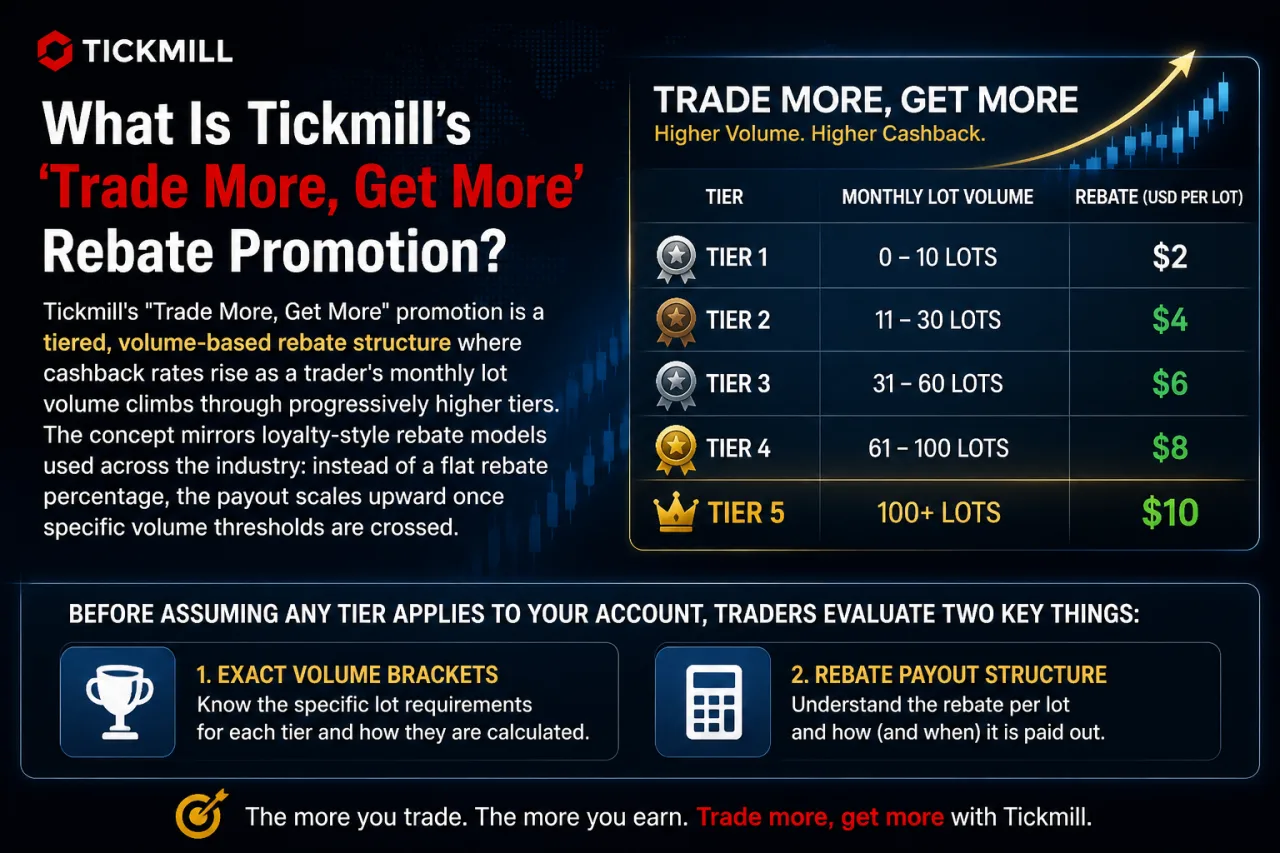
Tickmill’s “Trade More, Get More” promotion is a tiered, volume-based rebate structure where cashback rates rise as a trader’s monthly lot volume climbs through progressively higher tiers. The concept mirrors loyalty-style rebate models used across the industry: instead of a flat rebate percentage, the payout scales upward once specific volume thresholds are crossed.
Before assuming any tier applies to their account, traders reviewing this promotion evaluate two things:
- The exact volume brackets Tickmill sets for each tier.
- The eligibility conditions attached to each bracket.
The specific tier thresholds, rebate increases, and qualifying conditions for this promotion follow Tickmill’s official terms for the “Trade More, Get More” rebate promotion, rather than any estimate generated independently. [[CẦN_KIỂM_TRA_THỦ_CÔNG: xác nhận URL tham khảo https://www.tickmill.com/news/tickmill-announces-new-trade-more-get-more-rebate-promotion có tồn tại và đúng nội dung trước khi xuất bản; nếu không, thay bằng nguồn chính thức đúng hoặc bỏ trích dẫn cụ thể]]
The subsections below break down how these volume tiers function and what conditions determine tier qualification each period.
Who Is Eligible for This Promotion?
Eligibility for the “Trade More, Get More” promotion depends on holding a qualifying Tickmill account type, registering through the RebateFX IB link, and reaching the trade volume required for each tier. Confirming these three conditions determines whether a trader actually qualifies for the promotion rather than assuming automatic enrollment.
The three conditions break down as follows:
- Account type: Tickmill restricts certain rebate promotions to specific account tiers, so not every account opened with Tickmill automatically falls under this offer.
- Registration path: Only accounts opened and traded under the RebateFX IB link generate the commission RebateFX shares back as cashback.
- Qualifying trade volume: This acts as the gatekeeper for tier progression, though the exact lot thresholds and bracket structure follow Tickmill’s own published terms rather than a fixed figure quoted independently here.
Traders confirm eligibility by checking their account type against Tickmill’s promotion terms, verifying registration through the correct RebateFX link, and reviewing monthly volume against the official tier requirements before assuming a higher cashback rate applies.
Is the Tickmill Rebate Calculator Accurate for Estimating Real Payouts?
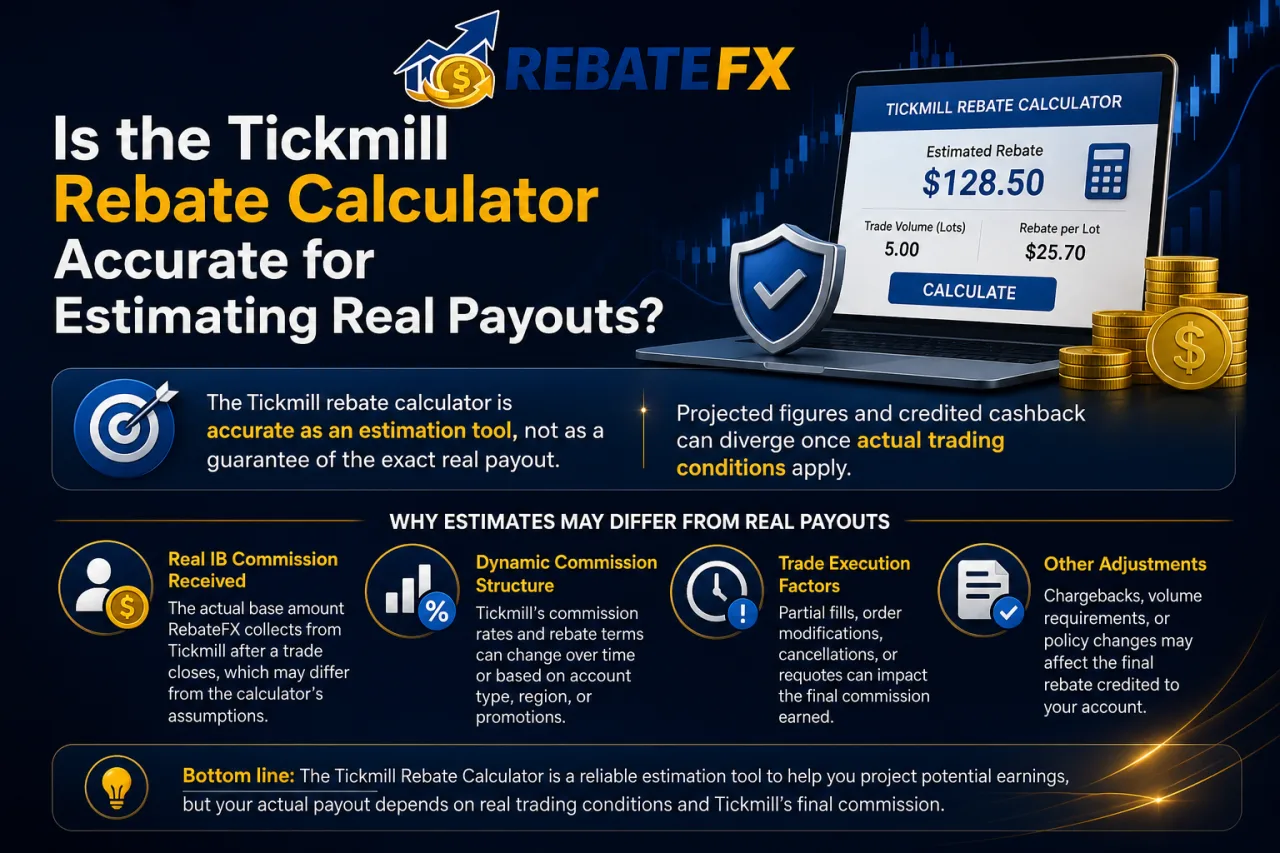
The Tickmill rebate calculator is accurate as an estimation tool, not as a guarantee of the exact real payout. This distinction matters directly for the calculator reliability question raised above, since projected figures and credited cashback can diverge once actual trading conditions apply.
Several factors explain the gap between estimate and final payout:
- Real IB commission received: the actual base amount RebateFX collects from Tickmill after a trade closes, which may differ from the commission assumed during calculation.
- Instrument spread and commission structure: forex pairs, indices, and commodities each carry distinct pricing that shifts the commission base per lot.
- Account type: commission schedules vary across Tickmill’s account tiers, changing the figure the rebate percentage applies to.
- Trade eligibility: only trades that generate qualifying IB commission count toward the final rebate.
EUR/USD and JPY pairs often show different results even at identical lot volume, since rate per lot and spread behavior are not uniform across instruments. Cross-checking calculator output against the actual RebateFX statement confirms whether the estimated cashback matches the credited amount for that period.
How to Register and Track Your Tickmill Rebate on RebateFX?
To register and track a Tickmill rebate on RebateFX, traders sign up through RebateFX’s dedicated IB link before opening a live account, then monitor payout status through the platform’s rebate dashboard. This process splits into two distinct stages, the initial sign-up step and the ongoing tracking step, each covered in the sections below.
What Account Types or Instruments May Affect Your Rebate Amount?
Two categories drive rebate variation on Tickmill: account type and product class, both changing the commission base before the rebate percentage applies. This grouping matters directly for anyone reading a calculator estimate and expecting that figure to match the credited payout exactly.
Account type shifts the outcome because commission schedules differ across Tickmill’s account tiers, so identical lot volume on two different accounts produces two different IB commission bases. Product class shifts the outcome separately, since forex majors, JPY pairs, and other instruments (indices, commodities) each carry distinct pricing per lot rather than one uniform rate.
- Account type: determines which commission schedule applies before the rebate percentage is calculated.
- Forex majors: carry a rate per lot that differs from JPY crosses and non-forex instruments.
- JPY pairs: often show commission variance tied to instrument-specific pricing and spread behavior.
- Other instruments: indices and commodities follow separate commission structures outside standard forex pairs.
Reviewing both categories together clarifies why a calculator estimate serves as a starting reference rather than the exact figure appearing on a RebateFX statement.
How Is Rebate Paid Out – Frequency and Method?
Rebate payout on RebateFX follows a defined crediting cycle and a fixed disbursement method, both applied once the IB commission from Tickmill clears. This concept ties directly into the frequency and method question, since payout timing and delivery channel determine when a trader actually sees cashback land in their account.
Payout crediting works on a cycle basis, where RebateFX processes the rebate after receiving and confirming the IB commission from Tickmill for a given period. The exact payout schedule and disbursement method (e.g., weekly, monthly, or per specific wallet/bank channel) follow RebateFX’s official published terms rather than a fixed figure quoted independently here.
Traders confirming payout status check the RebateFX dashboard against the credited amount for each cycle, since discrepancies between expected and received cashback trace back to commission clearance timing rather than a calculation error in the estimate itself.
Conclusion
In conclusion, the Tickmill rebate calculator helps traders estimate potential cashback by using lot volume, traded instrument, account type, and the applicable rebate rate. RebateFX returns 80% of the IB commission it actually receives from Tickmill, but the final payout may differ from the estimate because of trade eligibility, instrument-specific commission structures, and actual broker-confirmed data. Traders should enter accurate information, treat calculator results as projections, and compare them with the rebate statement and payout status shown in the RebateFX dashboard.

Liam Dravon is a Forex Market Analyst at RebateFX.org, specializing in Forex rebate programs, Introducing Broker (IB) structures, broker analysis, and trading cost optimization. He manages English-language content for XM Rebate, FBS Rebate, and HFM Rebate, focusing on account registration, IB transfers, cashback calculations, and rebate verification to help international traders understand rebate conditions and manage trading expenses more effectively.