

 Tiếng Việt
An IC Markets rebate calculator estimates cashback earnings by multiplying traded lot volume by the applicable rebate rate per instrument. Traders input account type, currency pair, and lot size to get an instant projection of expected payouts before placing trades.
Cashback per instrument depends on the IB commission rate IC Markets pays varies by product, such as EUR/USD, gold, or indices. Rebates are typically expressed in dollars per lot or fractions of a pip, allowing traders to translate trading volume directly into cashback value.
Rebate rates and provider terms vary because each cashback provider negotiates a different share of the IB commission with IC Markets. Comparing providers side by side reveals differences in payout percentage, minimum thresholds, and payment frequency before committing to one program.
Real trading costs drop once the rebate is applied, since net spread or commission equals the original trading cost minus the cashback received per lot. This adjusted figure gives a clearer picture of actual profitability across different trading volumes and instruments.
RebateFX applies the IB Commission Rebate model, returning up to 80% of the IB commission it earns from IC Markets back to traders as cashback. The section below explains what an IC Markets rebate calculator is and how to use it to estimate cashback accurately.
Contents:
What Is an IC Markets Rebate Calculator and How Do You Use It to Estimate Cashback?
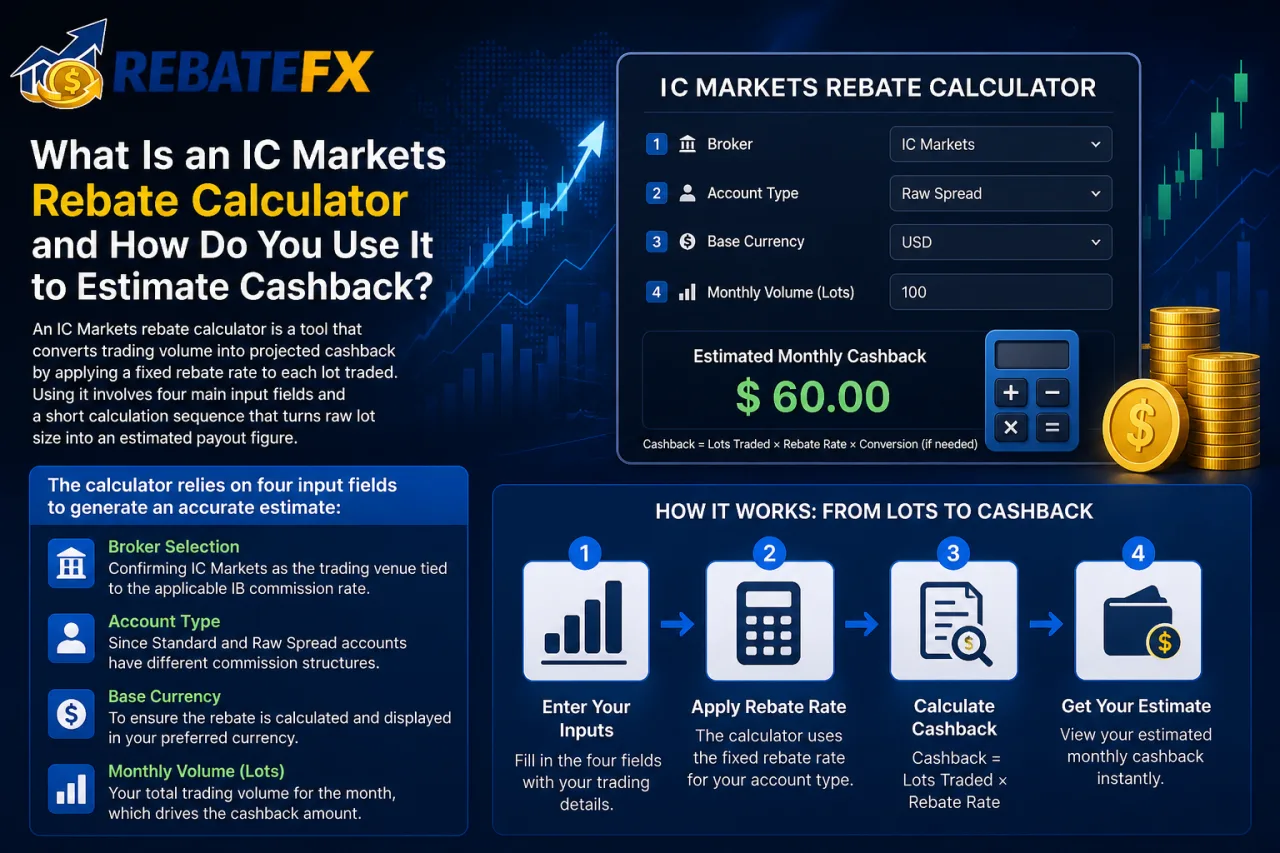
An IC Markets rebate calculator is a tool that converts trading volume into projected cashback by applying a fixed rebate rate to each lot traded. Using it involves four main input fields and a short calculation sequence that turns raw lot size into an estimated payout figure.
The calculator relies on four input fields to generate an accurate estimate:
- Broker selection, confirming IC Markets as the trading venue tied to the applicable IB commission rate.
- Account type, since Standard and Raw Spread accounts carry different commission structures.
- Trading volume in lots, the core variable multiplied against the rebate rate.
- Instrument choice, as forex pairs, gold, and indices each carry distinct IB commission values.
Estimating cashback with RebateFX follows the IB Commission Rebate model in a few steps. First, the trader enters account type and instrument to pull the correct base commission rate. Next, the calculator multiplies that rate by the entered lot volume to derive the total IB commission generated. Finally, it applies RebateFX’s rebate share, up to 80% of that commission for IC Markets, to output the projected cashback amount in dollars. This output updates instantly as volume or instrument inputs change, giving traders a real-time projection before executing trades.
What Formula Does the IC Markets Rebate Calculator Use to Estimate Your Earnings?
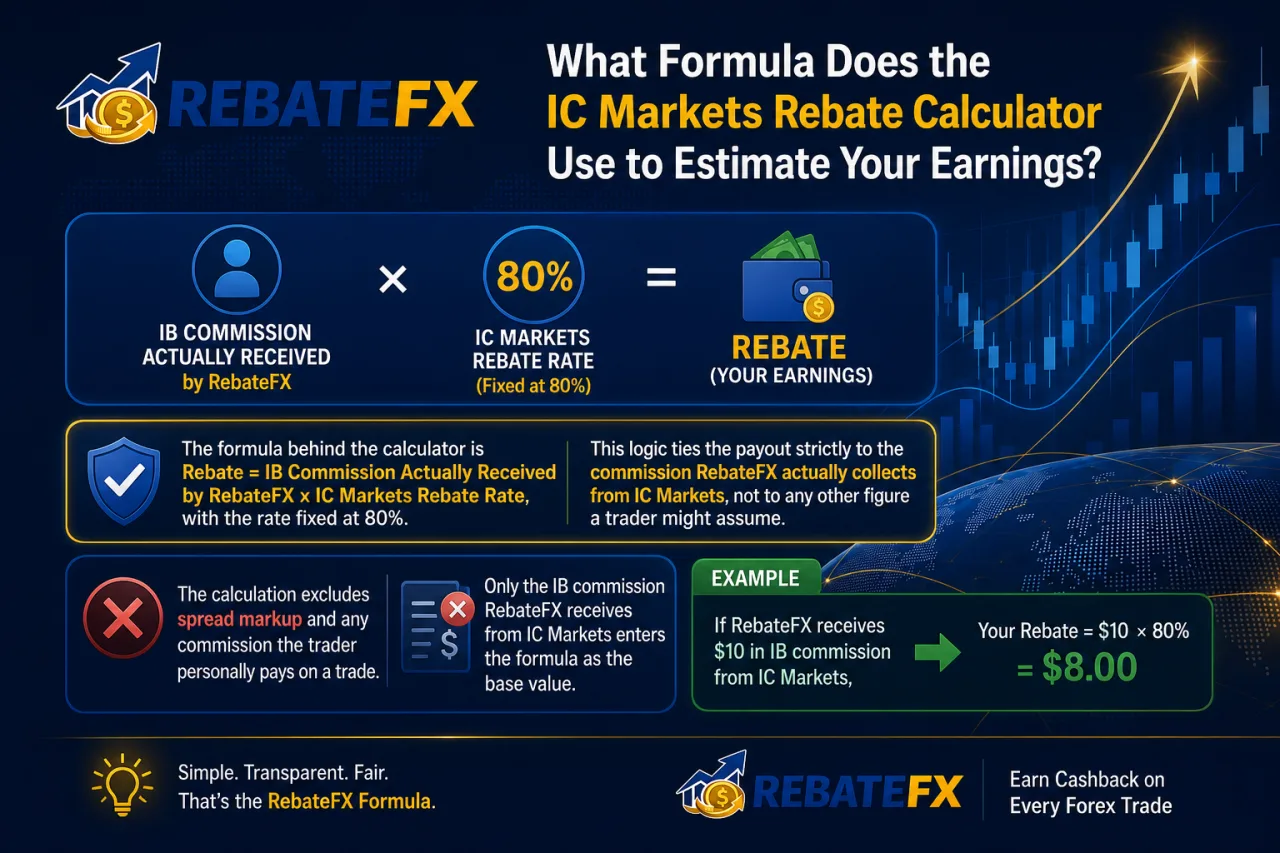
The formula behind the calculator is Rebate = IB Commission Actually Received by RebateFX x IC Markets Rebate Rate, with the rate fixed at 80%. This logic ties the payout strictly to the commission RebateFX actually collects from IC Markets, not to any other figure a trader might assume.
The calculation excludes spread markup and any commission the trader personally pays on a trade. Only the IB commission RebateFX receives from IC Markets enters the formula as the base value.
For example, if RebateFX earns 100 USD in IB commission from a trader’s volume, multiplying that by the 80% rebate rate yields 80 USD paid back to the trader. Doubling the commission to 200 USD produces 160 USD in cashback, since the rate stays constant at 80% regardless of volume. This fixed-rate structure keeps the formula predictable across account types and instruments, as long as the underlying IB commission figure stays accurate.
How Much Cashback Can You Earn Per Instrument, Lot, or Pip with IC Markets?
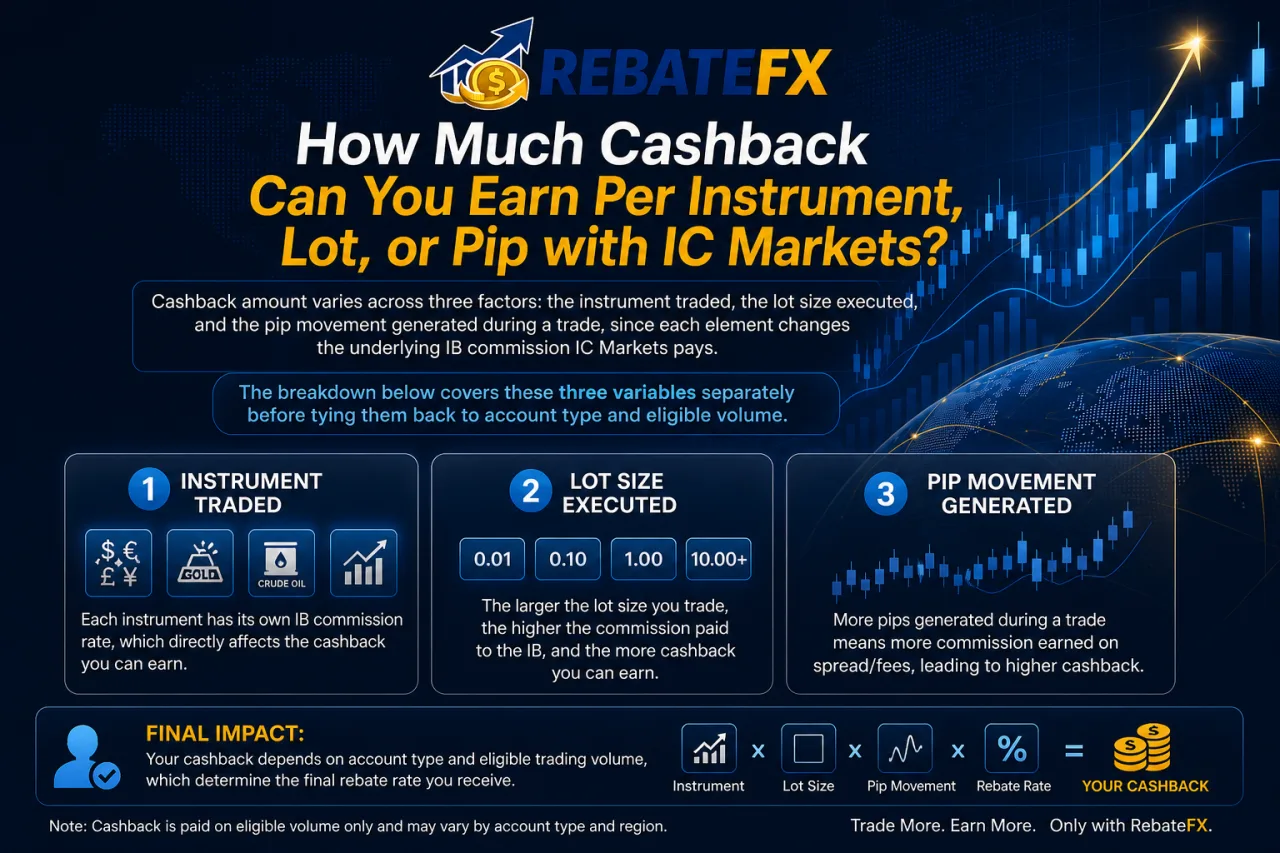
Cashback amount varies across three factors: the instrument traded, the lot size executed, and the pip movement generated during a trade, since each element changes the underlying IB commission IC Markets pays. The breakdown below covers these three variables separately before tying them back to account type and eligible volume.
How Does Trading Volume (Lots) Affect Your Rebate Amount?
Raising traded lot volume increases the IB commission IC Markets pays, which directly raises the rebate amount RebateFX passes back to the trader. This connects lot size to rebate payout, since every additional lot traded generates more commission for the same rate to act on.
The relationship stays linear because the rebate formula multiplies IB commission by a fixed 80% rate, not by a sliding scale tied to volume tiers.
- Trading 1 lot generates a base unit of IB commission, producing a small rebate.
- Trading 10 lots generates roughly ten times that commission, scaling the rebate proportionally.
- Trading across multiple sessions or instruments compounds total commission, raising cumulative rebate over a billing cycle.
Higher-frequency traders and larger-volume accounts see rebate totals grow faster in dollar terms, though the percentage rate itself never changes with volume. Account type and instrument still set the underlying commission rate per lot, so volume amplifies whatever base rate applies rather than replacing it.
Does the Instrument Traded (e.g., EUR/USD) Change the Rebate Rate?
No, the instrument traded does not change the rebate rate itself, since RebateFX applies a fixed 80% share to IC Markets IB commission regardless of the pair or product involved. What shifts per instrument is the cashback amount, not the percentage applied to it.
This distinction matters when comparing payouts across a trading portfolio. The 80% rate stays constant because it reflects RebateFX’s agreed share of IB commission with IC Markets, not a variable tied to specific products.
Actual cashback differs by instrument for a few reasons:
- Forex majors like EUR/USD generate a certain IB commission per lot, distinct from other product categories.
- Metals such as gold carry their own commission structure, producing a different cashback figure at the same lot size.
- Indices and other CFDs follow separate commission values, shifting the dollar payout even though the rebate percentage never moves.
Traders holding positions across multiple instrument types see varying cashback per lot, while the 80% rebate rate remains the fixed constant behind every calculation.
How Does the IC Markets Rebate Rate Compare to Other Rebate Providers?
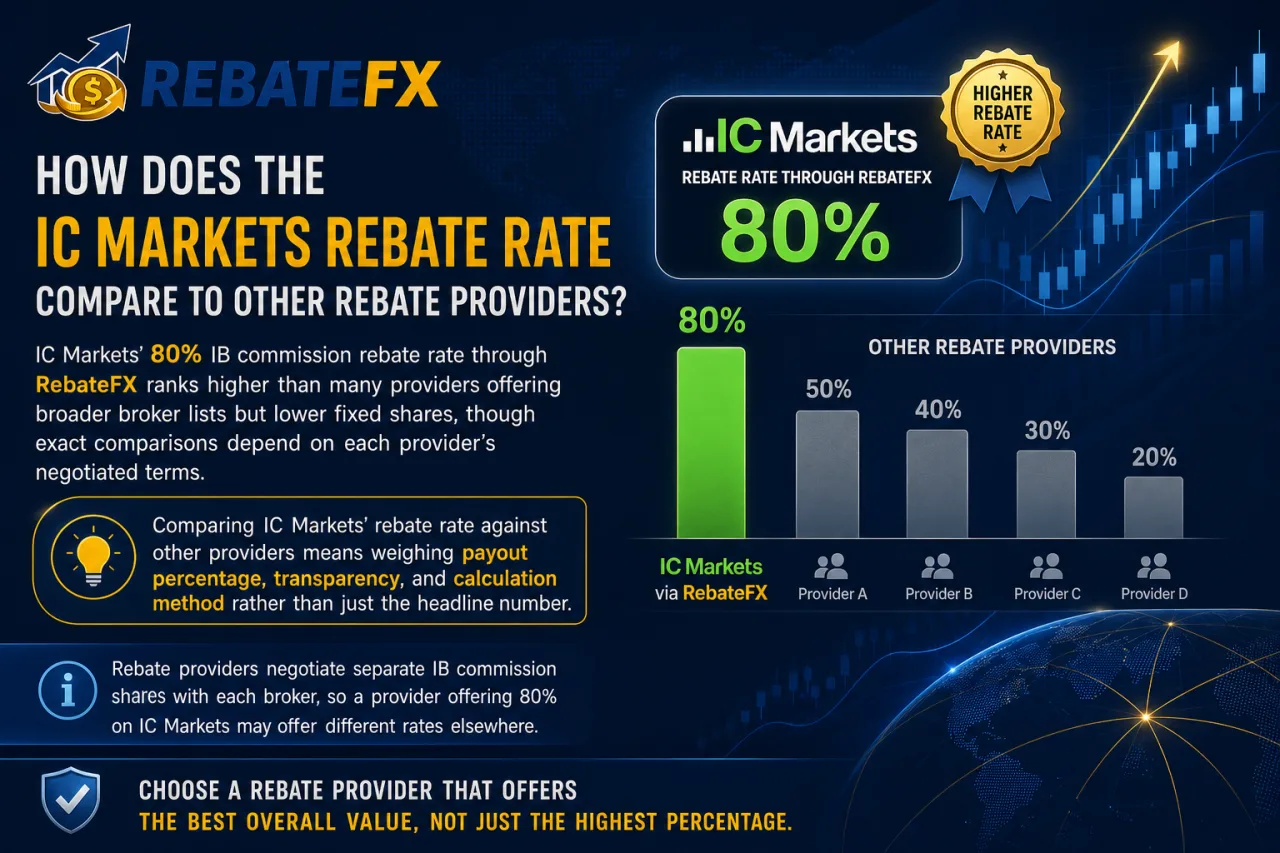
IC Markets’ 80% IB commission rebate rate through RebateFX ranks higher than many providers offering broader broker lists but lower fixed shares, though exact comparisons depend on each provider’s negotiated terms. Comparing IC Markets’ rebate rate against other providers means weighing payout percentage, transparency, and calculation method rather than just the headline number.
Rebate providers negotiate separate IB commission shares with each broker, so a provider offering 80% on IC Markets might offer a different percentage on another broker entirely. This variation makes side-by-side comparison necessary before choosing a program, since the same provider’s rate is not uniform across brokers.
RebateFX distinguishes itself through the IB Commission Rebate model, which bases every payout strictly on the commission actually received from IC Markets rather than an estimated or advertised spread figure. This transparency lets traders verify the calculation behind their cashback instead of relying on a fixed promotional claim.
Key comparison points include:
- Payout percentage, which varies by provider and by broker within the same provider’s offering.
- Calculation transparency, since some providers disclose the IB commission base while others do not.
- Payment consistency, reflecting whether the rebate share stays fixed across account types and instruments.
Traders evaluating options weigh these factors together rather than the rebate percentage alone.
How Do You Calculate Your Real Trading Costs After Applying the IC Markets Rebate?
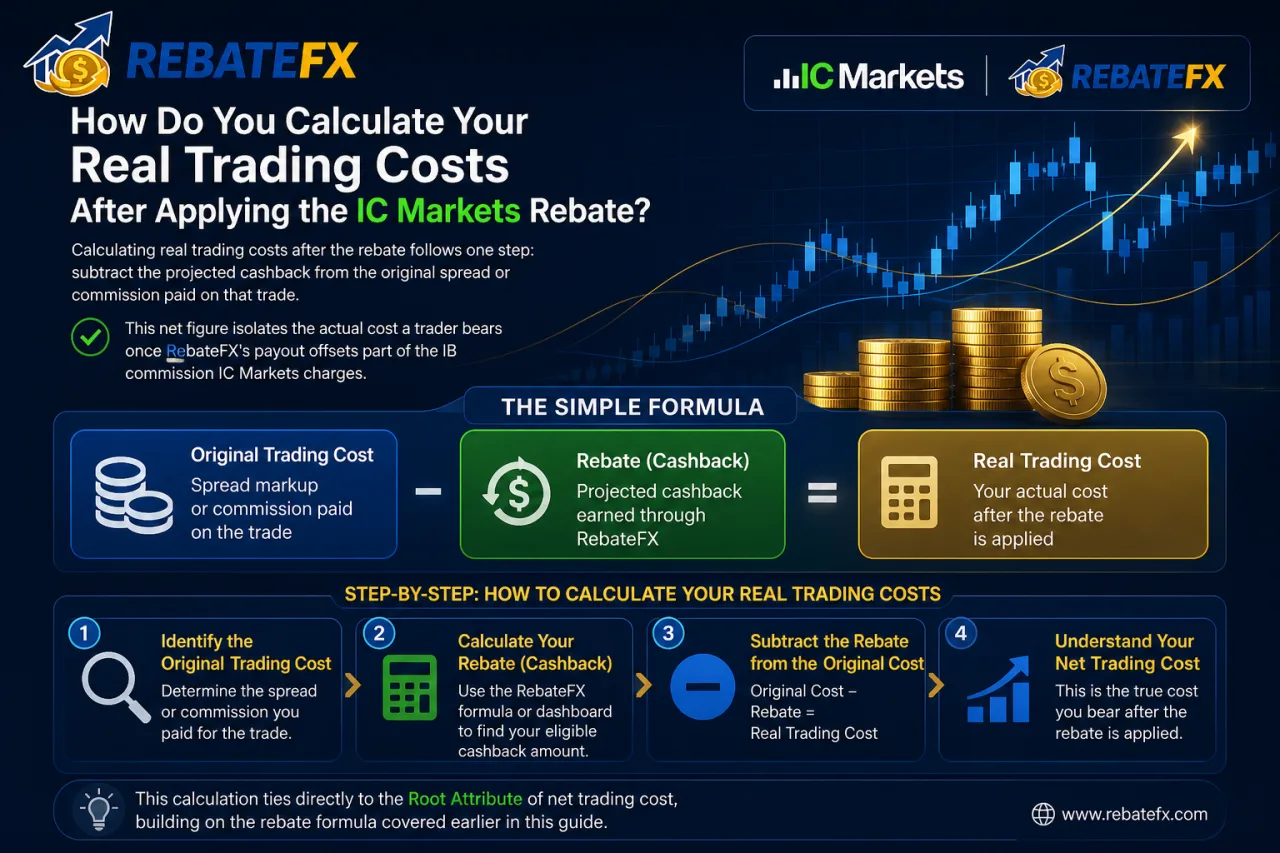
Calculating real trading costs after the rebate follows one step: subtract the projected cashback from the original spread or commission paid on that trade. This net figure isolates the actual cost a trader bears once RebateFX’s payout offsets part of the IB commission IC Markets charges.
The calculation ties directly to the Root Attribute of net trading cost, building on the rebate formula covered earlier in this guide.
- Identify the original trading cost, meaning the spread markup or commission charged on the executed lot volume.
- Pull the rebate amount already produced by the IB Commission Rebate model for that same volume.
- Subtract the rebate figure from the original cost to arrive at net trading cost.
- Compare net cost across account types, since Raw Spread and Standard accounts start from different base commission levels.
A trader paying a fixed commission per lot sees that figure drop once the 80% rebate share is applied, lowering the effective cost per trade. Repeating this subtraction across a full trading period totals cumulative savings, giving a clearer view of profitability than looking at gross commission alone.
What Factors Can Cause Your Actual IC Markets Rebate to Differ From the Calculator’s Estimate?
Actual rebate amounts diverge from the calculator’s estimate mainly when the underlying IB commission IC Markets pays differs from the figure entered, driven by account type, instrument, eligible transaction criteria, and volume thresholds. This variability ties directly to the Rebate Variability Factors behind every projection, since the calculator assumes a clean input that real trading conditions do not always match.
Several conditions push actual payouts away from the estimated figure:
- Account type shifts the base commission, as Standard and Raw Spread structures generate different IB commission per lot.
- Product traded changes the commission value, since forex, metals, and indices each carry distinct rates behind the same lot size.
- Transaction eligibility excludes certain trades, such as those falling outside qualifying volume or account rules IC Markets sets.
- Volume thresholds alter cumulative commission, as reaching or missing a tier changes total IB commission generated over a period.
Every factor above ultimately traces back to one constant: rebates reflect the IB commission RebateFX actually receives from IC Markets, not the spread or commission percentage a trader personally pays on a trade.
Does Your IC Markets Account Type Affect the Rebate Calculation?
Yes, IC Markets account type affects the rebate calculation, since Standard and Raw Spread accounts generate different IB commission levels that feed into the calculator’s estimate. This links directly to the Account Type Impact behind every projection, since the rebate output only reflects the commission figure tied to the selected account.
Three reasons explain why account type shifts the outcome:
- Commission structure differs between Standard and Raw Spread, changing the base IB commission per lot.
- Rebate calculations pull from that base commission, so a different account type produces a different projected payout.
- Estimate accuracy depends on selecting the correct account type before entering volume, since a mismatch skews the output.
Selecting the wrong account type in the calculator produces a figure that does not match actual cashback, since RebateFX applies its 80% share to the real IB commission IC Markets pays, not to an assumed base rate.
Conclusion
In conclusion, an IC Markets rebate calculator helps traders estimate cashback by applying the 80% rebate rate to the IB commission RebateFX actually receives from eligible trading activity. The projected amount varies according to account type, traded instrument, lot volume, and transaction eligibility, while the effective trading cost is calculated by subtracting cashback from the original spread or commission. For a more accurate estimate, traders should select the correct account type and instrument, compare provider terms, and verify the calculator’s result against the cashback actually credited.

Soren Carrick is a Broker Rebate Program Specialist at RebateFX.org, specializing in Forex rebate programs, Introducing Broker (IB) operations, broker cashback systems, and trading cost analysis. He manages English-language content for IC Markets Rebate, Tickmill Rebate, and XTB Rebate, focusing on account registration, IB transfers, rebate calculations, cashback tracking, and payment verification to help traders understand rebate conditions and manage trading expenses more effectively.