

 Tiếng Việt
An HFM rebate calculator estimates cashback earnings by multiplying trading volume with the applicable rebate rate before or during live trading. Traders enter lot size and account type to preview potential rebate value without waiting for manual statements.
HFM rebate rates and cashback percentages are generally calculated as a share of the IB commission actually received from the broker, rather than as a fixed spread discount. The final payout depends on account type, instrument traded, and total qualifying volume.
Comparing HFM rebate providers requires checking rebate rate, payout method, and payment frequency side by side. These factors determine how much cashback a trader actually receives and how quickly funds arrive.
Monthly rebate savings are typically tracked by recording total trading volume and applying the confirmed rebate rate for that period. This calculation reveals actual cashback accumulated from HFM trading activity over time.
The section below explains what an HFM rebate calculator is and how Rebate FX structures this tool to support accurate cashback estimation for traders.
Contents:
What Is an HFM Rebate Calculator?
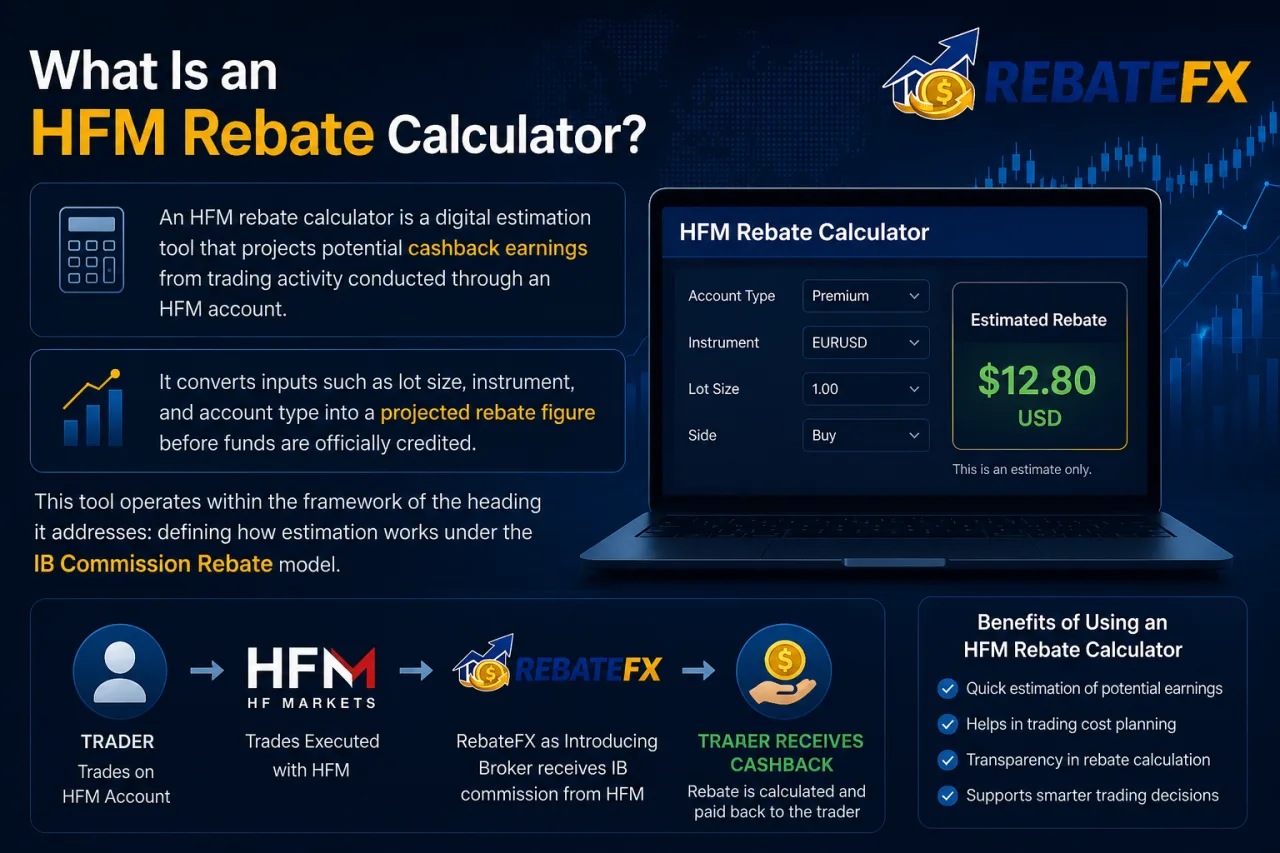
An HFM rebate calculator is a digital estimation tool that projects potential cashback earnings from trading activity conducted through an HFM account. It converts inputs such as lot size, instrument, and account type into a projected rebate figure before funds are officially credited.
This tool operates within the framework of the heading it addresses: defining how estimation works under the IB Commission Rebate model. RebateFX functions as an Introducing Broker for HFM and receives a commission from the broker based on client trading volume. The calculator then applies the confirmed rebate share, the portion of that IB commission RebateFX allocates back to the trader, to produce an estimated cashback value.
The output serves as a projection rather than a guaranteed final amount, since actual payouts depend on trade execution, volume confirmation, and account classification. Traders use this estimate to gauge expected returns before committing to a trading volume or strategy, making the calculator a planning reference rather than a settlement record.
How to Use the HFM Rebate Calculator to Estimate Cashback Earnings?
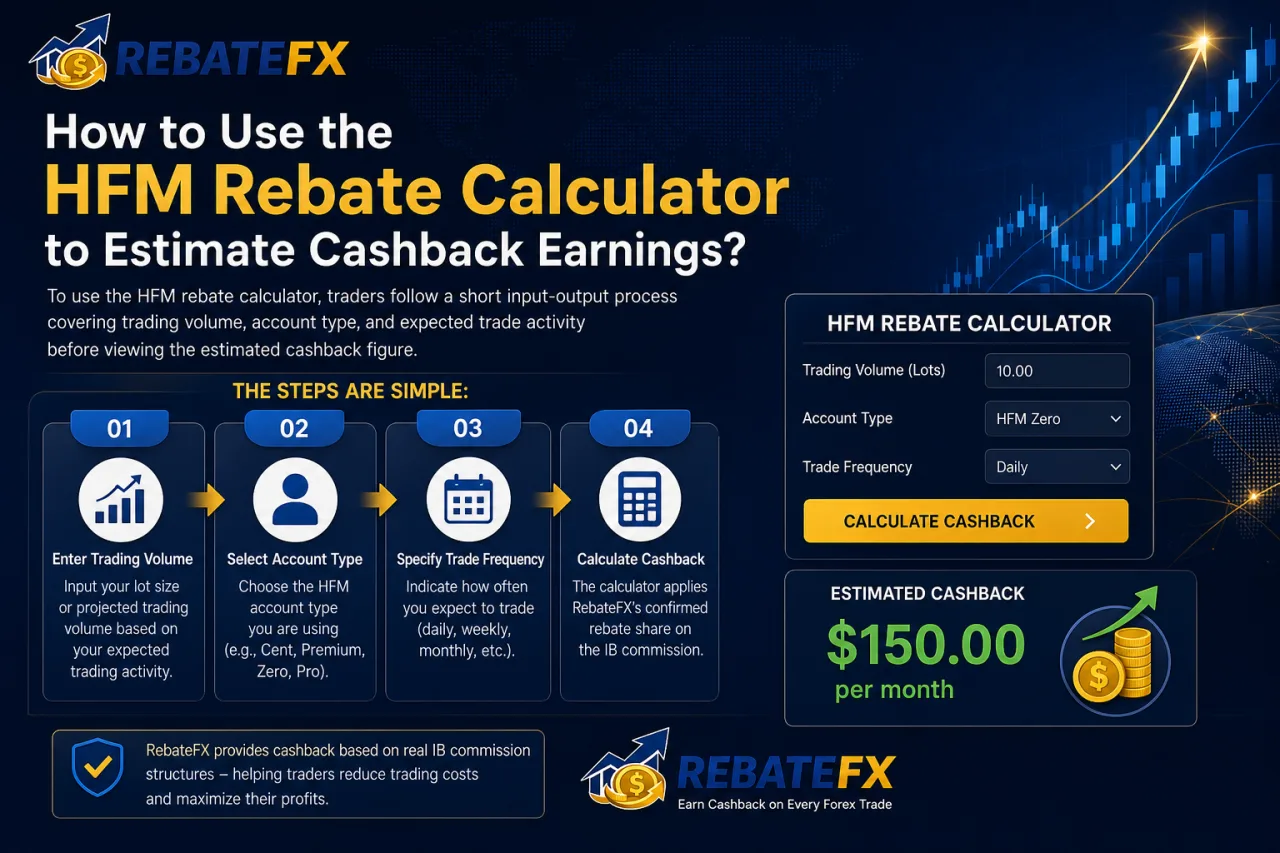
To use the HFM rebate calculator, traders follow a short input-output process covering trading volume, account type, and expected trade activity before viewing the estimated cashback figure. This process breaks down into a few distinct stages, each covered separately below.
The steps involve entering lot size or projected trading volume, selecting the HFM account type in use, and specifying anticipated trade frequency. The calculator then applies RebateFX’s confirmed rebate share on the IB commission received from HFM to generate a projected cashback value. The sections that follow detail each input field and explain how the output figure is derived.
What Inputs Are Needed Before Calculating Your HFM Rebate?
Four input fields feed the HFM rebate calculator: trading volume in lots, instrument type, account type, and expected number of trades per month. Each field shapes the accuracy of the projected cashback figure before any trade executes.
Gathering these details in advance keeps the estimation process consistent with actual trading behavior. The required inputs include:
- Trading volume, expressed in lots traded within a given period
- Instrument type, since forex pairs, metals, indices, or commodities may carry different rebate weightings
- Account type, as HFM offers multiple account classifications with distinct commission structures
- Expected number of trades per month, used to project recurring rebate accumulation rather than a single transaction value
Entering accurate figures for each field allows the calculator to apply RebateFX’s confirmed rebate share against the IB commission tied to that trading profile. Missing or estimated inputs produce a wider margin of error in the projected cashback output, so traders reviewing real account statements typically achieve closer alignment between the calculator’s estimate and the final credited amount.
How to Read the Calculator’s Estimated Cashback Result?
To read the calculator’s estimated cashback result, traders treat the figure as a projected rebate range rather than a confirmed payout amount. This output reflects the rebate model covered earlier: an estimate derived from inputs, not a final settlement record.
The displayed number represents RebateFX’s confirmed rebate share applied against a projected IB commission, so it moves in the same direction as trading volume and account type but does not lock in until trades close and volume is verified.
Reading the result correctly involves a few checks:
- Comparing the estimate against the account type selected, since different HFM classifications carry different commission structures
- Treating the figure as a range rather than a fixed number, since instrument type and execution conditions shift the final commission
- Cross-checking the projected value against actual trading statements once positions close
- Recognizing that the calculator output updates each time an input field changes, reflecting a new projection rather than a running total
Traders reviewing this figure alongside closed trade history typically see closer alignment between the projected number and the confirmed rebate credited to their account.
How Are HFM Rebate Rates and Cashback Percentages Calculated?
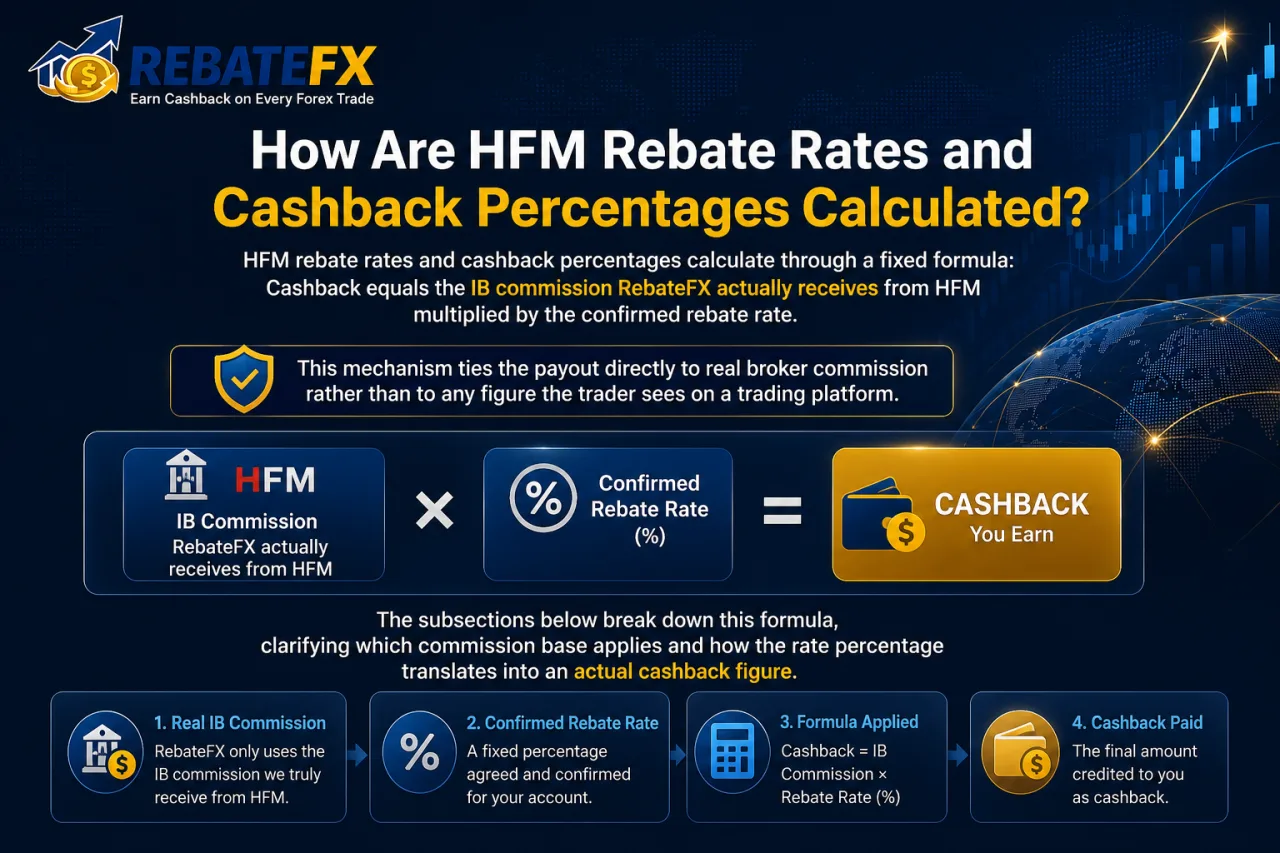
HFM rebate rates and cashback percentages calculate through a fixed formula: Cashback equals the IB commission RebateFX actually receives from HFM multiplied by the confirmed rebate rate. This mechanism ties the payout directly to real broker commission rather than to any figure the trader sees on a trading platform.
The subsections below break down this formula, clarifying which commission base applies and how the rate percentage translates into an actual cashback figure.
What Is the HFM Rebate Formula With an Example?
The HFM rebate formula states that cashback equals the IB commission RebateFX actually receives from HFM multiplied by the confirmed rebate rate applied to the trader’s account. This ties directly to the mechanism outlined above: a percentage share of real broker commission, not a spread markup or platform-displayed figure.
A worked example clarifies how the formula moves from commission to payout. If RebateFX receives 100 USD in IB commission from HFM on a given trading volume, and the confirmed rebate rate for that account stands at 80%, the trader receives 80 USD in cashback.
This example illustrates the direct proportionality built into the formula:
- Commission received sets the base figure before any rebate share applies
- Rebate rate determines what portion of that base commission transfers to the trader
- Final cashback rises or falls in step with either variable, since the formula multiplies rather than adds
Traders scaling volume up or down see the cashback figure shift accordingly, since the formula recalculates against the actual commission RebateFX receives for that specific volume rather than against a fixed rebate value.
Do Account Type, Product and Trading Volume Affect the Rebate Amount?
Yes, account type, product traded, and trading volume all affect the rebate amount, since each variable changes the IB commission RebateFX receives from HFM before the confirmed rebate rate applies. This follows directly from the formula covered above: cashback moves with the commission base, and that base shifts across three variables.
Account type shapes the outcome first, since HFM account classifications carry distinct commission structures tied to spread or fixed-fee models. Product traded factors in next, as forex pairs, metals, indices, and commodities typically generate different commission weightings per lot. Trading volume and eligible trade count complete the picture, since higher confirmed volume raises the commission base RebateFX receives, which then scales the final cashback figure. HFM rebate rates and payout conditions vary by account type, product, and volume, so any stated percentage reflects general terms rather than a fixed universal figure.
Traders comparing estimates against actual statements typically find variance traced back to one of these three factors rather than to the rebate formula itself.
How Does HFM Compare to Other Rebate Providers in Rate, Payout Method and Frequency?
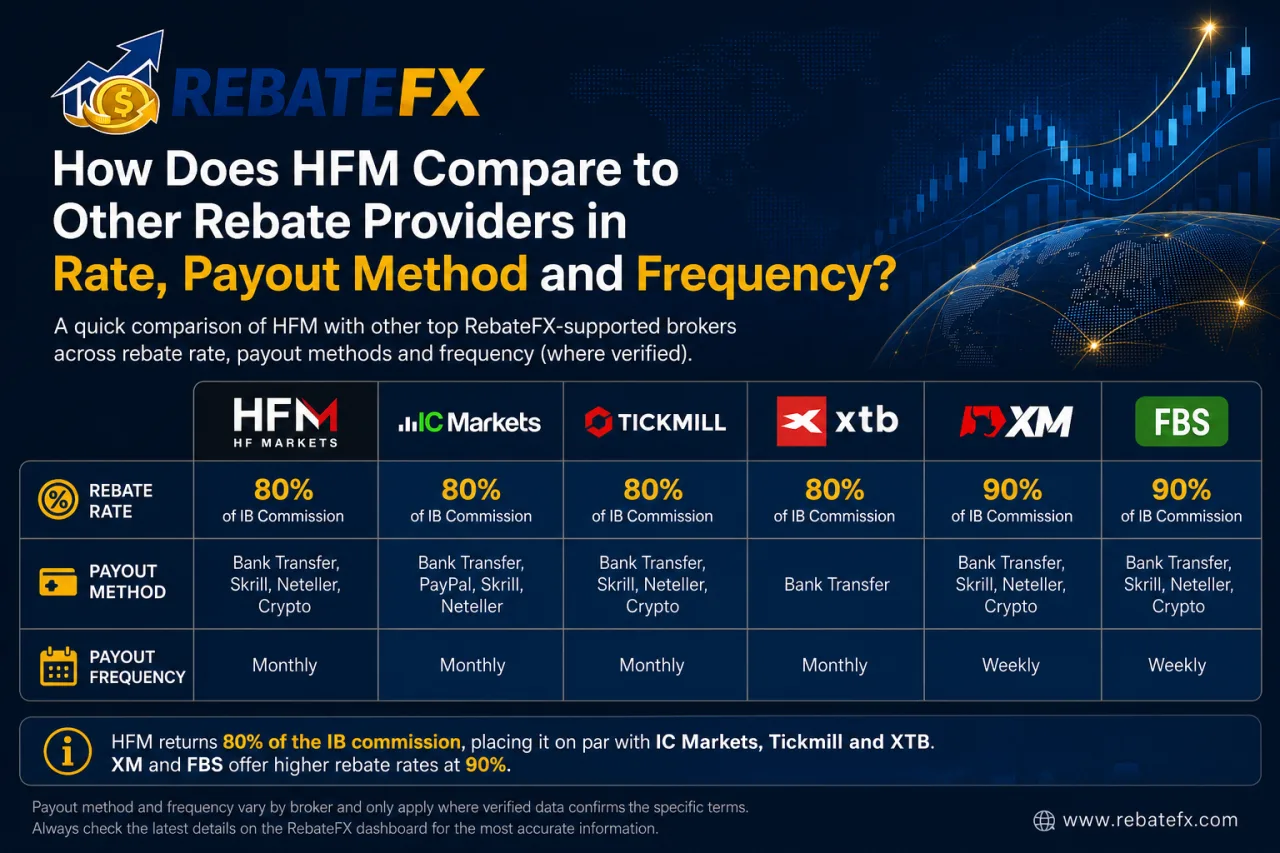
HFM stands roughly equal to IC Markets, Tickmill, and XTB on rebate rate, while XM and FBS post the higher share among RebateFX-supported brokers. Payout method and frequency vary by broker and only apply where verified data confirms the specific terms.
The comparison below breaks this down across rate first, then payout structure where confirmed. Each factor shapes how much cashback a trader actually collects and how the rebate model applies across brokers.
- HFM returns 80% of the IB commission RebateFX receives from the broker
- IC Markets matches this same 80% rebate share
- Tickmill and XTB both apply an 80% rebate rate as well
- XM raises the share up to 90% of the IB commission received
- FBS also extends up to 90% under the same commission-based model
Payout method and payment frequency vary by broker and rebate provider, so traders should confirm the specific schedule and transfer method that applies to their account before relying on it.
Traders weighing these brokers against HFM find the rate comparison consistent, since all six operate on the same IB commission rebate structure rather than a spread-discount model.
How Does HFM’s Rebate Rate Compare to XM and FBS?
HFM’s 80% rebate rate trails XM and FBS, both of which extend up to 90% of the IB commission RebateFX receives, while HFM matches the mid-tier group of IC Markets, Tickmill, and XTB. This gap traces back to the same commission-based mechanism covered earlier: the confirmed rebate rate multiplies against the IB commission RebateFX actually receives from each broker.
The comparison narrows to rate alone here, since payout method and frequency depend on separate broker-specific terms already addressed above.
- HFM applies an 80% rebate rate against the IB commission received
- XM extends the rate up to 90% under the same commission-based model
- FBS also reaches up to 90%, placing it alongside XM at the top of the range
Traders running identical volume across these brokers see a proportionally lower cashback figure from HFM, since the multiplier itself sits 10 percentage points below the higher-rate group, all else held equal.
How Does HFM’s Rebate Rate Compare to IC Markets, Tickmill and XTB?
HFM’s 80% rebate rate matches IC Markets, Tickmill, and XTB exactly, since all four brokers apply the same rebate share against the IB commission RebateFX receives. This comparison isolates rate alone, since the prior section already placed HFM against the higher-rate group of XM and FBS.
No hierarchy separates HFM from this equal-rate group, as the four brokers share one commission-based multiplier:
- HFM applies an 80% rebate rate against the IB commission received
- IC Markets applies the same 80% rate under an identical commission model
- Tickmill matches this 80% share as well
- XTB rounds out the group at the same 80% rate
Traders running identical volume across HFM, IC Markets, Tickmill, or XTB see equivalent cashback figures, since the multiplier itself stays fixed across the four. Any variance a trader observes traces back to commission structure differences per account type or instrument rather than to a gap in the rebate rate itself, a distinction already covered under the formula section above.
How to Track and Calculate Actual Monthly Rebate Savings From Trading Volume With HFM?
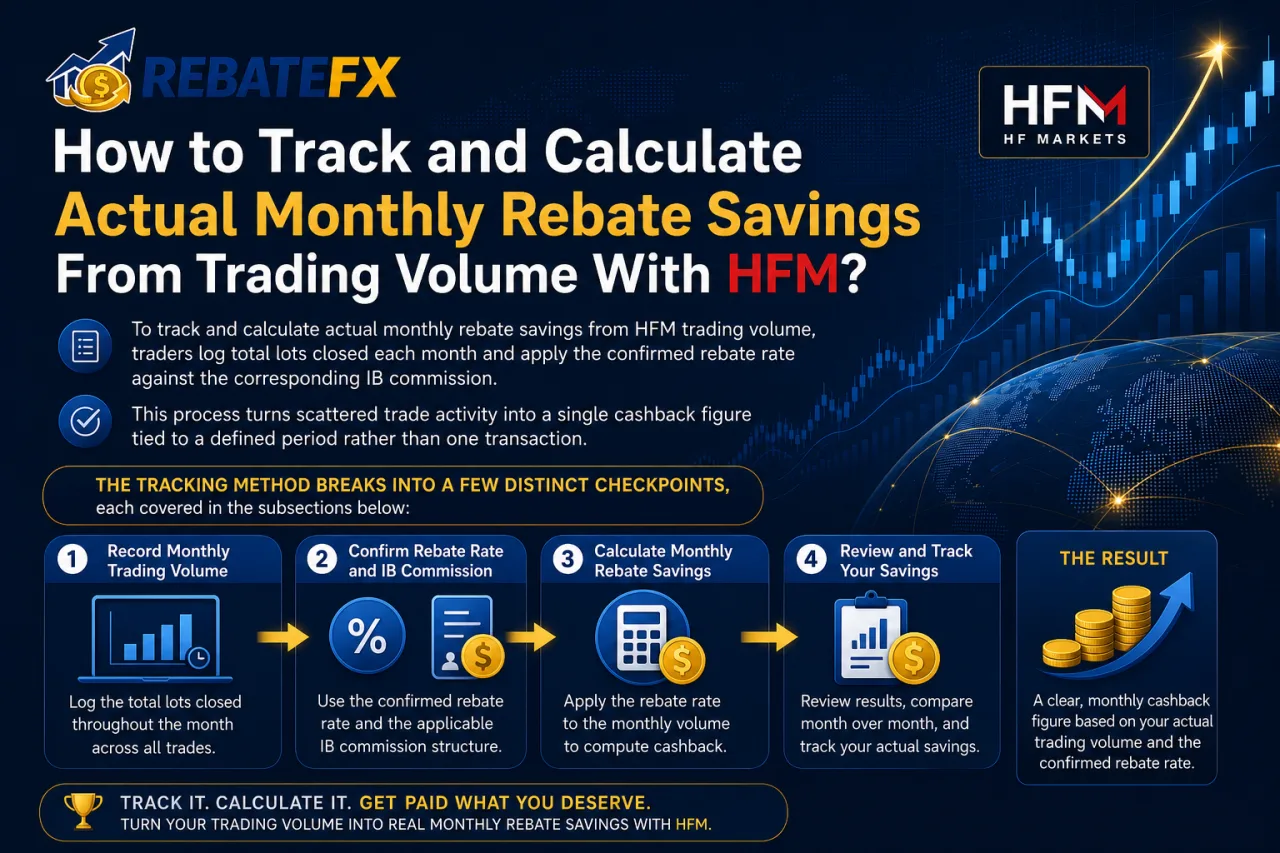
To track and calculate actual monthly rebate savings from HFM trading volume, traders log total lots closed each month and apply the confirmed rebate rate against the corresponding IB commission. This process turns scattered trade activity into a single cashback figure tied to a defined period rather than one transaction.
The tracking method breaks into a few distinct checkpoints, each covered in the subsections below: recording volume as it accumulates, and converting that volume into a monthly savings estimate.
Two clarifying points frame this process. First, the monthly figure reflects eligible trades only, since positions falling outside HFM’s qualifying criteria do not generate IB commission and therefore contribute nothing to the rebate base. Second, the calculator output at any point in the month remains an estimate, since final confirmation depends on RebateFX’s actual commission receipt from HFM once the reporting period closes.
What Factors Determine Your Real Monthly Cashback vs. the Calculator Estimate?
Real monthly cashback diverges from the calculator estimate mainly through eligible trade conditions, since only trades meeting HFM’s qualifying criteria generate the IB commission RebateFX shares back. The gap traces to three factors sitting on top of the formula covered earlier, each pulling the confirmed figure away from the projection.
This gap connects directly to the tracking process above: a projection built on planned volume rarely matches a settlement built on closed, qualifying trades. Three factors typically drive the difference:
- Eligible trade conditions exclude positions that fall outside HFM’s qualifying criteria, removing them from the commission base entirely
- Volume changes between the projection date and month-end shift the total lots closed, moving the commission figure up or down from the initial estimate
- Account type differences alter the underlying commission structure, since each HFM classification carries distinct spread or fixed-fee terms
Traders comparing the two figures side by side typically trace any variance back to one of these three points rather than to an error in the rebate formula itself. Confirming closed volume and account classification against the final statement narrows this gap before the next projection cycle.
What Rare Calculator Features Help Refine HFM Cashback Estimates for Specific Account Types?
Rare calculator refinement features include per-instrument commission breakdown, account-type-specific presets, and tiered volume scaling, each narrowing the estimate beyond a flat volume calculation. These inputs sit outside the basic lot-and-account fields covered earlier and target the specific factors that shift HFM’s IB commission base. The subsections below detail how each feature adjusts the projected cashback figure for a given account classification.
Can the Calculator Estimate Cashback Differently for Multiple HFM Account Types?
Yes, the calculator estimates cashback differently across multiple HFM account types, since each classification carries a distinct commission structure that changes the base figure before the rebate rate applies. This picks up the account-type variable already noted under the rebate formula section, narrowing it to how the estimation tool itself handles that difference.
Three points explain why identical volume still produces different projected numbers:
- Spread-based accounts generate a different commission base than fixed-fee accounts, shifting the input the calculator multiplies against
- Instrument availability varies by account type, so the same lot count on two account classifications may draw from different commission weightings
- Preset account selection inside the calculator locks in the correct commission structure automatically, preventing a trader from applying one account’s terms to another’s volume
A trader entering identical lots under two different HFM account types therefore sees two separate projected cashback figures, not because the rebate rate itself changes, but because the underlying commission base does.
Conclusion
In conclusion, an HFM rebate calculator helps traders estimate potential cashback by applying the confirmed rebate rate to the IB commission generated from their projected trading activity. The final amount depends on account type, instrument, eligible volume, and completed trades, so the calculator’s result should be treated as an estimate rather than a guaranteed payout. Traders should enter accurate data, compare the projection with their monthly trading statements, and confirm current rebate and payment conditions through RebateFX.

Liam Dravon is a Forex Market Analyst at RebateFX.org, specializing in Forex rebate programs, Introducing Broker (IB) structures, broker analysis, and trading cost optimization. He manages English-language content for XM Rebate, FBS Rebate, and HFM Rebate, focusing on account registration, IB transfers, cashback calculations, and rebate verification to help international traders understand rebate conditions and manage trading expenses more effectively.