

 Tiếng Việt
Checking your HFM rebate amount requires logging into your rebate provider’s dashboard or client portal, where credited cashback is displayed per trade or per lot. HFM itself does not display rebate figures directly on the MT4/MT5 trading account, since the rebate comes from the IB commission shared by the provider, not from HFM’s own system.
HFM rebate rates vary widely across providers, ranging from a fixed amount per lot to a percentage share of IB revenue, depending on the account type and the IB program terms. Comparing these structures side by side reveals significant differences in actual payout value depending on trading volume and account type.
HFM rebate is calculated based on the trading volume or IB commission generated from closed trades, with the exact calculation method and payout frequency varying by account type and rebate provider. Account type, whether Cent, Zero, or Pro, directly affects the commission base and therefore the final rebate amount.
Finding a trusted HFM rebate provider means verifying transparent payout history, clear calculation methods, and a functioning IB program registered directly with HFM. The general process for tracking an HFM rebate typically starts with checking the rebate provider’s dashboard, followed by matching the credited amount against actual trading volume. This process reflects common practice among rebate providers rather than a standard tied to any single brand.
Contents:
How to Check Your HFM Rebate Amount?
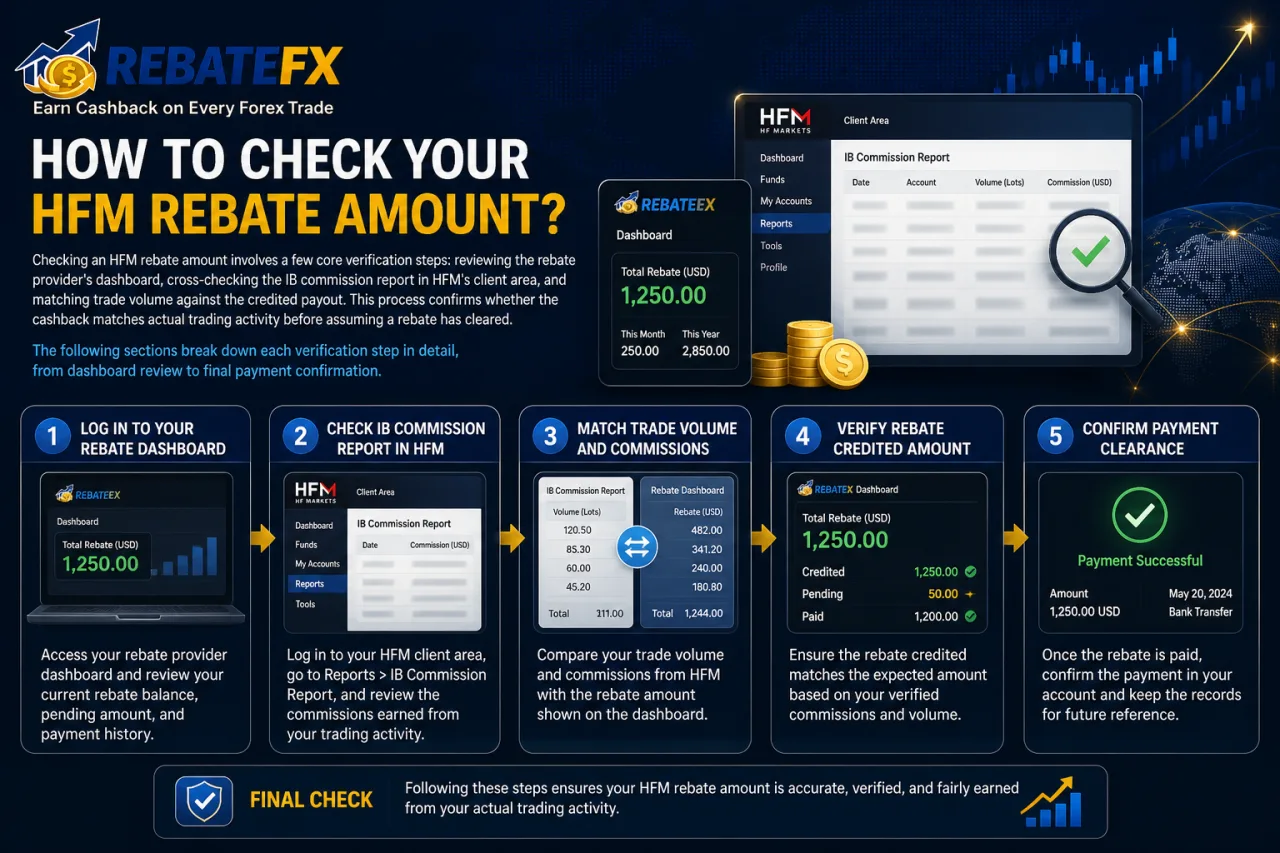
Checking an HFM rebate amount involves a few core verification steps: reviewing the rebate provider’s dashboard, cross-checking the IB commission report, and matching trade volume against the credited payout. These steps confirm whether the cashback matches actual trading activity, using data from HFM’s client area before assuming a rebate has cleared. The following sections break down each verification step in detail, from dashboard review to final payment confirmation.
Where Can You View Your HFM Rebate History?
HFM rebate history appears inside the rebate provider’s member area or dashboard, where a statement lists credited cashback by day, by month, or by individual trade. This location differs from HFM’s own client portal, since the rebate record originates from the provider’s IB tracking system rather than HFM’s back office.
Inside that dashboard, the statement typically breaks down by trade ticket, showing lot size, instrument, and the rebate amount tied to each closed position. Most providers also offer a downloadable report, often in PDF or spreadsheet format, letting traders archive the data or cross-check it against their MT4/MT5 trade history. A monthly summary view usually aggregates total volume and total rebate paid, which simplifies comparison across periods without opening every trade-by-trade line item.
What Information Should You Verify in Each Rebate Report?
Each HFM rebate report requires verifying seven core fields: account number, trading volume in lots, instrument traded, IB commission received, rebate rate applied, rebate amount credited, and date of payment. Cross-checking these fields against the trading terminal confirms the report matches actual account activity rather than an estimated figure.
- Account number: matches the exact MT4/MT5 login linked to the rebate provider’s IB registration.
- Trading volume (lots): reflects closed positions only, since open trades typically do not generate rebate credit yet.
- Instrument: identifies which currency pair, metal, or CFD product produced the commission.
- IB commission received: shows the raw amount the provider earned from HFM before splitting.
- Rebate rate applied: confirms the percentage or fixed-per-lot value used for that account type.
- Rebate amount credited: the final cashback figure deposited to the trader.
- Date of payment: verifies the payout cycle, whether daily, weekly, or monthly.
Missing or mismatched entries in any of these fields signal a reporting error worth raising with the provider before assuming the rebate calculation itself is incorrect.
Is Your HFM Rebate Being Calculated Correctly?
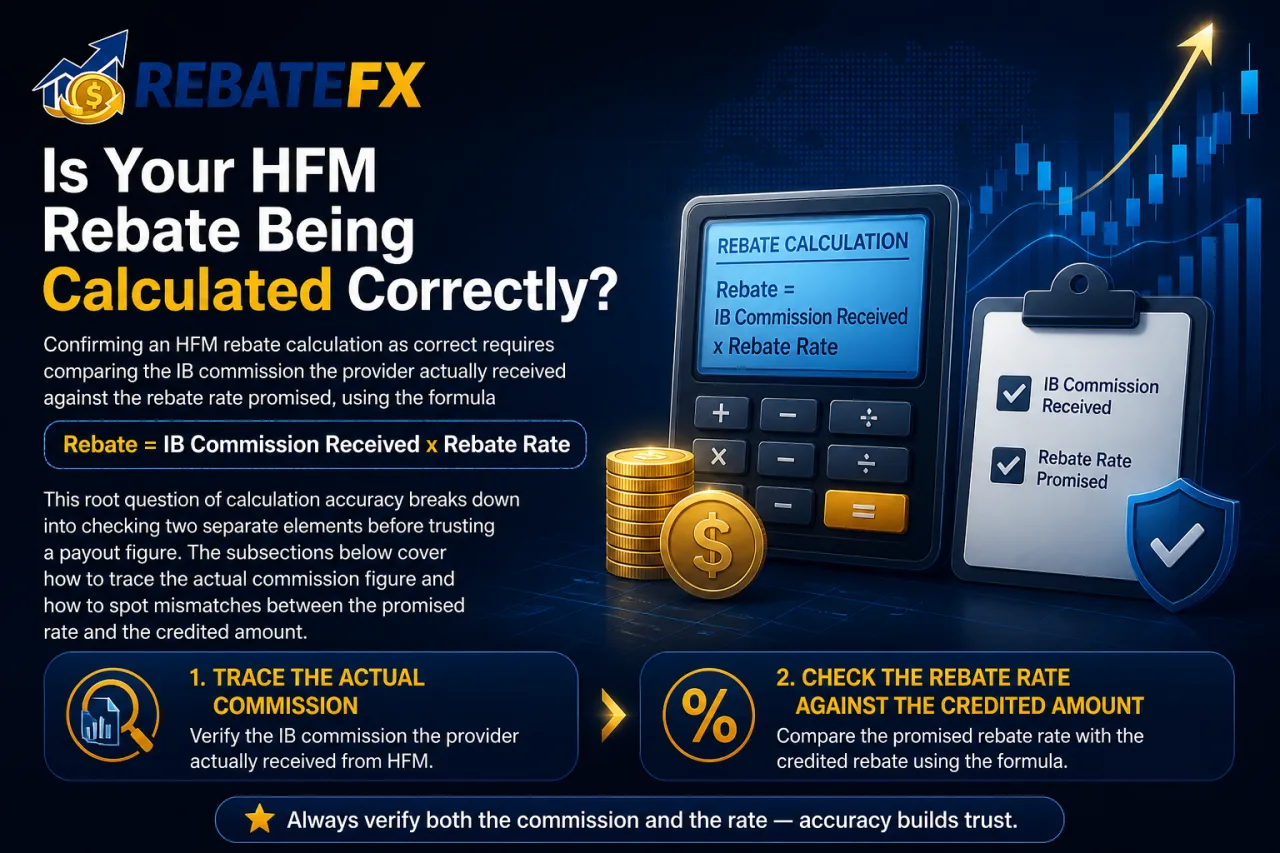
Confirming an HFM rebate calculation as correct requires the formula Rebate = IB Commission Received x Rebate Rate. This means comparing the IB commission the provider actually received against the rebate rate promised. This root question of calculation accuracy breaks down into checking two separate elements before trusting a payout figure. The subsections below cover how to trace the actual commission figure and how to spot mismatches between the promised rate and the credited amount.
Rebate figures never derive from the spread or commission a trader pays directly, since that portion belongs to HFM’s own revenue split with the broker. Only the IB commission the rebate provider receives from HFM feeds into the calculation, making the provider’s commission report the single reliable reference point for verification.
How Is the HFM Rebate Formula Applied?
The HFM rebate formula applies by multiplying the IB commission the provider actually receives by the fixed rebate rate assigned to the account type. This calculation mirrors the same structure raised in the previous section, applied here directly through a numeric example.
For instance, if the rebate provider receives 100 USD in IB commission from a closed trade and the rebate rate stands at 80%, the trader receives 80 USD in cashback. That 80 USD figure never shifts based on the spread the trader paid, only on the commission the provider collected from HFM.
The final output still depends on three variables beyond the base formula:
- Account type: Cent, Zero, or Pro accounts carry different commission structures per lot.
- Product traded: forex pairs, metals, and indices generate different IB commission rates.
- Volume traded: higher lot sizes scale the IB commission received, which scales the rebate proportionally.
Two identical trade sizes on different account types or instruments therefore produce different rebate outputs, even under the same 80% rate.
HFM Rebate vs Other Rebate Providers: Which Rate Is Better?
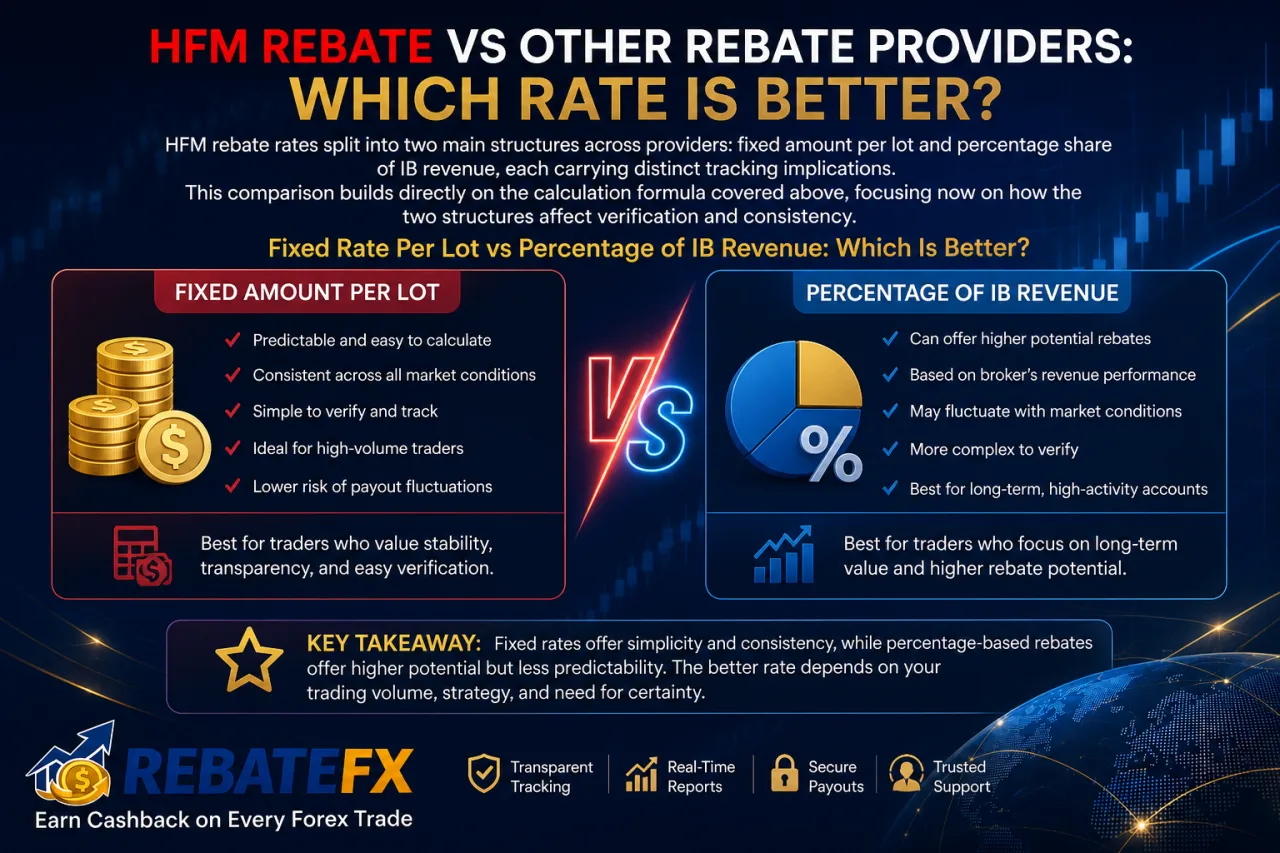
HFM rebate rates split into two main structures across providers: fixed amount per lot and percentage share of IB revenue, each carrying distinct tracking implications. This comparison builds directly on the calculation formula covered above, focusing now on how the two structures affect verification and consistency. The following breakdown covers what separates a fixed-rate model from a percentage-based model when checking payout accuracy, including which structure suits verification better between a fixed rate per lot and a percentage of IB revenue.
A fixed rate per lot pays a set cashback amount for every lot traded regardless of instrument, while a percentage-of-IB-revenue model, such as an 80% rebate rate, scales with the actual commission the provider receives from HFM. Rebate FX applies the percentage model for HFM at 80% of IB commission, tying the payout directly to real broker revenue rather than a flat estimate.
Fixed-rate-per-lot structures simplify tracking since the trader multiplies lot count by a known figure without needing the underlying commission report. This structure loses accuracy when instruments carry different commission bases, since one flat number cannot reflect varying IB revenue across products.
Percentage-of-IB-revenue structures require checking the actual commission report from the provider, adding one extra verification step. This structure stays proportional to what HFM actually pays the provider, making the 80% rate a consistent multiplier regardless of which instrument generated the trade.
What Are the Common HFM Rebate Rate Structures?
HFM rebate rate structures group into two main categories: fixed cashback per lot and percentage-based rebate calculated on IB commission received. This grouping mirrors the fixed-rate versus percentage comparison raised earlier, sorted here by how each model treats the underlying commission figure rather than by payout frequency.
The two models differ in how the payout is calculated:
- Fixed cashback per lot: pays a set dollar amount for every lot closed, independent of the instrument’s actual commission value.
- Percentage-based rebate: multiplies the IB commission the provider receives by a set rate, tying the payout directly to what HFM actually pays out per trade.
Rebate FX applies the percentage-based model for HFM, crediting 80% of the IB commission received on every closed trade. This structure keeps the rebate proportional across account types and products, since the payout scales with real commission rather than a flat per-lot estimate.
Traders comparing these two structures typically weigh simplicity against accuracy. Fixed-per-lot models require no commission report to verify. Percentage-based models like the 80% HFM rate demand checking the actual IB commission figure for full confirmation.
How Is HFM Rebate Calculated and Paid Across Account Types?
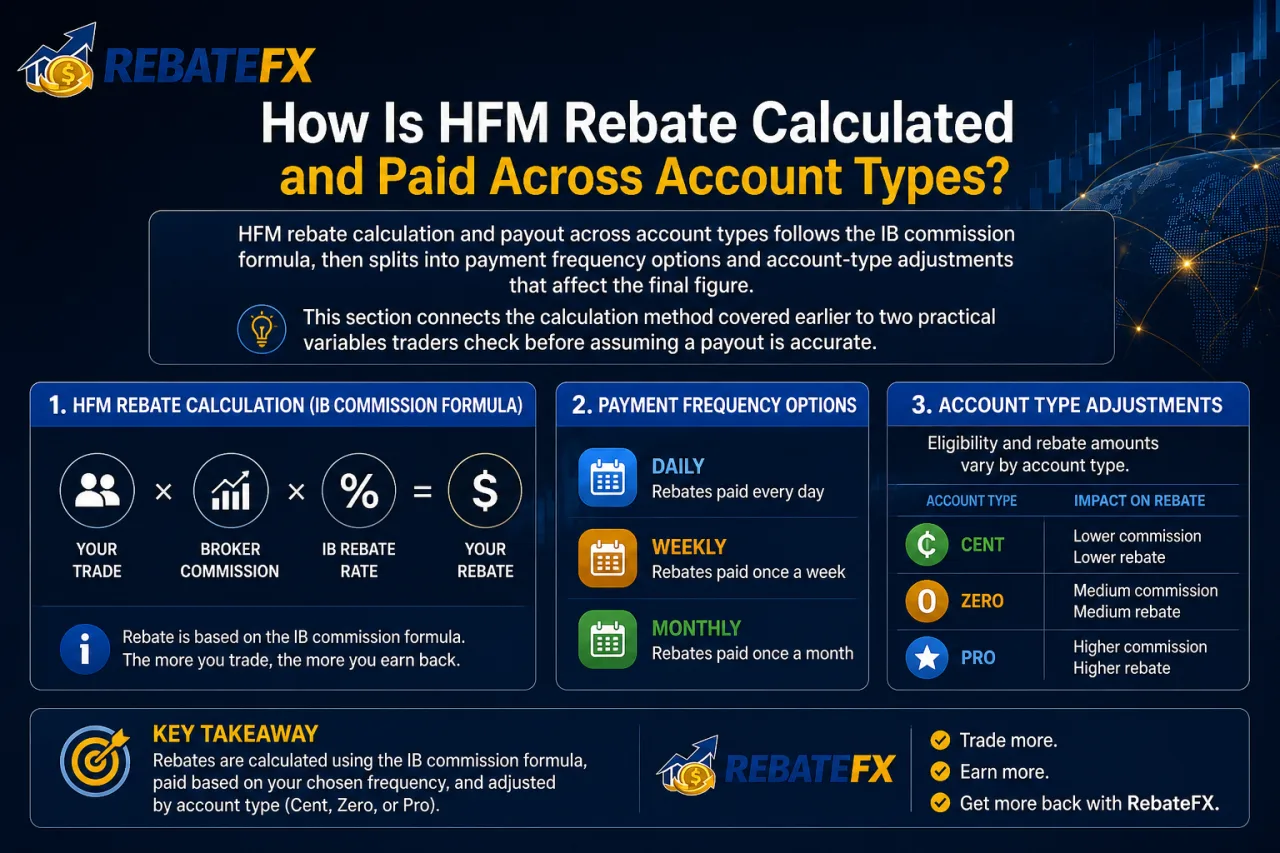
HFM rebate calculation and payout across account types follows the IB commission formula, then splits into payment frequency options and account-type adjustments that affect the final figure. This section connects the calculation method covered earlier to two practical variables traders check before assuming a payout is accurate. The subsections below cover payment frequency patterns and how Cent, Zero, or Pro accounts shift eligibility and amount.
Daily vs Monthly Rebate Payout: What Should You Track?
Daily rebate payout tracking checks each trading day’s credited amount against that day’s closed volume, while monthly payout tracking sums the entire cycle before comparing it against total volume reported in HFM’s IB commission statement. This distinction connects directly to the payment frequency variable raised at the start of this section, since a mismatched daily log versus a mismatched monthly total point to different sources of error.
Daily payout tracking catches errors faster, since a trader spots a discrepancy the same day a trade closes rather than waiting weeks to notice a shortfall. This frequency suits active traders running high volume, where a single missed credit becomes obvious against a short daily log.
Monthly payout tracking simplifies record-keeping for lower-volume accounts, since one consolidated statement replaces dozens of daily entries. This frequency still requires cross-checking the monthly total against the sum of individual trade tickets pulled from the MT4/MT5 history, otherwise a small daily error compounds unnoticed across the full cycle.
Rebate providers set the payout schedule as part of the IB program terms, so traders should confirm which frequency applies before assuming consistency between the two tracking methods.
Do Cent, Zero, and Pro Accounts Get the Same Rebate?
Cent, Zero, and Pro accounts do not generate the same rebate output, since the underlying IB commission base differs across each account type. This account-type impact connects directly to the three variables raised in the rebate formula above, now applied specifically to how HFM structures each account category.
Each account type shifts the commission base in its own way:
- A Cent account trades in smaller nominal lot values, which typically produces a lower IB commission base per trade compared to a standard Pro account.
- A Zero account often carries tighter spreads paired with a separate commission structure, shifting the commission the rebate provider receives even at matching lot sizes.
- A Pro account usually generates commission through wider spreads rather than a fixed per-trade fee, changing the reference figure the rebate rate multiplies against.
Product traded and volume closed still layer on top of this account-type variation, since a Cent account trading high volume can still outproduce a Pro account trading low volume in raw rebate terms.
Actual rebate figures for each account type appear only in the provider’s commission report, not through a uniform rate assumption. No fixed per-account-type rebate figure applies universally, since eligible trades and instrument mix also factor into the final credited amount.
How to Choose a Trusted HFM Rebate Provider to Register With?
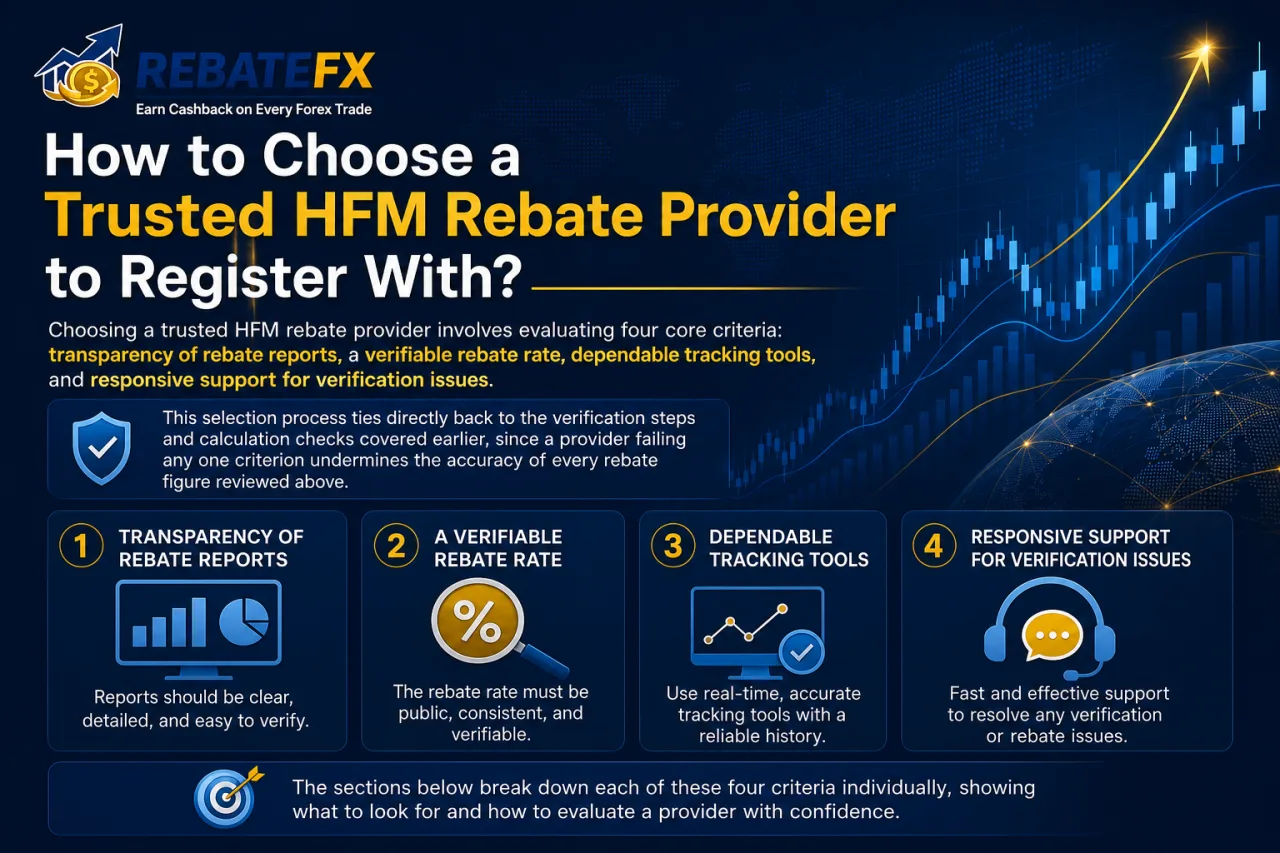
Choosing a trusted HFM rebate provider involves evaluating four core criteria: transparency of rebate reports, a verifiable rebate rate, dependable tracking tools, and responsive support for verification issues. This selection process ties directly back to the verification steps and calculation checks covered earlier, since a provider failing any one criterion undermines the accuracy of every rebate figure reviewed above. The sections below break down each of these four criteria individually, starting with report transparency.
Rebate FX applies an 80% IB commission rebate for HFM, a rate that stays verifiable against the commission report structure discussed throughout this guide. That verifiable rate, paired with clear tracking access, forms the baseline a trader checks before registering under any given IB link.
What Should You Check Before Registering With an HFM Rebate Program?
Registering with an HFM rebate program requires checking five criteria: rebate rate clarity, dashboard availability for tracking, payment schedule, provider reputation, and ease of verifying the rebate. These five points connect directly to the calculation and verification steps covered throughout this guide, applied here as a pre-registration checklist rather than a post-payout check.
- Rebate rate clarity: confirms whether the provider states a fixed amount per lot or a percentage of IB commission, and whether that structure is disclosed clearly before signup.
- Dashboard availability: verifies the provider offers a member area showing trade-by-trade or daily rebate history rather than manual reporting only.
- Payment schedule: identifies whether payout runs daily, weekly, or monthly, matching the frequency raised in the earlier tracking comparison.
- Provider reputation: checks that the IB program registers directly with HFM, avoiding unverified or unregistered rebate links.
- Ease of verifying rebate: tests whether the commission report breaks down account number, volume, instrument, and rebate rate clearly enough to cross-check against MT4/MT5 trade history.
A provider failing any single item on this list undermines the accuracy of every rebate figure calculated afterward, regardless of the advertised rate.
What Rare Issues Can Cause HFM Rebate Discrepancies?
Rare HFM rebate discrepancies trace back to three uncommon causes: ineligible trades excluded from the IB program, delayed IB commission crediting on HFM’s side, or an account never properly linked to the rebate provider’s IB link. These causes sit beyond the basic verification steps covered earlier, surfacing only after account number, volume, and commission fields all check out correctly. The subsections below break down each of these three rare causes individually, starting with which trades fall outside rebate eligibility.
Which Trades or Products May Be Excluded From HFM Rebate?
Trades or products excluded from HFM rebate typically include those falling outside the IB program’s defined eligibility, such as certain bonus-linked accounts, specific restricted instruments, or trades executed outside the registered rebate account. This eligibility question follows directly from the account-type variation covered earlier, since exclusions add another layer beyond the Cent, Zero, or Pro distinction already established.
Eligible trades and products vary by provider and by the specific IB agreement HFM maintains with that provider, so no single exclusion list applies universally across every rebate account. A trader running high volume on one instrument may find that product fully eligible under one provider’s terms while a different provider treats the same instrument as excluded.
Assuming all traded volume automatically qualifies for rebate risks a mismatch between expected and credited cashback. Verifying eligible products directly with the rebate provider before trading confirms which instruments, account types, or promotional conditions actually generate rebate credit, rather than relying on assumptions carried over from a different broker or a different provider’s terms.
What to Do If Your HFM Rebate Is Missing or Delayed?
Resolving a missing or delayed HFM rebate follows three steps: contact the rebate provider’s support team, submit the account number and trade history, then request reconciliation against HFM’s IB commission report. This dispute process addresses cases where the earlier verification checks, account number, volume, commission, and payment date, all appear correct yet the credited cashback still fails to arrive on schedule.
Opening a support ticket with the rebate provider starts the process, stating the expected payout date and the amount believed missing. Attaching the MT4/MT5 trade history alongside the account number gives support staff a concrete record to match against their own tracking system, rather than relying on a general complaint.
Requesting reconciliation with HFM’s IB report forms the final step once the provider confirms the trades in question. This reconciliation compares the provider’s internal commission figures against what HFM actually paid out, isolating whether the delay traces to a reporting lag, an excluded trade, or a linking error on the account.
Conclusion
Checking HFM rebates through the provider’s dashboard and comparing each report with MT4/MT5 trading history helps confirm that cashback has been calculated and credited correctly. The final rebate depends on the IB commission actually received, the applied rebate rate, account type, instrument, trading volume, and trade eligibility. Traders should choose a transparent provider, verify the current payout schedule and calculation method, and submit complete account and trade records to support when a rebate is missing or delayed.

Liam Dravon is a Forex Market Analyst at RebateFX.org, specializing in Forex rebate programs, Introducing Broker (IB) structures, broker analysis, and trading cost optimization. He manages English-language content for XM Rebate, FBS Rebate, and HFM Rebate, focusing on account registration, IB transfers, cashback calculations, and rebate verification to help international traders understand rebate conditions and manage trading expenses more effectively.