

 Tiếng Việt
To check FBS rebate means tracking the cashback amount returned from IB commission on every trading lot. Traders confirm this figure through a rebate provider’s dashboard or statement, comparing it against actual trading volume before assuming any fixed payout amount.
FBS rebate rates offered by providers can reach a high percentage of the IB commission received, depending on the specific program. Rates vary by account type, instrument traded, and the specific rebate program a trader registers under.
An FBS rebate calculator estimates cashback per lot by multiplying trading volume with the provider’s rebate rate. Traders input lot size and account currency into the tool to project earnings before executing trades, though final payouts depend on broker-confirmed IB commission data.
FBS rebate service works by registering under a provider’s IB link, then receiving a share of the commission that provider earns from the broker. According to publicly available information on RebateFX’s official website, RebateFX documents this registration and tracking process for FBS traders, including a rebate rate of up to 90% of the IB commission, guiding readers through what determines actual rebate rates and how each stage of the calculation applies in practice.
Contents:
What Is FBS Rebate and How Does It Work?
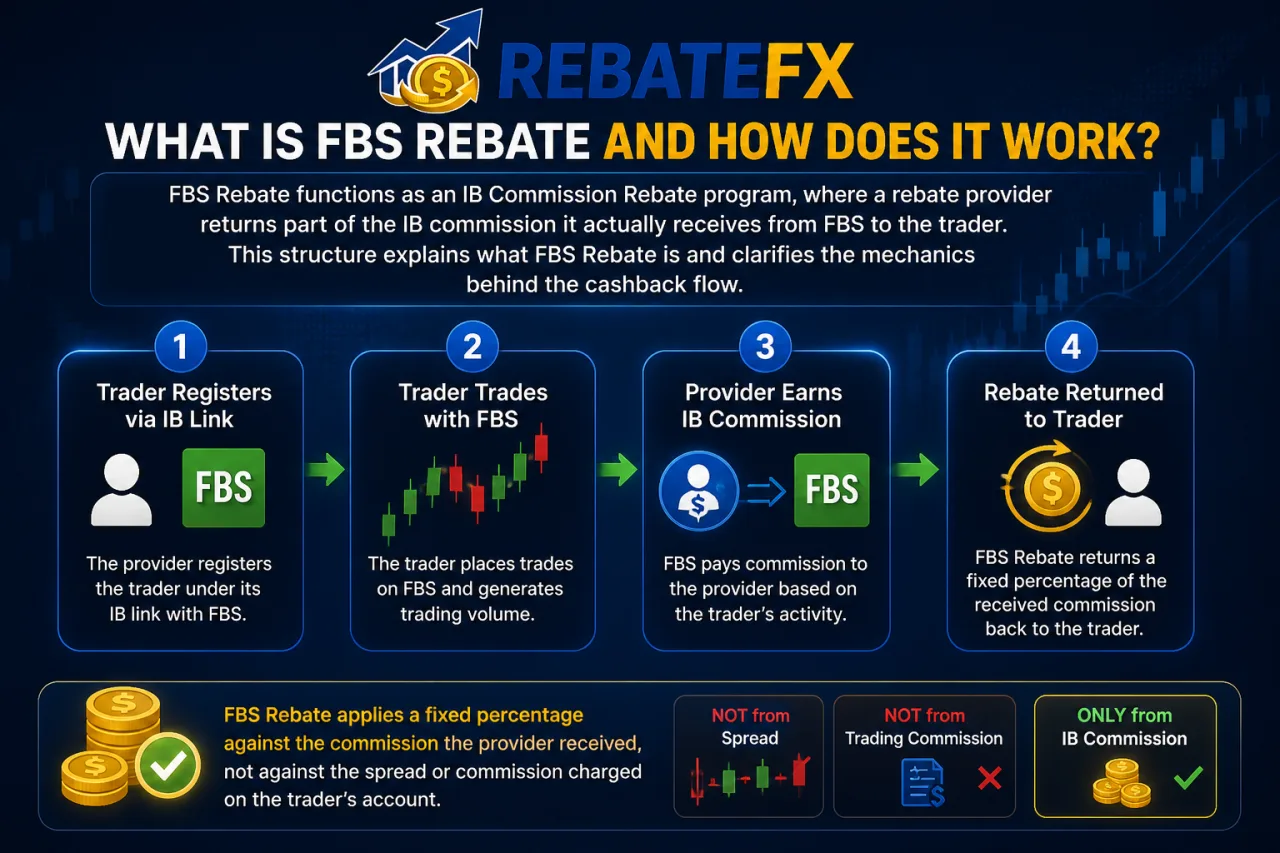
FBS Rebate functions as an IB Commission Rebate program, where a rebate provider returns part of the IB commission it actually receives from FBS to the trader. This structure explains what FBS Rebate is and clarifies the mechanics behind the cashback flow.
The provider first registers a trader under its IB link with FBS, earning commission from that trader’s trading activity. FBS Rebate then applies a fixed percentage against the commission the provider received from FBS.
This distinction matters because the rebate base sits on provider-side IB commission data, not on the spread or commission the trader directly paid to the broker. The payout traces back to what FBS actually pays the provider rather than raw trading costs.
Once the IB commission clears, the provider transfers the agreed share to the trader’s account or rebate wallet on the platform’s payout schedule.
What Are the Current FBS Rebate Rates Offered by Providers?
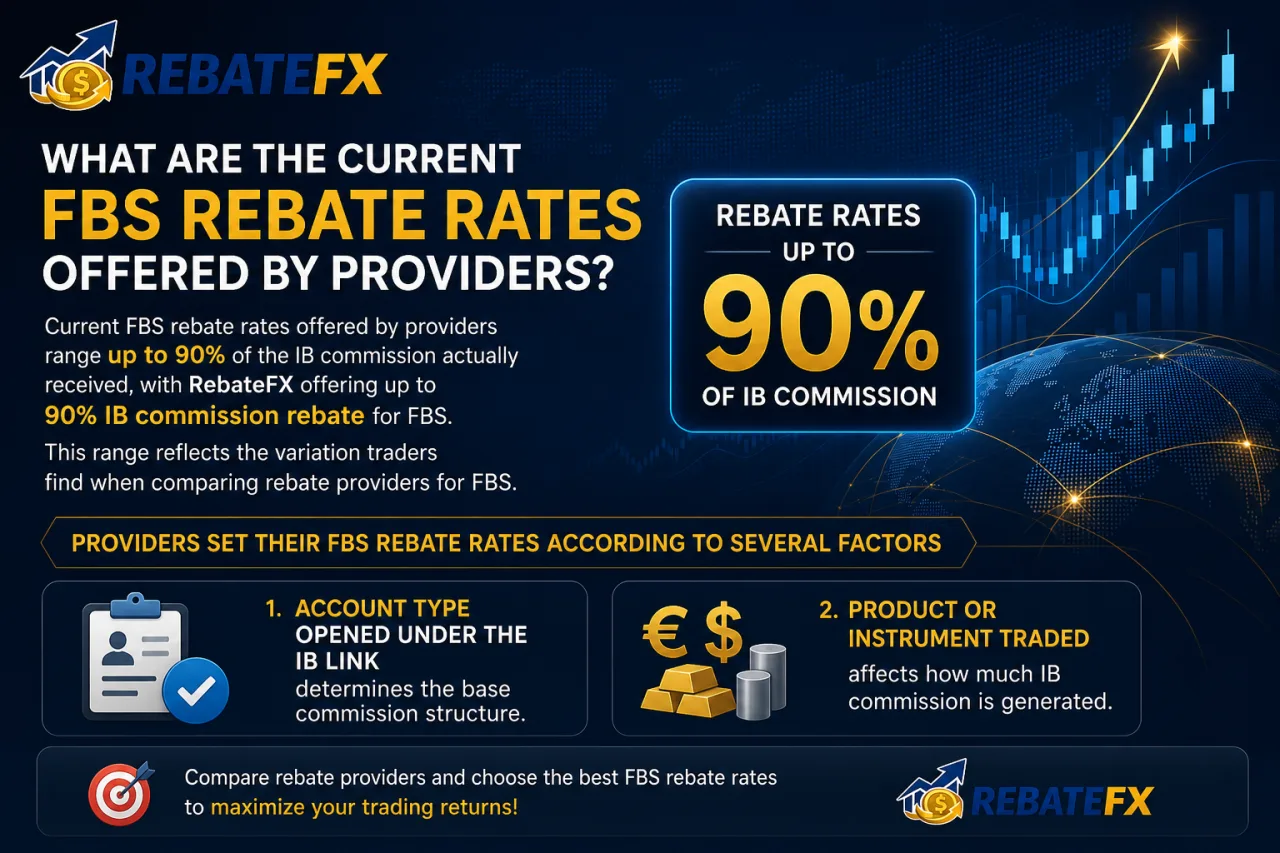
Current FBS rebate rates offered by providers range up to 90% of the IB commission actually received. Some providers advertise rebate rates up to this level, though traders confirm such figures directly with the provider rather than treating them as independently verified. This range reflects the variation traders find when comparing rebate providers for FBS.
Providers set their FBS rebate rates according to several factors rather than a single fixed number:
- Account type opened under the IB link determines the base commission structure.
- Product or instrument traded affects how much IB commission the provider earns per lot.
- Provider chosen changes the percentage share passed back to the trader.
Rebate rates advertised by providers stay tied to the IB commission the provider receives from FBS, not the raw spread or commission a trader pays directly. Traders confirm the exact applicable rate through their chosen provider’s terms before calculating expected cashback on a given trading volume.
How to Calculate FBS Rebate Using a Calculator?
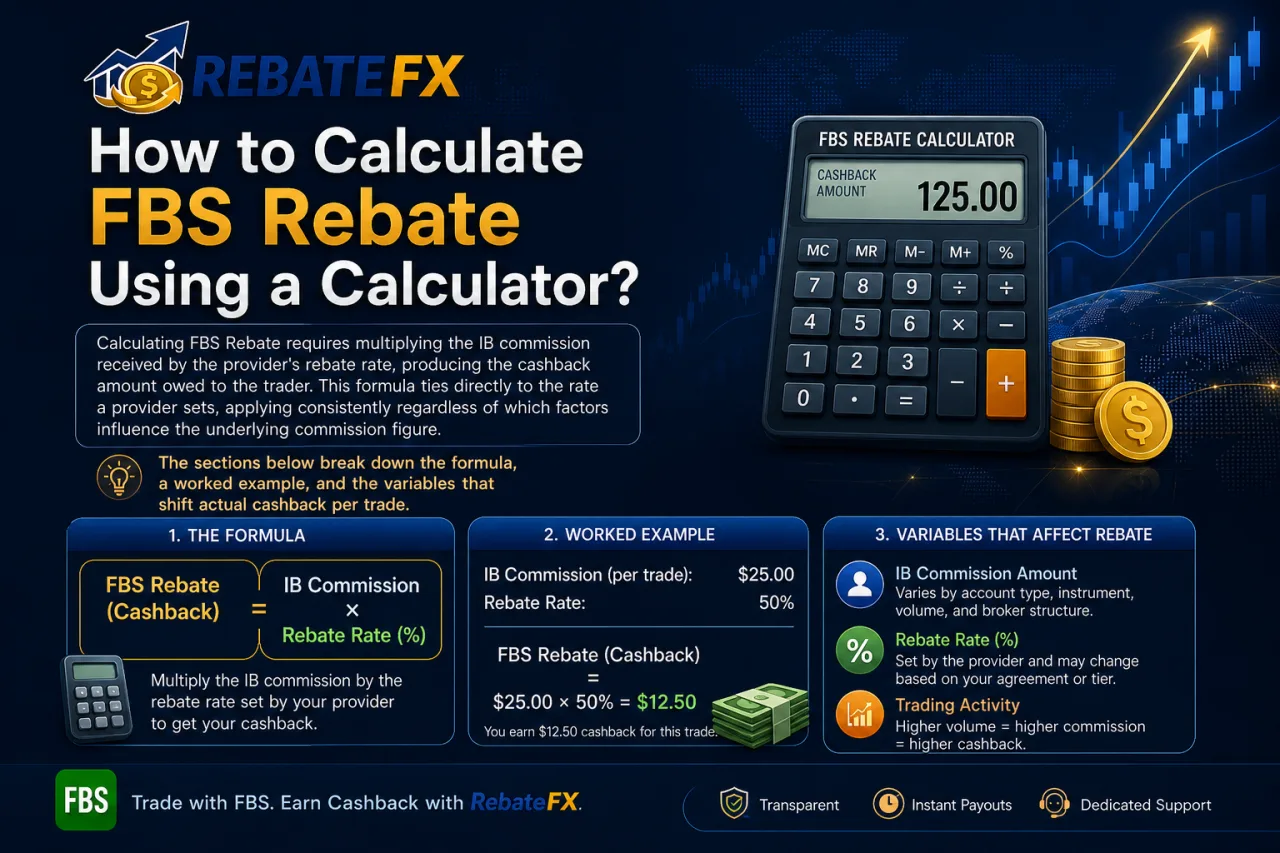
Calculating FBS Rebate requires multiplying the IB commission received by the provider’s rebate rate, producing the cashback amount owed to the trader. This formula ties directly to the rate a provider sets, applying consistently regardless of which factors influence the underlying commission figure. The sections below break down the formula, a worked example, and the variables that shift actual cashback per trade.
How to Estimate Cashback Per Lot or Per Trade?
Estimating cashback per lot or per trade requires dividing focus between the IB commission received per lot traded and the applied rebate percentage from the chosen provider. This estimation step follows directly from the rebate formula, applying it at the individual lot or trade level instead of a full account cycle.
The IB commission earned per lot depends on the account type and instrument traded, since FBS structures commission differently across products. The provider’s rebate percentage then multiplies against that per-lot commission figure to produce the cashback owed for that single trade. Trading volume plays a direct role here: a higher lot size traded within a session raises the total IB commission base, which raises the projected cashback proportionally.
Using a calculator with trading volume as the input variable simplifies this estimation. Traders enter expected lot size and let the tool apply the provider’s rebate rate automatically, producing a projected cashback figure before the trade closes. Actual payout still depends on broker-confirmed IB commission data once the trade settles, so calculator outputs function as estimates rather than guaranteed final amounts.
How Do FBS Rebate Rates Compare Across Different Providers?
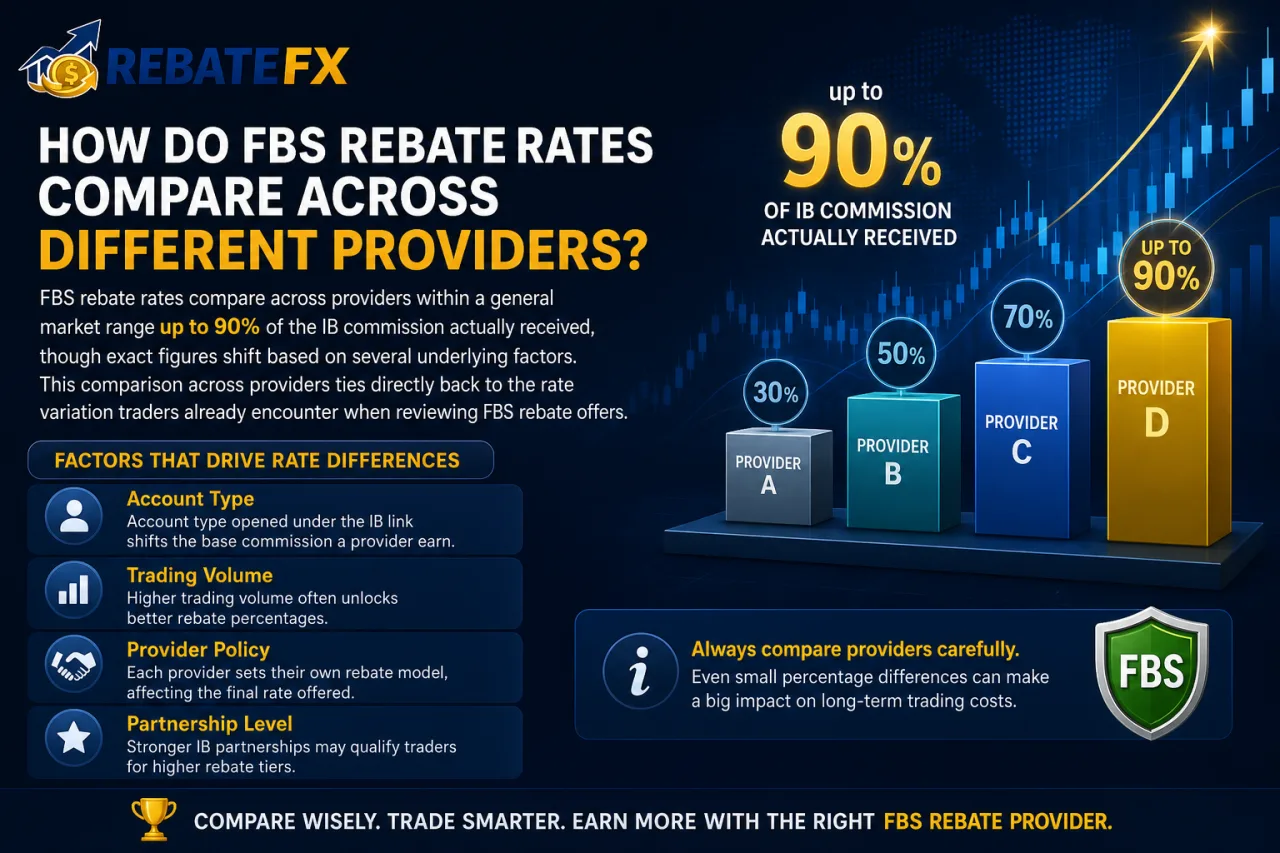
FBS rebate rates compare across providers within a general market range up to 90% of the IB commission actually received, though exact figures shift based on several underlying factors. This comparison across providers ties directly back to the rate variation traders already encounter when reviewing FBS rebate offers.
Several factors drive rate differences between providers rather than a single arbitrary markup:
- Account type opened under the IB link shifts the base commission a provider earns per lot.
- Trading product or instrument changes the IB commission structure FBS applies.
- Volume tier reached within a trading period alters the commission base available for rebate.
Providers publish these rates as maximum figures rather than guaranteed flat payouts, since actual cashback still depends on broker-confirmed IB commission for each trade. Traders comparing providers verify the applicable tier and account conditions before assuming the advertised maximum rate applies to their own trading volume.
How Does the FBS Rebate Service Work From Registration to Payment?
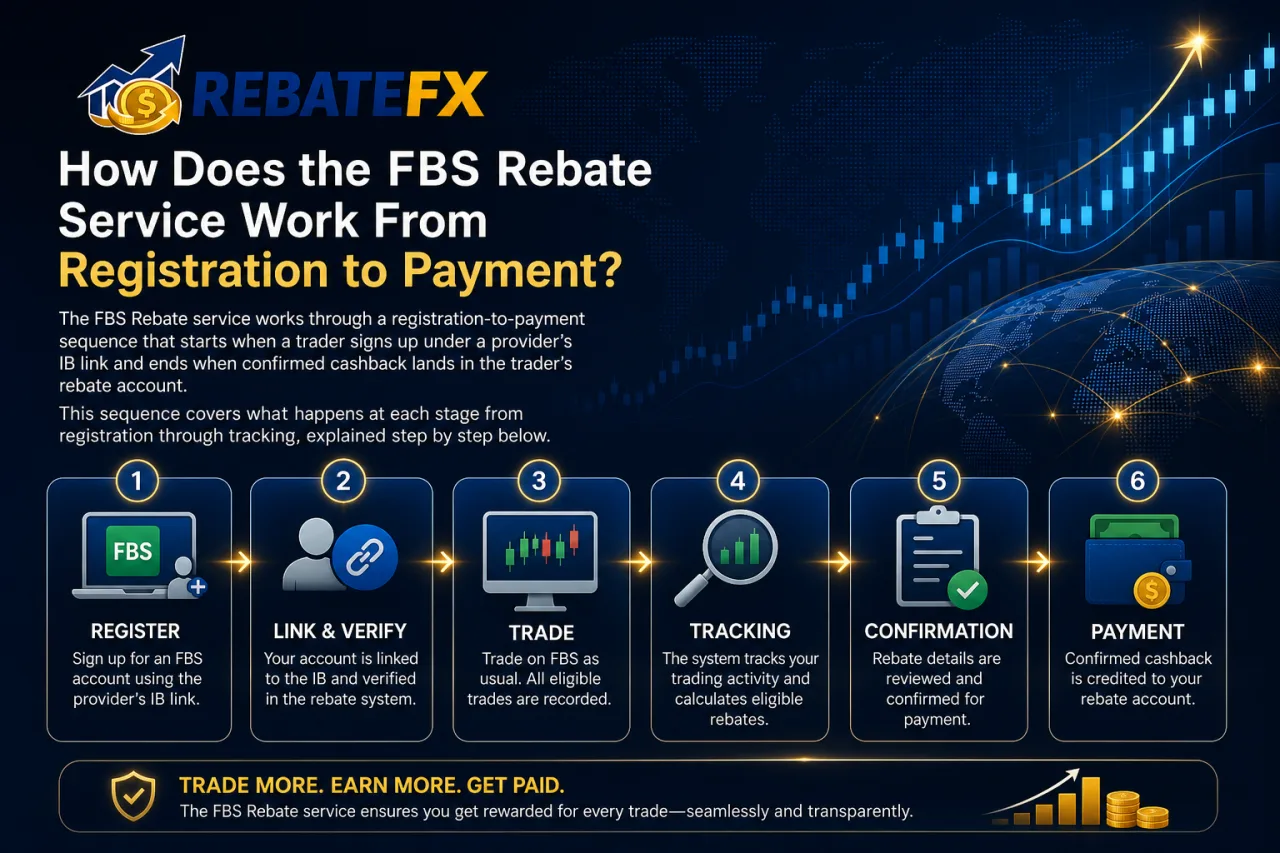
The FBS Rebate service works through a registration-to-payment sequence that starts when a trader signs up under a provider’s IB link and ends when confirmed cashback lands in the trader’s rebate account. This sequence covers what happens at each stage from registration through tracking, explained step by step below.
The process moves through five distinct stages:
- Registration: The trader opens an FBS account through the provider’s IB link, which tags the account under that provider’s IB code.
- Trading: The trader places trades on FBS as normal, with volume and activity recorded under the linked account.
- Commission collection: FBS pays the provider an IB commission based on the trader’s trading volume.
- Rebate calculation and crediting: The provider calculates the trader’s share according to the agreed rebate rate and credits it to the trader’s rebate account.
- Tracking: The trader monitors accumulated rebates and payment history through the provider’s dashboard or reporting system.
How to Track and Verify Rebate Payments?
Tracking and verifying FBS rebate payments requires logging into the provider’s dashboard to compare accrued IB commission against calculated cashback for each trading period. This verification step confirms transparency across the rebate accrual process referenced in earlier sections on registration and calculation.
The dashboard typically displays trading volume, IB commission received per trade, and the corresponding cashback owed based on the applied rebate rate. Traders cross-check this data against their own broker account statement to confirm the figures align before expecting payment.
Providers also issue periodic reports summarizing accrued rebate over a given cycle, listing individual trades alongside their commission and cashback breakdown. Payment history within the same dashboard shows past payouts, dates, and amounts transferred to the trader’s rebate wallet or linked account. Reviewing both the accrual report and payment history together confirms whether the provider applied the correct rebate rate consistently across trades.
What Additional Factors Can Affect Actual FBS Rebate Cashback Amounts?
Several less common factors shift actual FBS rebate cashback beyond the base rate, including account type, eligible products, minimum volume thresholds, and instrument exclusions. These variables sit alongside the rate and calculation mechanics already covered, adding another layer traders check before expecting a fixed payout. The subsections below break down each factor individually.
Are All FBS Account Types Eligible for the Same Rebate Rate?
No, FBS account types do not carry the same rebate rate, since providers set the IB commission structure per account type opened under the link. This eligibility question ties directly to the account-type factor already noted alongside product and provider variation.
Several reasons explain this variance:
- Commission structure differs across FBS account types, changing the IB commission base a provider earns per lot.
- Eligible products under one account type may differ from another, shifting the rebate calculation.
- Some account types carry minimum volume thresholds or exclusions that alter the effective cashback rate.
Traders confirm the exact rebate rate tied to their specific FBS account type directly with their chosen provider before assuming the advertised maximum applies. Rebate providers typically publish account-specific terms for FBS rebate eligibility rather than a single blanket rate across all account types.
Do All Trading Products on FBS Qualify for Rebate?
No, not all trading products on FBS qualify for rebate, since eligibility depends on whether a given instrument generates IB commission under the provider’s link. This eligibility question sits alongside the account-type and exclusion factors already noted above.
Several reasons explain why product coverage varies:
- Instrument category traded determines whether FBS applies IB commission at all on that product.
- Provider terms list specific eligible products separately from excluded ones.
- Commission structure per product changes the rebate base a provider passes back to the trader.
Traders confirm the eligible product list directly with their chosen provider before assuming every instrument traded on FBS generates rebate. Rebate providers typically publish a separate list of eligible products rather than applying a single blanket rule across all instruments.
Conclusion
In conclusion, checking FBS rebates through the provider’s dashboard helps traders verify that trading volume, IB commission, cashback calculations, and payment records are accurately reported. The final rebate depends on the provider’s rate, account type, traded instrument, eligible products, and broker-confirmed commission data, so calculator results should be treated as estimates rather than guaranteed payouts. Traders should confirm their account-specific terms, compare providers carefully, and regularly cross-check dashboard figures against their FBS trading statements.

Liam Dravon is a Forex Market Analyst at RebateFX.org, specializing in Forex rebate programs, Introducing Broker (IB) structures, broker analysis, and trading cost optimization. He manages English-language content for XM Rebate, FBS Rebate, and HFM Rebate, focusing on account registration, IB transfers, cashback calculations, and rebate verification to help international traders understand rebate conditions and manage trading expenses more effectively.